Zand and XDC Network: Bridging TradFi and DeFi for Institutional Clients
TL;DR (Key Points)
- Strategic Integration: UAE’s Zand Bank has successfully integrated the XDC Network to streamline institutional digital finance.
- Institutional Custody: The partnership enables secure, regulated storage of digital assets on the XDC infrastructure.
- Modernized Payments: Business clients gain access to faster, more transparent, and cost-effective payment rails via blockchain.
- ISO 20022 Compliance: The integration leverages XDC’s enterprise-grade standards to ensure interoperability with global banking systems.
- Regional Milestone: Announced in Dubai, this move reinforces the UAE’s position as a global leader in the regulated Web3 economy.
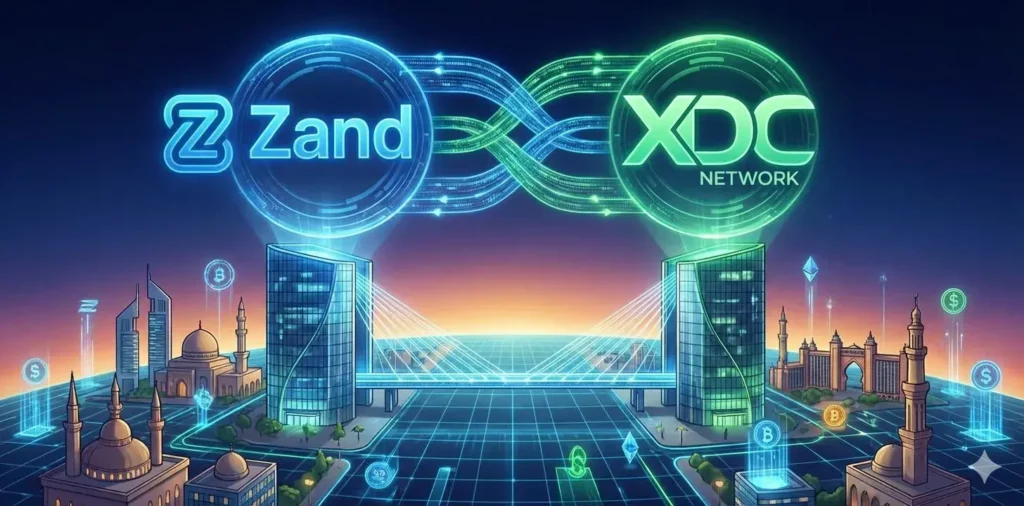
The landscape of institutional finance in the Middle East reached a significant milestone on Monday, January 12, 2026. Zand, the UAE’s pioneering AI and blockchain-powered digital banking group, officially announced the completion of its integration with the XDC Network. This collaboration is designed to provide corporate and institutional clients with a seamless bridge between Traditional Finance (TradFi) and the rapidly maturing world of Decentralized Finance (DeFi).
By merging the regulated stability of a licensed digital bank with the high-performance throughput of an enterprise-grade blockchain, the two entities are setting a new standard for how corporations manage liquidity and digital assets. In a region where regulatory clarity has met technological ambition, this integration represents a decisive step toward the “Machine Economy”—an era where automated, transparent, and instant financial settlement becomes the default for global business.
Zand x XDC Integration: A Milestone for Institutional Crypto
The announcement, made in the heart of Dubai’s thriving fintech corridor, details a comprehensive technical alignment. Zand has long positioned itself as more than just a digital bank; it is a financial technology group that utilizes Artificial Intelligence (AI) to optimize risk management and blockchain to secure transaction data. The XDC Network, known for its focus on trade finance and Real-World Asset (RWA) tokenization, provides the ideal infrastructure for the bank’s ambitious roadmap.
Under this new arrangement, eligible corporate clients can now access institutional-grade digital asset custody services. This allows firms to hold, manage, and transfer digital assets directly through the bank’s interface, while the actual settlement and verification take place on the XDC Network. For many large-scale enterprises that have remained on the sidelines due to security concerns or regulatory ambiguity, this provides a “safe harbor” managed by a reputable, licensed financial institution.
Institutional-Grade Digital Asset Custody
For corporate treasurers, custody is the “Alpha and Omega” of digital asset management. Without a secure, regulated environment, the risks of private key loss or protocol hacks are simply too high for institutional fiduciary duties. Zand addresses this by providing a custodial solution that meets the stringent requirements of the Central Bank of the UAE (CBUAE) while leveraging the decentralized security of the XDC protocol.
The integration supports a variety of digital assets, including the recently launched AED-backed stablecoin and tokenized commodities like ComTech Gold. By placing these assets under a regulated custodial umbrella, institutional investors can participate in the digital economy with the same confidence they would have in a traditional brokerage account. The use of the XDC Network as the underlying ledger ensures that all holdings are verifiable on-chain in real-time, providing an auditable trail that legacy banking systems often lack.
The Role of ISO 20022 and Enterprise Readiness
One of the primary reasons for selecting the XDC Network is its native compatibility with ISO 20022 standards. As global payment systems migrate toward this unified messaging standard, blockchains that cannot “speak the language” of legacy banks will face significant friction. XDC was designed from the ground up to be interoperable, making it the perfect partner for Zand as it seeks to integrate with global trade finance networks.
Revolutionizing Corporate Payment Rails
Beyond custody, the partnership targets the inefficiencies of cross-border corporate payments. Traditional SWIFT transfers often involve multiple correspondent banks, each taking a fee and adding a delay of 2–5 business days. Through this integration, business customers can now utilize blockchain-powered payment rails that settle in seconds at a fraction of the cost.
These “smart” payment rails are particularly beneficial for the Gulf-India corridor, where Zand already serves hundreds of SMEs. By leveraging XDC’s high transaction speeds (over 2,000 transactions per second) and its integration with stablecoins like USDC and the bank’s own AED stablecoin, liquidity can move across borders without the volatility of traditional crypto or the sluggishness of wire transfers.
AI and Blockchain: The Zand Synergy
The unique value proposition of the bank lies in its dual focus. While blockchain provides the transparency and settlement speed, AI acts as the “brain” behind the operations. Zand uses AI-enabled platforms to automate client onboarding, detect fraudulent transaction patterns in real-time, and provide businesses with predictive tools for cash flow management.
When combined with the XDC Network, this creates a “Proactive Banking” experience. For instance, a smart contract on the blockchain can trigger a payment automatically once certain conditions are met, while the AI layer ensures that the transaction complies with all Anti-Money Laundering (AML) and Know Your Customer (KYC) regulations before the funds are released. This level of automation is essential for the burgeoning “Machine Economy,” where IoT devices and AI agents will soon need to handle financial transactions autonomously.
Regional Leadership: Dubai as a Global Web3 Hub
The timing of this announcement aligns perfectly with the UAE’s broader economic vision. Dubai has aggressively pursued a strategy to become the “Capital of the Digital Economy,” largely through the efforts of the Virtual Assets Regulatory Authority (VARA). By supporting projects like the one led by Zand, the UAE is demonstrating that it can foster innovation within a prudentially regulated framework.
The bank’s recent achievements, including becoming the first Middle Eastern bank to secure ISO 27001 and ISO 27701 certifications for Web3 services, have built a foundation of trust. These certifications are not merely plaques on a wall; they are technical proofs that the institution’s systems for digital asset custody and smart contract management meet the highest international standards for security and data privacy.
Bridging the Gap Between TradFi and DeFi
Michael Chan, CEO of the group, noted during the launch that the world is entering an era where blockchain is the foundation of more inclusive banking. The goal for Zand is to bridge the “DeFi-TradFi Gap.” Many decentralization purists believe that traditional banks will eventually be replaced, but this partnership suggests a different outcome: a hybrid model where regulated banks become the gateways to decentralized protocols.
In this model, the bank provides the regulatory compliance, insurance, and user-friendly interface, while the XDC Network provides the neutral, high-speed infrastructure for value transfer. This synergy allows institutions to benefit from the efficiencies of the blockchain without having to manage the complexities of decentralized wallets or gas fees directly.
Stay informed, read the latest crypto news in real time!
Conclusion: The Future of Digital Banking in 2026
The integration of the XDC Network is a testament to the maturity of the digital banking sector in 2026. No longer relegated to experimental pilots, blockchain is now a core component of the institutional stack. Zand has successfully navigated the transition from a fintech disruptor to a cornerstone of the UAE’s financial infrastructure.
As corporate and institutional clients begin to migrate their liquidity and custody requirements to this new system, the benefits of transparency, speed, and cost-efficiency will become undeniable. In a world where “Data is Value” and “Code is Payment,” the partnership between Zand and XDC Network is not just a technological upgrade—it is the blueprint for the future of global finance.