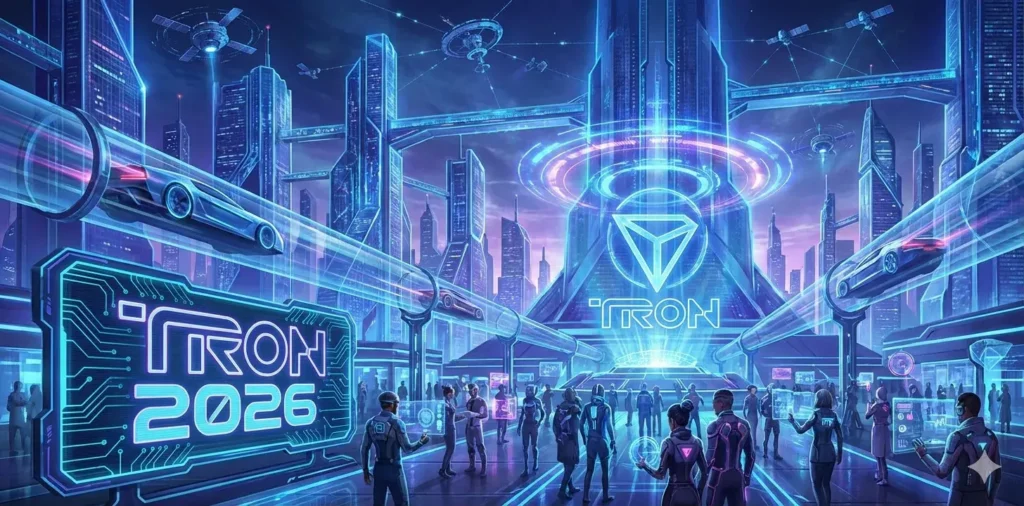
TRON 2026: The Global Digital Payment Pivot
TL;DR (Key Points)
- Strategic Evolution: Justin Sun identifies 2026 as a pivotal year for the TRON network’s transition from a speculative platform to a fundamental utility layer.
- Stablecoin Supremacy: The ecosystem continues to dominate the USDT market share, driven by low transaction costs and instant finality.
- Infrastructure Focus: Justin Sun’s comments emphasize the network’s role in the “Machine Economy” and global remittances.
- Economic Efficiency: The resource model (Energy and Bandwidth) provides a competitive edge over Ethereum and Solana for high-frequency transfers.
- Emerging Markets: The protocol is becoming the primary financial rail in regions with limited access to traditional banking.
The landscape of blockchain technology is undergoing a profound shift, moving away from the “Wild West” of meme coins and purely speculative trading toward a future built on tangible utility. At the forefront of this transformation is Justin Sun, the founder of one of the world’s most active decentralized networks. Recently, Sun remarked that 2026 could be a definitive, pivotal year for TRON, signaling a maturation of the project that many industry observers have anticipated for years.
His vision for the middle of this decade centers on one specific goal: establishing the blockchain as the world’s most reliable and cost-effective infrastructure layer for digital payments. As global inflation and the demand for dollar-pegged assets rise, the protocol’s architecture is uniquely positioned to handle the next billion users.
The 2026 Vision: Utility Over Speculation
For much of its early history, the blockchain space was characterized by “hype cycles.” However, Justin Sun’s recent comments suggest that TRON is shedding its image as a platform driven by retail speculation. Instead, the focus has shifted toward sustained network activity—consistent, day-to-day transactions that reflect real-world use cases.
By 2026, the goal is to have the network integrated so deeply into global commerce that it functions as a “background” utility, much like the SWIFT system or Visa, but with the added benefits of decentralization and transparency. This evolution is necessary because the market is becoming increasingly discerning. Investors and users are no longer satisfied with promises; they demand networks that can facilitate millions of transactions daily without breaking under the weight of high gas fees.
The Stablecoin Powerhouse
One cannot discuss the current success of the network without focusing on its dominance in the stablecoin sector. Currently, a significant portion of all Tether (USDT) in circulation resides on this specific chain. This is not a coincidence. The preference for TRON as a stablecoin transport layer is a direct result of its economic design.
Why Low Fees Are the Ultimate Competitive Moat
In the traditional financial world, cross-border transfers can take days and cost upwards of 5% in fees. On the blockchain, these barriers are virtually non-existent. However, even within the crypto space, costs vary wildly. While Ethereum’s Layer 1 can see fees spike to $50 during times of congestion, this protocol maintains a fee structure that is accessible to the average person in an emerging economy.
The ability to send $1,000 across the globe for less than the price of a cup of coffee is the primary reason why high-volume stablecoin transactions gravitate toward Sun’s ecosystem. This “liquidity moat” is expected to widen by 2026 as more institutional partners seek out reliable payment rails that do not eat into their margins.
The Role of Instant Settlement
Speed is the other half of the equation. In commercial payments, “fast settlement” is not a luxury—it is a requirement. The network’s Delegated Proof of Stake (DPoS) consensus mechanism allows for block times and finality that far exceed older proof-of-work systems. For a merchant in Latin America or Southeast Asia, receiving a payment in seconds rather than minutes is the difference between a successful transaction and a lost sale.
Building Core Infrastructure for Digital Payments
As we approach 2026, the internal roadmap for the project looks less like a tech startup and more like a global financial institution. Justin Sun has hinted at deeper integrations with traditional payment processors and the development of more robust API tools for developers.
The objective is to move TRON into a position where it serves as a “Core Infrastructure Layer.” This means that when a user sends money via a fintech app or a digital wallet, the underlying transaction may happen on the blockchain without the user even needing to know they are using crypto. By abstracting away the complexity of “gas” and “private keys,” the network can reach the mass market.
The Machine Economy and Automated Payments
Looking ahead, the pivot toward 2026 also includes the rise of automated, machine-to-machine payments. As Artificial Intelligence and IoT devices become more prevalent, they will require a payment rail that is both programmable and extremely cheap. The smart contract capabilities of the network, combined with its high throughput, make it an ideal candidate for these automated micro-transactions.
Regional Adoption: The Heart of the Growth
While Western markets often focus on the price of Bitcoin, users in the Global South are using TRON to survive and thrive. In countries experiencing hyperinflation, holding USDT on a decentralized network is a lifeline.
Asia and the Middle East
In these regions, the network has seen explosive growth. The ease of access to the protocol through local exchanges and peer-to-peer markets has made it the default choice for businesses engaged in international trade. Many suppliers now prefer receiving digital dollars on the chain over traditional bank wires, citing the transparency of the public ledger as a key trust factor.
Latin America and Africa
In Brazil, Argentina, and Nigeria, the “stablecoin-first” approach is solving real problems. By providing a stable, dollar-linked medium of exchange that can be moved 24/7, the protocol is effectively “banking the unbanked.” Justin Sun’s focus on 2026 includes doubling down on these regions, ensuring that the infrastructure remains robust enough to handle the massive influx of users fleeing failing local currencies.
Technical Superiority and the Resource Model
A critical aspect of why TRON has remained relevant while other “Ethereum killers” have faded is its unique resource model. Instead of a flat fee for every transaction, the network utilizes a system of “Energy” and “Bandwidth.”
Users who stake the native token can generate these resources, allowing them to perform a certain number of transactions for free every day. This model is particularly attractive for dApp developers and high-volume traders who want to predict their costs without worrying about market volatility affecting transaction fees. By 2026, improvements to this model are expected to make the network even more efficient, further lowering the barrier to entry for corporate clients.
Assessing the Competitive Landscape
The year 2026 will undoubtedly see fierce competition from other layer-1 and layer-2 solutions. Solana offers speed, while Ethereum’s L2s offer the security of the mainnet. However, the network led by Sun has a distinct advantage: a proven track record of uptime and a specialized focus on the payment sector.
While other chains try to be everything to everyone—hosting NFTs, gaming, and complex DeFi—this protocol has found its “Product-Market Fit” in payments. This specialization is what Sun believes will make TRON the dominant force in the second half of the decade. By focusing on one thing and doing it better than anyone else, the project is building a legacy of reliability that institutions value over experimental features.
Stay informed, read the latest crypto news in real time!
Conclusion: A Legacy of Utility
As Justin Sun looks toward 2026, the message is clear: the era of blockchain as a mere speculative casino is coming to an end. The networks that survive will be those that provide the plumbing for the global economy. Through a combination of low fees, high speed, and a relentless focus on stablecoin integration, TRON is positioning itself as the indispensable rail for digital value transfer.
Whether it is a small business owner in Lagos or a major financial firm in Dubai, the demand for efficient payments is universal. If the current trajectory continues, the pivotal year of 2026 will not just be a milestone for one project, but a milestone for the entire world’s transition to a decentralized financial future.