Altcoin Market Trends: AI, RWA, Gaming & Layer-2 Tokens
TL;DR: Key Takeaways
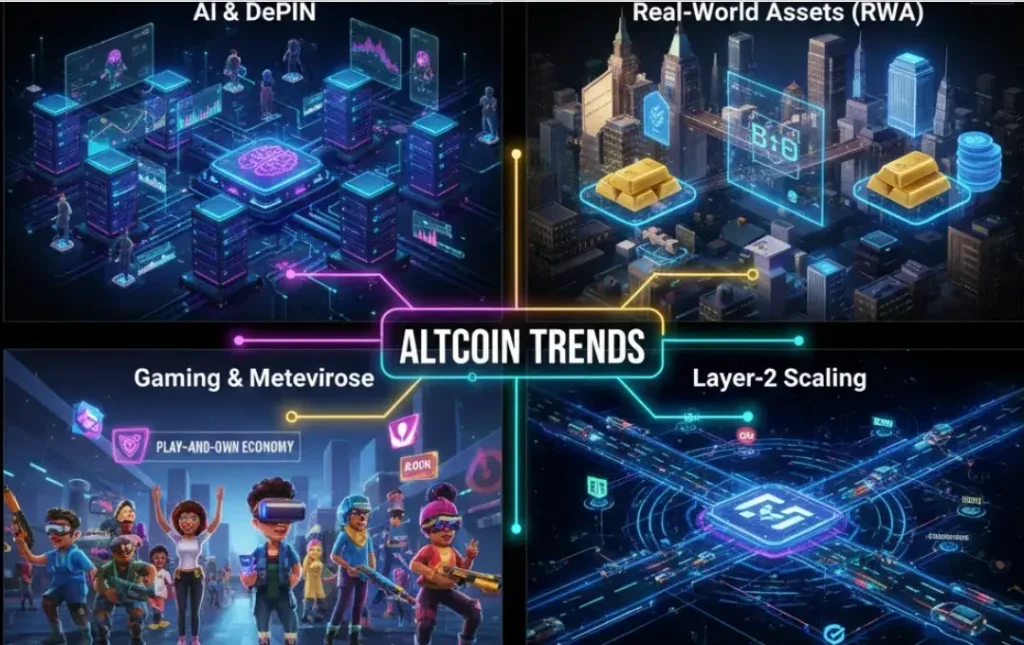
- The AI-Crypto Convergence: Artificial Intelligence is no longer a buzzword; in 2026, AI agents are autonomously managing DeFi portfolios and securing networks.
- RWAs Go Mainstream: Real-World Assets have bridged the gap between Wall Street and Web3, with tokenized Treasuries and private credit doubling in market cap.
- Gaming Evolution: The GameFi sector has pivoted from “Play-to-Earn” to “Play-and-Own,” prioritizing sustainable economies and AAA-quality gameplay.
- Layer-2 Dominance: Ethereum L2s like Arbitrum and Base have become the primary execution layers, successfully onboarding millions of daily active users.
Introduction: The Shift from Speculation to Utility
As we navigate the first quarter of 2026, the digital asset landscape has undergone a profound transformation. The “Wild West” era of crypto has matured into a sophisticated financial ecosystem where altcoin market trends are no longer driven by social media hype alone. Instead, institutional adoption, regulatory clarity, and tangible technological breakthroughs are the new engines of growth.
In this cycle, the market has moved beyond the simple “buy and hold” mentality. Investors are now looking for top altcoin trends that offer real cash flow and address fundamental needs in the global economy. From the integration of AI into decentralized systems to the tokenization of multi-trillion dollar traditional asset classes, the emerging crypto sectors of 2026 are setting the stage for the next decade of finance.
The Rise of the AI-Driven Economy
Artificial Intelligence remains the most explosive of all crypto narratives this year. However, the focus has shifted from mere “AI-themed” tokens to functional infrastructure that powers autonomous agents.
AI Agents and Autonomous DeFi
In 2026, the most significant altcoin market trends involve AI agents—autonomous programs capable of trading, lending, and executing complex yield strategies without human intervention. These agents utilize decentralized compute networks like the Artificial Superintelligence Alliance (FET) and Bittensor (TAO) to process data and make real-time financial decisions.
Decentralized GPU Networks
As the demand for AI training grows, the need for decentralized computing power has skyrocketed. Projects like Render (RNDR) have become essential infrastructure, allowing creators and developers to lease GPU power globally. This “physical infrastructure” (DePIN) is a cornerstone of the current altcoin market trends, providing a decentralized alternative to Big Tech monopolies.
Real-World Assets (RWA): The Institutional Bridge
If there is one sector that has redefined the term “utility” in 2026, it is Real-World Asset tokenization. The narrative of bringing traditional finance (TradFi) on-chain has moved from pilot programs to production scale.
Tokenized Treasuries and Bonds
Led by giants like BlackRock and Franklin Templeton, tokenized U.S. Treasuries have become a staple for crypto-native treasuries and institutional investors alike. Platforms such as Ondo Finance and Centrifuge are at the forefront of these altcoin market trends, offering yield-bearing products backed by the safety of government debt.
Fractional Ownership and Private Credit
Beyond bonds, 2026 has seen a surge in the tokenization of real estate and private credit. Investors can now purchase fractional shares of commercial properties or participate in corporate lending through protocols like Realio Network. This democratization of high-entry-barrier markets is one of the top altcoin trends attracting retail investors who want exposure to tangible assets without the traditional paperwork hurdles.
The Gaming Renaissance: From Hype to High-Quality
The GameFi sector has officially graduated from its “Play-to-Earn” infancy. In 2026, the most successful gaming altcoin market trends are centered around “Play-and-Own” models that prioritize entertainment value over financial extraction.
Sustainable In-Game Economies
Previous cycles were plagued by inflationary tokenomics that crashed as soon as new user growth slowed. Today’s leading games focus on sustainable sinks and utility-driven NFTs. Players now have true ownership of their assets, which can be moved across different games within the same ecosystem or used as collateral in DeFi.
AI-Enhanced Gameplay
AI has also permeated the gaming world. AI-driven NPCs (Non-Player Characters) and dynamic quest systems are now powered by blockchain, ensuring that every player’s experience is unique and cryptographically verifiable. This blend of entertainment and tech is a key driver in the current altcoin market trends.
Layer-2 Solutions: The New Execution Standard
While Layer-1 blockchains provide the security foundation, Layer-2 (L2) solutions have become the “everyday” home for crypto users. In 2026, the friction of high gas fees and slow confirmation times has largely been solved.
The Ethereum L2 Ecosystem
Ethereum’s vision of a “rollup-centric” future has materialized. Networks like Arbitrum, Optimism, and Base now handle the vast majority of user transactions, allowing the Ethereum mainnet to function as a global settlement center. These altcoin market trends highlight the importance of scalability in reaching mass adoption.
Interoperability and Cross-Chain UX
One of the most frustrating aspects of previous cycles was the fragmentation of liquidity. In 2026, cross-chain bridges have become nearly invisible. Users can interact with dApps on different L2s without manually switching networks or worrying about bridge security, thanks to advanced zero-knowledge (ZK) technology and intent-centric protocols.
The Macro Picture: Regulatory Clarity and Liquidity
The altcoin market trends of 2026 are deeply tied to the global macroeconomic reset. With the passing of major legislation like the GENIUS Act in the United States and the full implementation of MiCA in Europe, the industry has finally shed its “unregulated” label.
Institutional Inflows
Clear rules have opened the floodgates for pension funds and insurance companies. These entities are no longer just buying Bitcoin; they are allocating capital toward emerging crypto sectors that offer yield, such as liquid staking and RWA-backed protocols.
The Death of the Four-Year Cycle?
Interestingly, many analysts suggest that the traditional “four-year cycle” is being replaced by a “structural slow bull.” As crypto integrates into global commerce, the extreme volatility of the past is slowly dampening, replaced by sustained growth driven by real-world usage rather than speculative bubbles.
Stay informed, read the latest crypto news in real time!
Conclusion: Staying Ahead of the Curve
The altcoin market trends of 2026 prove that the industry has entered its most consequential phase yet. Whether it’s AI agents automating your wealth, RWA tokens providing access to global credit markets, or L2s making blockchain as fast as the traditional web, the shift toward substance over speculation is undeniable.
As an investor, the real edge in this market comes from understanding these crypto narratives and identifying projects with verifiable on-chain activity. The next wave of value won’t be found in the loudest shout on social media, but in the protocols that are quietly rebuilding the pipes of the global financial system.