
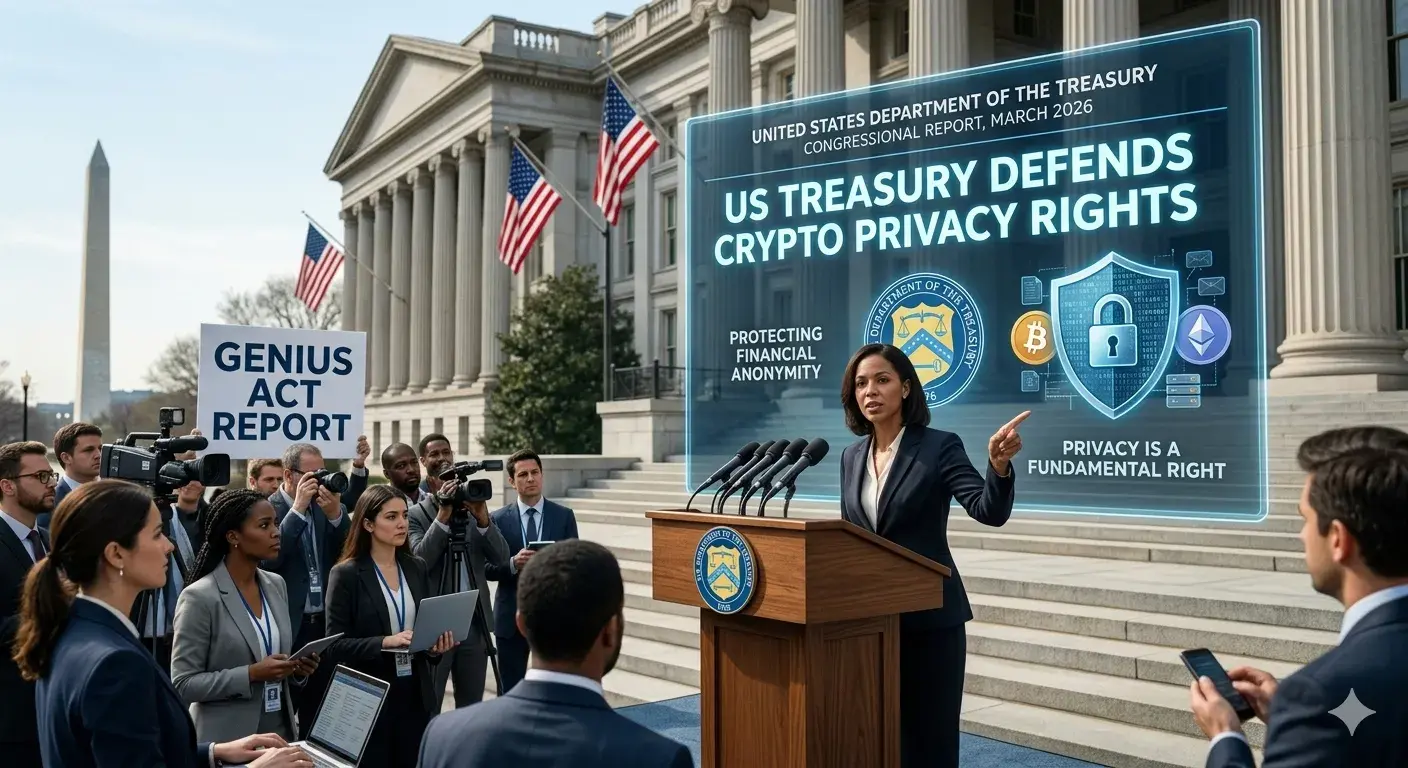
In a move that has stunned the global financial community, the United States Treasury Department has officially shifted its stance on digital anonymity. In its latest report to Congress, the department acknowledges that crypto privacy rights are not a luxury or a tool for evasion, but a fundamental necessity for a secure digital economy. This recognition marks the first time a major regulator has distinguished between the technical need for privacy and the illicit use of mixing services.
The report suggests that the era of treating every privacy-conscious investor as a “suspect” is ending, paving the way for a more balanced approach to financial surveillance and individual freedom.
The Recognition of Crypto Privacy Rights: A Paradigm Shift
For years, the narrative from Washington was clear: transparency is the only path to compliance. However, the “GENIUS Act” report of March 2026 presents a more nuanced view. It argues that without robust crypto privacy rights, the blockchain remains too “exposed” for institutional and corporate adoption.
Privacy as a Functional Requirement
The Treasury now categorizes financial discretion as a “functional requirement.” This means that for digital assets to replace or augment traditional fiat systems, they must offer the same level of confidentiality that a bank account or a cash transaction provides. For crypto-mixing app users, this is the legal validation they have been waiting for.
Moving Beyond the “Criminal” Label
By officially backing crypto privacy rights, the Treasury is effectively telling law enforcement and global regulators that the act of “mixing” or “shielding” transactions is a legitimate defensive strategy against data harvesting and cyber-theft.
Related: Florida’s New Crypto Law: Regulating Payment Stablecoins in 2026
Key Highlights from the GENIUS Act Report
The 2026 report isn’t just a statement of intent; it provides a framework for how the US will govern digital assets moving forward.
- Distinction of Intent: The government will now focus on “bad actors” rather than “bad tools.”
- Safe Harbors for Developers: Recognition of crypto privacy rights means developers of privacy protocols (like ZK-proofs) are less likely to face prosecution for the actions of their users.
- Institutional Frameworks: The report encourages the development of “compliant privacy” tools that allow for audits without exposing the user to the public web.
Expert Analysis: Why This Happened Now
We spoke with several industry veterans to understand the catalyst behind this sudden change of heart.
“The government realized that if they didn’t protect crypto privacy rights, they would lose the innovation race to jurisdictions with better digital rights frameworks,” says Alexei Petrov, a senior analyst at Crypto Quorum. “You cannot have a digital dollar or a tokenized economy where every transaction is a public broadcast. It’s a security nightmare.”
Legal experts also point out that several recent court cases favored the individual’s right to digital privacy, forcing the Treasury to update its guidelines to avoid further legal setbacks.
Related: Tokenized Gold: Why Billions are Flooding Into Digital Bullion
The Future for Crypto-Mixing App Users
While the recognition of crypto privacy rights is a victory, it comes with a new set of expectations. The Treasury envisions a world where “Privacy Pools” become the standard. These pools allow users to prove they are not on a sanctions list through cryptographic proofs, without revealing their identity to the entire world.
The Rise of “Proof of Innocence”
The next generation of privacy tools will likely include a “proof of innocence” feature. This allows crypto-mixing app users to interact with regulated exchanges while keeping their transaction history private from the public, but verifiable by a trusted third party if legally required.
Why This Matters for the Global Market
The US Treasury’s stance on crypto privacy rights will undoubtedly influence the FATF and European regulators. If the US acknowledges that privacy is a right, other nations will find it difficult to maintain blanket bans on privacy coins or mixing protocols.
Stay informed, read the latest crypto news in real time!
Conclusion
The recognition of crypto privacy rights in early 2026 marks the beginning of a more mature, secure, and private decentralized world. While the battle for digital freedom is far from over, the US Treasury has finally admitted that in the digital age, privacy is a prerequisite for progress.
Don’t let your financial data be an open book. Join the conversation on digital freedom and learn how to protect your crypto privacy rights by joining the Crypto Quorum community today.

Dennis Mwangi is a crypto strategist and blockchain advocate who simplifies the world of decentralized finance for everyday readers. He tracks market trends, evaluates emerging projects, and uncovers opportunities in the fast-moving crypto space. His goal is to make blockchain technology accessible, actionable, and exciting, helping readers navigate the future of digital finance with confidence.
📩 Subscribe Now
Join thousands of crypto readers who stay ahead of the market. 100% Free. No Spam. Unsubscribe anytime.