
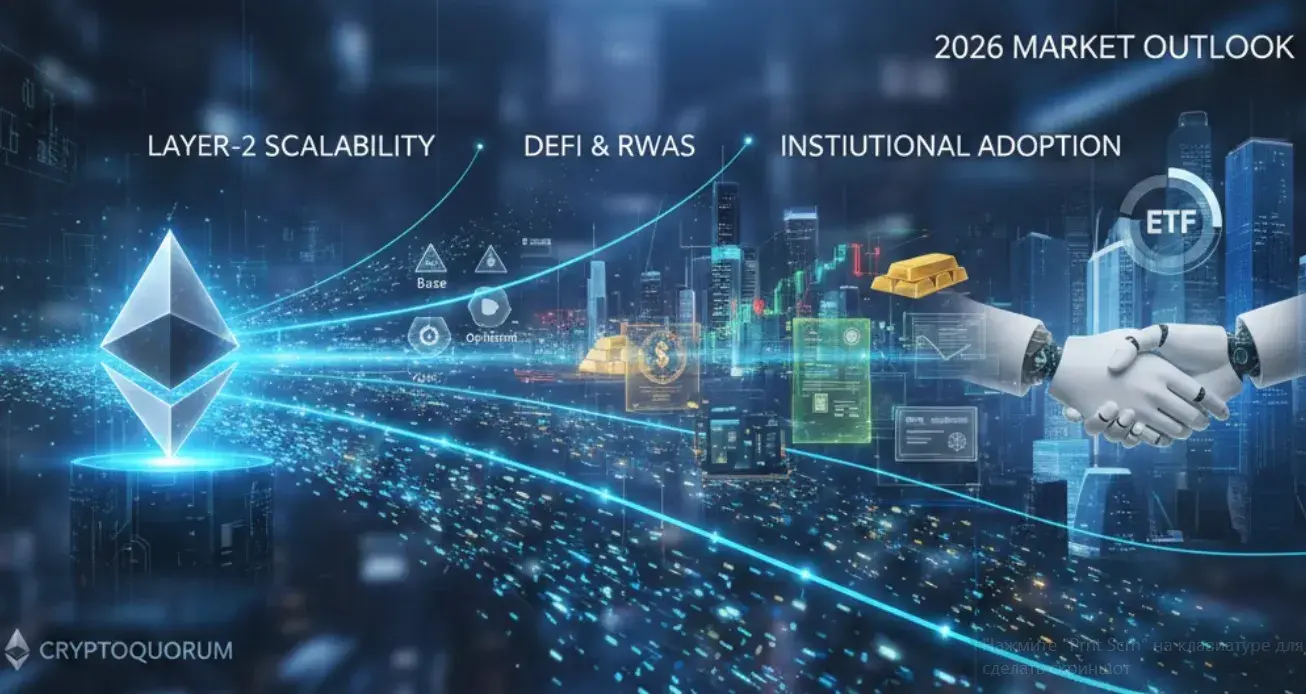
Executive Summary: The State of Ethereum in 2026
- The Layer-2 Flip: Over 95% of daily user transactions have migrated to L2s like Base and Arbitrum, leaving Mainnet as a “Settlement Layer” for big-ticket finance.
- Institutional Integration: With Spot ETFs and the proposed CLARITY Act, ETH is no longer a “crypto trade”—it’s a standard portfolio allocation for global funds.
- Economic Realignment: Ethereum’s “burn” mechanism and staking yields have positioned ETH as “productive digital capital,” outperforming traditional yield-bearing assets in risk-adjusted returns.
- DeFi Maturity: The focus has shifted from speculative “yield farming” to tokenized Real-World Assets (RWAs) and institutional-grade restaking protocols.
The digital asset landscape in 2026 is no longer defined by speculative bubbles but by structural integration. As the world’s leading smart-contract platform, Ethereum has matured into the “Global Settlement Layer.” Understanding the current ethereum market trends requires looking beyond price action and into the technical milestones of Layer-2 scaling, the institutionalization of the ethereum defi ecosystem, and the formal entry of global capital.
1. The Great Migration: Ethereum Layer 2 Dominance
One of the most defining ethereum market trends this year is the finality of the “Layer-2 Flip.” In earlier years, users complained about high gas fees on the main chain. In 2026, the average user never even touches the Mainnet.
Why L2s are the New “Main Street”
The ethereum layer 2 ecosystem—led by networks like Arbitrum, Base, and Optimism—now handles the vast majority of retail activity. Following the Pectra and Fusaka upgrades, transaction costs on these networks have plummeted to near zero.
- User Experience (UX): Thanks to “Account Abstraction,” users now interact with these networks using biometrics or emails, making the ethereum layer 2 experience as seamless as traditional banking apps.
- Interoperability: New shared sequencing layers have reduced fragmentation, allowing assets to move between different L2s without the friction of complex bridging.
ZK-Rollups and Institutional Privacy
While “Optimistic Rollups” dominated early on, 2026 is seeing a surge in Zero-Knowledge (ZK) technology. ZK-Rollups are becoming the preferred choice for ETH institutional adoption because they offer superior privacy and instant transaction finality, which is a requirement for regulated financial institutions.
2. DeFi 2.0: From Speculation to Real-World Utility
The ethereum defi ecosystem is undergoing a sophisticated rebirth. The industry has moved past the “ponzinomics” of 2020 and into a phase of sustainable, real-world value.
The Rise of Real-World Assets (RWAs)
A massive driver of ethereum market trends in 2026 is the tokenization of traditional assets.
“Ethereum has become the default ledger for the world’s debt. We are seeing everything from U.S. Treasuries to private credit and real estate being traded 24/7 on-chain.” — Market Analyst Insight, 2026.
By integrating these assets, the ethereum defi ecosystem now offers yields backed by real-world economic activity rather than just token inflation.
Liquid Restaking and Capital Efficiency
Platforms like EigenLayer have transformed ETH into “productive capital.” Users can now secure multiple networks simultaneously, earning compounded rewards. This “Restaking” trend has deepened liquidity within the ethereum defi ecosystem, creating a more robust financial foundation for the entire network.
3. The Wall Street Era: ETH Institutional Adoption
Perhaps the most significant of all ethereum market trends is the change in who is buying. The successful maturation of Spot Ethereum ETFs has permanently altered the market’s DNA.
The “Productive Capital” Narrative
Wall Street no longer views ETH as a “lite” version of Bitcoin. Instead, ETH institutional adoption is driven by the asset’s unique properties:
- The Burn Mechanism: Under EIP-1559, high network activity leads to ETH being burned, creating a deflationary pressure that appeals to long-term value investors.
- The Yield Factor: Staking rewards provide a “crypto-native interest rate” that makes ETH more comparable to a high-tech bond or dividend-paying stock.
Regulatory Clarity: The CLARITY Act
The anticipated passage of the CLARITY Act in 2026 is providing the legal guardrails necessary for Fortune 500 companies to put ETH on their balance sheets. This shift marks a transition from ETH institutional adoption being a “niche experiment” to a standard corporate treasury strategy.
The Path Ahead: What to Watch
As we navigate these ethereum market trends, several key indicators will signal the next phase of growth:
- L2 Transaction Volume: If L2 activity continues to outpace Mainnet at a 20:1 ratio, it confirms the “Rollup-Centric” success.
- ETF Inflow Consistency: Steady monthly inflows into ETH ETFs suggest a decoupling from volatile retail sentiment.
- On-chain Identity: The adoption of ENS (Ethereum Name Service) and decentralized IDs will be the “metric to watch” for social and gaming growth.
Stay informed, read the latest crypto news in real time!
Conclusion
The ethereum market trends of 2026 reveal a network that has finally grown into its potential. Through the efficiency of ethereum layer 2 solutions, the utility of the ethereum defi ecosystem, and the massive scale of ETH institutional adoption, Ethereum is no longer just a “crypto project”—it is the bedrock of a new, transparent global financial system.

Steven Andros is a crypto enthusiast whose main goal is to tell everyone about the prospects of Web 3.0. His love for cryptocurrencies began in his student years, when he realized the obvious advantages of decentralized money over traditional payments. Email: [email protected]
2 thoughts on “Ethereum Market Trends: Navigating Layer-2 Growth, DeFi Evolution, and Institutional Shifts”