
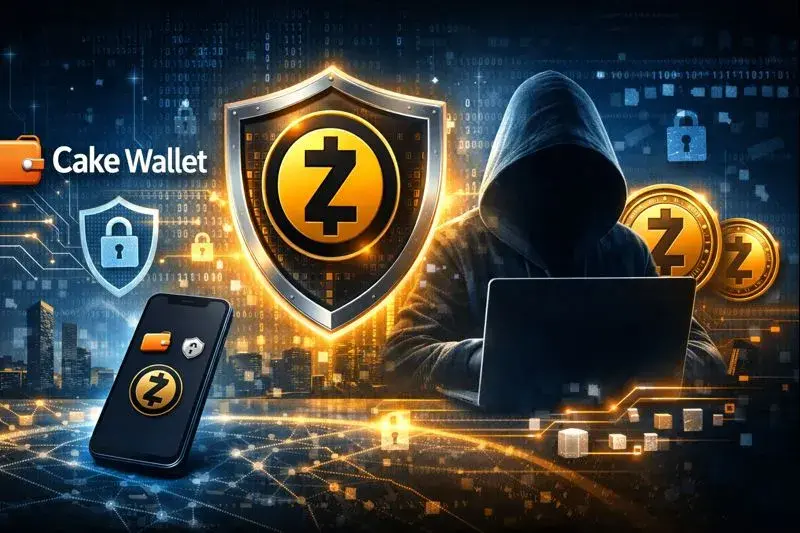
TL;DR (Key Points)
- Zcash Support: On January 15, the multi-chain application Cake Wallet officially rolled out full support for Zcash (ZEC).
- Privacy by Default: The integration features shielded addresses as the default setting, alongside an automated rotation system for transparent addresses.
- Cross-Chain Utility: Users can now perform seamless cross-chain swaps utilizing the NEAR Intents protocol.
- Legacy of Privacy: Founded in 2018, the wallet has evolved from a Monero-only tool to a comprehensive self-custody suite for BTC, LTC, and now ZEC.
- Advanced Tech: The update continues the wallet’s trend of supporting cutting-edge privacy tech like Silent Payments (BTC) and MWEB (LTC).
In the ever-evolving landscape of digital finance, the demand for sovereignty and anonymity has never been higher. As regulators worldwide increase their scrutiny of public ledgers, the tools that empower individual privacy are becoming the backbone of the decentralized movement. On January 15, a major milestone was reached in this sector as Cake Wallet announced the successful integration of full support for Zcash (ZEC), reinforcing its position as a premier sanctuary for privacy-conscious investors.
CRYPTOCAP:TOTAL Real-Time Chart
This update is not merely a token addition; it is a sophisticated implementation designed to respect the core tenets of the Zcash protocol while maintaining the user-friendly experience that the wallet’s community has come to expect.
The Zcash Integration: Shielded by Design
Zcash has long been regarded as a pioneer in the cryptographic space, utilizing Zero-Knowledge Proofs (zk-SNARKs) to allow users to transact without revealing their sensitive data. However, the complexity of managing shielded addresses has often been a barrier to entry for the average user.
 Cross River Brings RLUSD Into Core Banking→
 MoneyGram Joins XDC Network as Institutional Validator→
 Mastercard and BVNK have launched a new global payments platform→
 Fink: Data Center Moratorium Risks Recession→
With this latest update, Cake Wallet removes that friction by enabling shielded addresses by default. This “shielded-first” approach ensures that users benefit from the highest level of privacy without needing to be cryptography experts. By defaulting to the shielded pool, the wallet helps increase the overall anonymity set of the Zcash network, making the entire ecosystem more robust.
Address Rotation and Transparency
For those moments when transparent addresses are necessary—such as withdrawing from centralized exchanges that do not yet support shielded addresses—the wallet has introduced a clever rotation system. This system automatically manages transparent addresses to prevent address re-use, a common pitfall that can lead to Deanonymization. By rotating these addresses, the app minimizes the digital footprint of the user on the public blockchain.
Empowering Users through NEAR Intents
One of the most exciting technical aspects of this rollout is the enablement of cross-chain swaps through the NEAR Intents protocol. In the past, moving value between different blockchains—especially privacy-focused ones—often required the use of centralized exchanges or complex, multi-step bridging processes that could compromise user data.
By integrating NEAR Intents, Cake Wallet allows for “intent-based” swaps. Instead of the user navigating the technical minutiae of a cross-chain transaction, they simply express their “intent” (e.g., “I want to swap XMR for ZEC”). The protocol then handles the underlying execution across chains in a decentralized manner. This integration significantly lowers the barrier to moving assets into the Zcash privacy pool, allowing for a more fluid and private multi-chain experience.
A History Rooted in Financial Sovereignty
To understand the significance of this update, one must look back at the origins of the project. Cake Wallet originally launched in January 2018, entering the market as the first open-source wallet for Monero (XMR) on iOS. At a time when Monero users had few options for mobile self-custody, this launch was a game-changer.
The founder, Vikrant Sharma, started the project with a clear and singular mission: to make financial privacy and self-custody accessible to everyone, regardless of their technical background. Sharma recognized that for cryptocurrency to truly fulfill its promise as “electronic cash,” it needed to be private, fungible, and easy to carry in one’s pocket.
From Monero to a Multi-Chain Future
While Monero remains a core pillar of the application, the team recognized that the privacy community is diverse. Over the years, Cake Wallet expanded its horizons, carefully selecting assets that align with its mission of sovereignty.
The wallet’s support for Bitcoin was enhanced with the implementation of “Silent Payments,” a protocol that allows users to receive Bitcoin to a static address without revealing their transaction history to the public. Similarly, the integration of Litecoin included support for MWEB (MimbleWimble Extension Blocks), which provides Litecoin users with optional confidentiality and better scalability.
Why Open Source Matters for Your Security
In the world of self-custody, the phrase “Don’t Trust, Verify” is a mantra. Because Cake Wallet is open-source, its code is available for anyone in the global developer community to audit. This transparency is vital for a privacy tool; it ensures there are no “backdoors” or hidden trackers that could compromise user funds or data.
When you use a closed-source wallet, you are essentially trusting the developers with your financial life. In contrast, an open-source model provides a level of collective security that is impossible to achieve in a proprietary environment. This commitment to transparency is a major reason why the app has maintained a loyal following for over eight years.
The Importance of Self-Custody
In 2026, the risks of leaving assets on centralized platforms have been well-documented. From exchange insolvencies to arbitrary account freezes, the vulnerabilities of centralized custody are numerous. By providing a robust self-custody solution, Cake Wallet ensures that the user is the only person with access to their private keys. If you own your keys, you own your money.
Practical Benefits for the Modern Crypto User
The addition of Zcash is more than just a win for privacy advocates; it provides practical utility for various use cases:
- Secure Savings: Users can store their ZEC in cold-storage-like conditions while maintaining the ability to spend it on the go.
- Private Remittances: Sending money across borders without revealing the sender or receiver’s total wealth.
- De-linking Assets: Using the cross-chain swap feature to move from transparent chains like Bitcoin into the shielded pools of Zcash or Monero.
User Interface and Accessibility
Despite the advanced cryptography happening under the hood, the interface remains remarkably clean. The team has managed to balance the “power user” features—like custom nodes and sub-addresses—with a layout that a beginner can navigate. This accessibility is key to the founder’s original goal of bringing privacy to the masses.
The Road Ahead: The Future of Privacy Tech
The integration of Zcash is just the latest chapter in a long story of innovation. As we look toward the future, the team behind Cake Wallet continues to explore new ways to enhance user anonymity. Whether it is through further improvements to the swap infrastructure or the adoption of emerging privacy BIPs (Bitcoin Improvement Proposals), the focus remains on the user’s right to financial secrecy.
The partnership with the NEAR Intents protocol, in particular, suggests a future where the “borders” between blockchains become even more transparent for the user, while their transaction details remain completely opaque to prying eyes.
Conclusion: A Vital Tool for the Digital Age
The January 15 update is a resounding victory for the Zcash community and the broader privacy ecosystem. By making shielded addresses the default and providing decentralized swap options, Cake Wallet has once again demonstrated its leadership in the self-custody space.
CRYPTOCAP:TOTAL Real-Time Chart
In a world that is increasingly digital and increasingly monitored, having a “Swiss Army Knife” for financial privacy is not just a luxury—it is a necessity. Whether you are a Monero maximalist, a Bitcoin hodler using Silent Payments, or a Zcash user looking for the best mobile experience, this application remains the gold standard for those who value their freedom.