
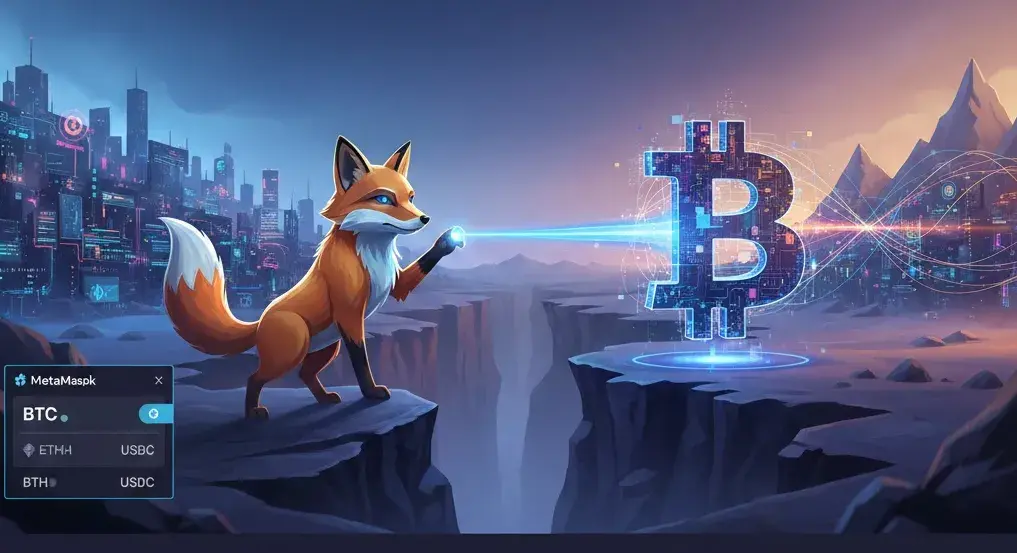
TL;DR (Key Points)
- Native BTC Functionality: MetaMask has officially rolled out native support for Bitcoin (BTC), moving beyond its traditional Ethereum-centric focus.
- Unified Management: Users can now buy, swap, and transfer BTC directly within their existing MetaMask wallet application.
- Automatic Address Generation: The update leverages MetaMask’s multichain accounts feature to automatically generate a Bitcoin address for all users who upgrade.
- SegWit Implemented: The initial implementation utilizes the native SegWit (P2WPKH) derivation path, ensuring efficient transaction sizes and lower fees.
- Taproot Planned: Future releases are scheduled to include support for Taproot (P2TR), which will further enhance privacy and script flexibility for advanced Bitcoin use cases.
MetaMask, the undisputed king of browser and mobile wallet applications in the Ethereum ecosystem, has officially confirmed its long-awaited Bitcoin support, a move that fundamentally reshapes the Web3 landscape. For years, the wallet has served as the primary gateway for interacting with Ethereum, its Layer 2s, and compatible EVM chains. Today’s announcement signals a monumental shift, bridging the historical gap between the two largest cryptocurrency networks by market capitalization and positioning MetaMask as a true multi-chain utility.
BINANCE:BTCUSDT Real-Time Chart
This pivotal update grants users the ability to seamlessly buy, swap, and transfer the digital asset within the application they already know and trust. It marks the end of juggling separate wallets for different networks and ushers in an era of consolidated asset management that is far more user-friendly and intuitive.
The Dawn of Multi-Chain MetaMask
For the longest time, the lack of native Bitcoin functionality was one of MetaMask’s most significant limitations. Users who wanted to interact with the Bitcoin network had to either rely on complicated workarounds—such as using Wrapped Bitcoin (wBTC) on Ethereum—or, more commonly, resort to entirely separate wallet software. This created friction, increased the risk of user error, and fragmented the Web3 experience.
 SEC Sets Compliance Seminar for Nov. 19→
 Ripple Expands Prime Brokerage With Brevan Howard→
 SEC Warns Investors About Investment Scams During World Investor Week→
 Coinbase and Citi Expand Stablecoin Payments for Businesses→
The addition of native Bitcoin support is a powerful acknowledgment of the industry’s trajectory toward cross-chain interoperability. MetaMask has strategically capitalized on its “multichain accounts” feature to roll out this integration. The moment a user upgrades to the latest wallet version, a unique Bitcoin address is automatically generated and linked to their existing seed phrase. This effortless process ensures that users do not need to go through a complex setup or migration phase, reinforcing MetaMask’s commitment to ease of use.
The significance of this development extends beyond mere convenience. It is a strategic move that solidifies MetaMask’s dominance not just in the EVM world, but potentially across the entire digital asset space. By incorporating Bitcoin, MetaMask is making a bold statement: the future of cryptocurrency is unified, not siloed.
Technical Deep Dive: SegWit and Future Taproot Integration
The implementation of native Bitcoin support is not a trivial undertaking. The technical differences between Bitcoin’s UTXO model and Ethereum’s account-based model are vast. MetaMask’s developers have made a deliberate, future-proof choice in their initial rollout by focusing on specific address types.
The wallet currently supports the native SegWit derivation path (P2WPKH or Bech32 addresses). Segregated Witness (SegWit) is a protocol upgrade implemented on the Bitcoin network in 2017. Its primary function is to optimize transaction data storage by separating the transaction signature (the “witness”) from the main transaction block. The benefits of using native SegWit addresses are considerable:
- Lower Fees: SegWit transactions generally require less block space, leading to lower transaction fees for the user.
- Faster Confirmation Times: By reducing the data size, these transactions can be confirmed more quickly.
- Improved Security: SegWit addresses eliminate transaction malleability, a vulnerability that was present in older Bitcoin transactions.
This pragmatic decision ensures that initial users of MetaMask’s BTC functionality will benefit from the best practices of the Bitcoin network. However, the wallet’s development team is not stopping there. The official announcement confirms that Taproot support is planned for a future release.
Taproot is the most recent major upgrade to the Bitcoin protocol, activated in November 2021. It builds upon SegWit and offers advanced features, including:
- Enhanced Privacy: Taproot makes complex multi-signature transactions look like simple single-signature transactions on the blockchain, improving user privacy.
- Greater Script Flexibility: It simplifies the implementation of complex smart contracts and multi-signature schemes on the Bitcoin network.
- Further Fee Reduction: Taproot addresses offer even greater efficiency, potentially lowering transaction costs even more.
The commitment to integrating both SegWit now and Taproot later demonstrates a genuine, long-term strategy for providing robust Bitcoin support, not just a superficial integration.
A Unified Web3 Wallet Experience
Before this update, a typical crypto enthusiast’s setup might have included MetaMask for Ethereum dApps, a separate software or hardware wallet for long-term BTC storage, and possibly another dedicated application for other L1 blockchains. This level of complexity is a significant barrier to entry for newcomers.
This new level of Bitcoin support changes the narrative entirely. For the average user, the ability to manage their primary assets—Ethereum and Bitcoin—under a single, familiar interface is the most revolutionary aspect of this release.
Buy, Swap, and Transfer: New Functionality
The integration is comprehensive, covering the three core activities users perform with their digital assets:
- Buying (On-Ramp): Users can now purchase BTC directly within the MetaMask interface using fiat currency via its integrated network of on-ramp partners, just as they could with ETH or stablecoins.
- Transferring: Sending and receiving native BTC is now a straightforward process, eliminating the need to export keys or switch applications for simple peer-to-peer transactions.
- Swapping: While native BTC cannot be directly swapped with Ethereum tokens on an EVM DEX, the implementation includes functionality to facilitate swaps through integrated services, allowing users to exchange BTC for other supported assets, and vice versa, without leaving the application. This is a crucial feature for active traders and portfolio rebalancers.
This seamless experience transforms MetaMask from an EVM gateway into a genuine universal digital asset manager, one that respects the user’s need for simplicity and accessibility.
The Implications for the Ecosystem
The addition of Bitcoin support has profound implications that ripple throughout the cryptocurrency ecosystem, touching everything from competing wallets to the relationship between the two biggest chains.
Bridging the Divide: Ethereum and Bitcoin
While Bitcoin remains focused on its role as “digital gold” and a store of value, and Ethereum continues to push the boundaries of decentralized application development, this move forces a closer relationship. It makes the user experience of holding both assets frictionless, which in turn might encourage more capital flow and new cross-chain developments. For example, while not directly supported yet, an easier pathway could be created for users to move their native BTC into tokenized formats (like wBTC) to utilize it in Ethereum’s DeFi ecosystem, all starting from the same wallet.
Competition in the Wallet Space
MetaMask was losing ground on a crucial feature to competitors like Trust Wallet, which has long offered multi-chain Bitcoin support, and hardware wallet interfaces like Ledger Live. By finally integrating native BTC, MetaMask neutralizes a key competitive disadvantage. Given its immense user base and the network effects it enjoys within the dApp community, this functionality ensures that a large portion of the user base has no compelling reason to leave the MetaMask environment for core asset management tasks.
Installation and Upgrade: Getting Started with your BTC Address
For current MetaMask users, accessing the new feature is incredibly simple. The multichain accounts feature does the heavy lifting:
- Update: Ensure your MetaMask browser extension or mobile application is updated to the latest available version.
- Open Wallet: Open your wallet and navigate to your account details or settings.
- Automatic Address: Your new Bitcoin address will be automatically generated and appear under your list of accounts. It is derived from your existing seed phrase, meaning you do not need to create a new one.
This automatic generation is perhaps the most significant benefit of the multichain approach, as it means users manage all their assets—ETH, stablecoins, NFTs, and now BTC—under a single, secure master key.
Security and Best Practices
With the introduction of Bitcoin support, the stakes for security have never been higher. Users are now potentially storing the two most valuable digital assets using the same seed phrase. It is an opportune moment to reiterate essential wallet security protocols:
- Never Share Your Seed Phrase: Your 12- or 24-word recovery phrase is the master key to all your funds, including your new BTC holdings. Never store it digitally, share it with anyone, or input it into any website or application other than the official MetaMask interface during recovery.
- Verify Addresses: Always double-check the recipient address when sending any BTC or other digital asset. Be wary of malware that attempts to swap legitimate addresses with malicious ones.
- Use Hardware Wallets: For maximum security, especially for substantial holdings, connecting a hardware wallet (like Ledger or Trezor) to your MetaMask account is the industry-standard best practice. This ensures your private keys never leave the secure hardware device.
CRYPTOCAP:TOTAL Real-Time Chart
Conclusion
The rollout of native Bitcoin support by MetaMask is more than just a feature addition; it is a seismic event in the world of Web3 infrastructure. It solves a decades-old fragmentation problem by giving users a powerful, yet simple, one-stop solution for managing their most critical digital assets. By committing to both SegWit today and Taproot in the future, MetaMask has demonstrated a dedication to providing high-quality, efficient Bitcoin integration. This move not only expands MetaMask’s utility but also paves the way for a more unified, accessible, and ultimately user-centric decentralized future.