

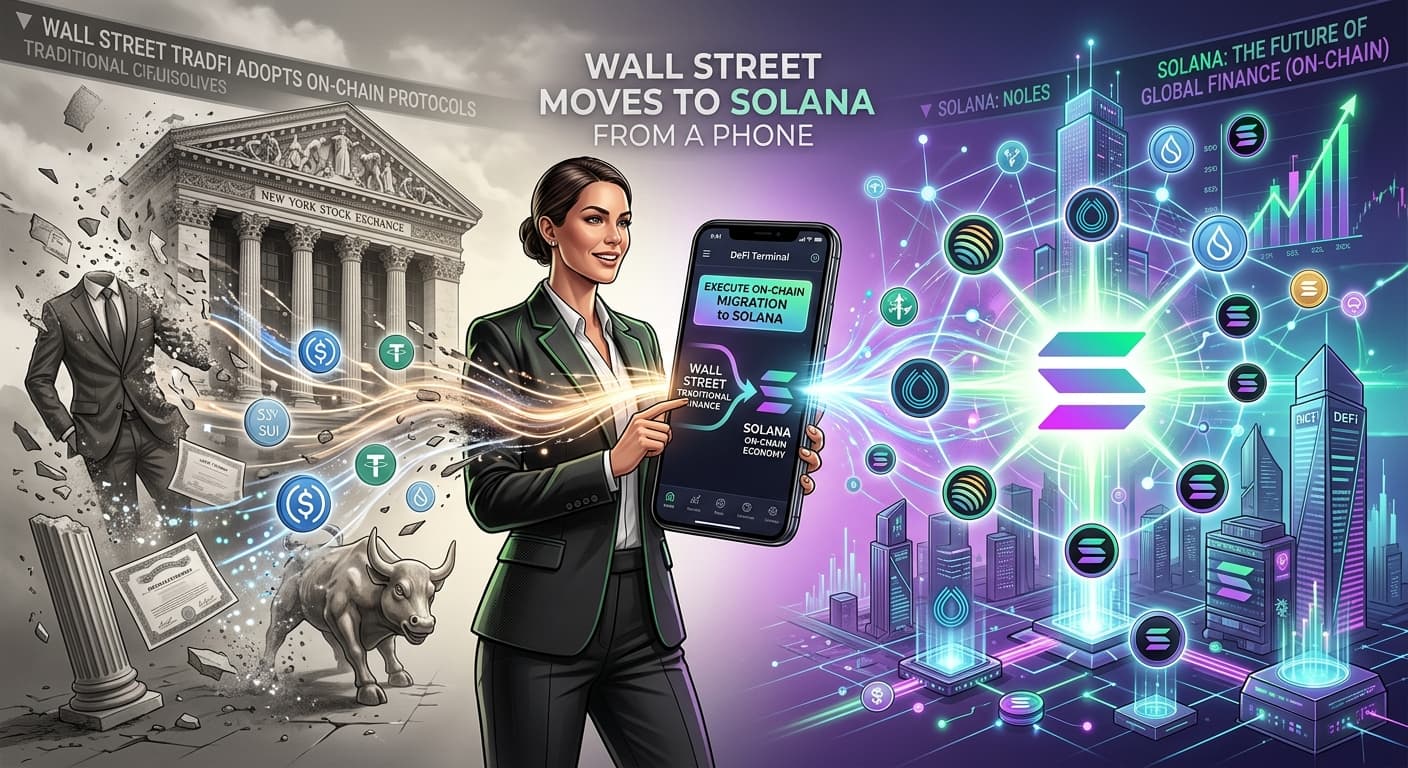
The idea of accessing Wall Street from a phone is no longer purely theoretical.
In a recent Solana post, the network highlighted a growing range of financial products available through onchain applications, including tokenized stocks, commodities, Bitcoin, foreign exchange and yield products.
BINANCE:SOLUSDT
The message was deliberately ambitious: “Everything Wall Street can do, now on Solana from a phone and an internet connection.” The statement came from Vidor Gunes, associated with Solflare, during Solana Summit Serbia and was subsequently shared by the Solana account.
The underlying technology is important, but so is the change in distribution.
 SEC Sets Compliance Seminar for Nov. 19→
 Ripple Expands Prime Brokerage With Brevan Howard→
 SEC Warns Investors About Investment Scams During World Investor Week→
 XRP Asia Officially Launches in Seoul to Accelerate XRP Ledger Adoption Across the Asia-Pacific Region→
For decades, access to sophisticated financial markets depended on banks, brokers, exchanges and other intermediaries. Today, blockchain applications can put many financial instruments behind a wallet interface and an internet connection.
That does not mean a smartphone has literally replaced a regulated brokerage account or investment bank.
It does mean the architecture of financial access is changing.
Stocks are already appearing onchain
The strongest evidence for the trend is the rapid expansion of tokenized equities.
Solana’s ecosystem now includes tokenized versions of public companies and exchange-traded funds. Ondo Global Markets, for example, launched on Solana with more than 200 tokenized U.S. stocks and ETFs, including major equities and products such as SPY and QQQ.
xStocks has also brought a broad range of U.S. equities and ETFs onto Solana. Its listed assets include familiar names such as Apple, Nvidia, Tesla and Amazon. The products are designed to provide financial exposure to the corresponding securities while making that exposure transferable within blockchain applications.
Solana’s own July ecosystem report documented another expansion of the market. Backpack Securities added tokenized shares including Robinhood, Intel, Strategy and other companies, while Ondo expanded its set of assets supporting 24/7 minting and redemption.
This is the key distinction between today’s blockchain markets and the early cryptocurrency era.
The ecosystem is increasingly dealing with traditional financial assets represented in programmable form.
From a stock ticker to a programmable asset
A conventional stock is primarily an investment instrument.
A tokenized stock can potentially become something more.
Depending on the legal structure and platform, a tokenized security or economic exposure can be held in a blockchain wallet, transferred between supported applications, traded onchain or used as collateral.
That creates a new financial primitive.
Consider a token representing exposure to a major technology company.
Instead of simply holding it in a brokerage account, an eligible user could potentially move it into an onchain application, use it as collateral for borrowing, or trade it against other digital assets.
This is one of the reasons tokenization has attracted attention from financial institutions.
The technology is not simply about creating a digital copy of an existing security.
It is about making financial assets programmable and composable.
CryptoQuorum recently examined this development in Solana’s growing tokenized-equity market, including the arrival of SpaceX, Securitize and other institutional issuers on the network.
Gold and silver are joining the same ecosystem
Equities are only one part of the expansion.
Solana’s real-world-asset ecosystem also includes tokenized commodities such as gold and silver.
Ondo’s expansion to Solana includes commodity-linked products alongside equities and ETFs, while Solana’s own RWA infrastructure highlights tokenized metals as part of the growing asset universe.
This matters because traditional portfolios have never consisted solely of stocks.
Investors use commodities, bonds, currencies, cash equivalents and other instruments to diversify risk and manage liquidity.
If these assets can increasingly be represented onchain, the potential market becomes much larger than cryptocurrency alone.
The long-term vision is closer to an internet-native capital market.
Bitcoin fits naturally into the model
Bitcoin is already native to digital markets, but Solana’s ecosystem can provide another layer of financial functionality through wrapped or bridged representations and applications that interact with Bitcoin exposure.
The result is a market where a user could potentially combine:
- Bitcoin exposure;
- tokenized equities;
- gold and silver;
- stablecoins;
- yield-bearing assets;
- decentralized lending;
- foreign-exchange markets.
The important word is potentially.
Availability depends on the application, jurisdiction, asset structure and user eligibility. Not every product is accessible to every investor, and tokenized representations do not necessarily provide identical ownership rights.
Nevertheless, the technical direction is clear.
Financial assets are becoming increasingly interoperable inside blockchain environments.
The FX claim needs context
One of the strongest statements in the Solana video concerns foreign exchange.
Vidor Gunes said users can obtain better FX rates on Solana than through any bank.
That is a significant claim, but it should be treated as a statement about the speaker’s experience or the specific onchain routes being discussed rather than as a universal market fact.
Foreign-exchange pricing depends on:
- currency pair;
- liquidity;
- transaction size;
- time of day;
- routing;
- stablecoin liquidity;
- spreads;
- network fees;
- withdrawal and conversion costs.
A blockchain-based FX transaction can eliminate or reduce some intermediaries, but it does not automatically guarantee a better rate.
The more defensible point is that programmable markets can introduce new FX liquidity and routing mechanisms that operate outside traditional banking hours.
That can be particularly valuable for cross-border payments.
Why 24/7 markets change the equation
Traditional stock exchanges operate according to defined trading sessions.
Blockchain networks operate continuously.
That creates a fundamental difference.
A tokenized stock can potentially remain transferable outside the opening hours of the underlying exchange, although the exact trading and redemption rules depend on the issuer.
Ondo, for example, introduced 24/7 minting and redemption for selected tokenized stocks and ETFs on Solana.
xStocks has similarly promoted 24/7 onchain trading and settlement for eligible non-U.S. users.
This does not mean the underlying stock exchange suddenly operates 24/7.
Instead, it means the tokenized financial representation can have a different operational lifecycle from the traditional market.
That distinction will become increasingly important as investors use blockchain assets as collateral or combine them with other markets.
DeFi adds another layer
The biggest difference between tokenized assets and traditional brokerage holdings may ultimately be what happens after purchase.
On a conventional brokerage platform, buying a stock generally ends with ownership or economic exposure to that security.
In DeFi, the token can potentially become part of another financial transaction.
For example:
Tokenized stock → collateral → borrowing → liquidity → additional investment
Solana’s current RWA infrastructure already connects tokenized assets with decentralized exchanges, lending markets and collateral systems. The Solana Foundation identifies Jupiter and Kamino among the protocols supporting this growing RWA market.
This is where the concept of “Wall Street from a phone” becomes more than a marketing slogan.
A traditional financial product can become an input into a programmable financial system.
Kamino and the search for onchain yield
The Solana post also points to Kamino as an example of onchain yield.
Kamino is a Solana DeFi protocol offering lending, borrowing, liquidity and leveraged strategies.
Its yield products can offer returns that vary according to market conditions, utilization, asset demand and incentives.
Recent independent risk analysis of Kamino Lend showed just how variable these markets can be. In July 2026, for example, the reported net APYs across major Kamino vaults ranged from roughly 2.7% to 7.6%, depending on the vault and asset.
That is why the statement that onchain platforms can offer “better interest” than a deposit account should not be interpreted as a permanent or risk-free advantage.
DeFi yield is not the same product as a bank deposit.
A bank deposit may have different protections, liquidity characteristics and counterparty structures. DeFi positions can introduce smart-contract risk, liquidation risk, market risk and loss of principal.
The comparison is therefore useful as an illustration of different financial architectures, not as a blanket investment recommendation.
Expert perspective: the financial interface is changing
The most interesting part of Vidor Gunes’ argument is not the claim that every Wall Street instrument is already available on Solana.
The more important observation is that financial technology is moving toward a model where the interface becomes the wallet.
Historically, electronic market access itself was revolutionary.
Solana’s post referenced 1971, when Nasdaq introduced electronic price quotation and changed how market information could be distributed.
The analogy is imperfect, but the underlying idea is relevant.
Nasdaq did not eliminate finance.
It changed the infrastructure through which financial information and orders moved.
Blockchain networks are attempting something similar with ownership, settlement and financial programmability.
Instead of asking a broker to execute every movement of an asset, a smart contract can potentially perform certain functions automatically.
Solana’s RWA market is already substantial
This transformation is supported by measurable growth.
By late July 2026, Solana reported approximately $3.7 billion in non-stablecoin real-world-asset value and more than 313,000 RWA holders. The ecosystem spans public equities, Treasuries, private credit, commodities, reinsurance and other financial products.
Solana’s current RWA dashboard reports more than $6.7 billion in indexed tokenized value across 2,673 assets, although the methodology is broader than the non-stablecoin RWA figure reported in the July ecosystem analysis.
These figures should not be mixed together as if they measured exactly the same thing.
The important conclusion is the direction of growth.
The network is developing into a significant venue for tokenized financial assets.
Why institutional investors are paying attention
The institutional case for tokenization is not primarily about replacing every existing exchange.
It is about improving the movement and use of financial assets.
Solana’s tokenization infrastructure supports features including rapid settlement and compliance controls through its Token-2022 framework. The network documentation describes capabilities such as transfer restrictions, pausing and atomic delivery-versus-payment settlement.
For institutions, those controls can be as important as transaction speed.
A financial institution needs to know:
- who can hold an asset;
- how transfers are controlled;
- how ownership is recorded;
- how settlement occurs;
- how corporate actions are handled;
- how the asset can be redeemed;
- what happens during market disruption.
Tokenization therefore requires much more than a blockchain and a token.
It requires financial infrastructure.
The legal structure still matters
There is an important limitation to the “Wall Street on your phone” narrative.
A tokenized stock is not necessarily equivalent to directly owning the corresponding share through a conventional brokerage.
Different products can have different structures.
Some tokens may represent direct ownership of securities. Others may provide economic exposure through a contractual or custodial arrangement.
For example, Solana’s documentation on xStocks describes products backed 1:1 by underlying shares held with regulated custodians, while other tokenized products can use different legal structures.
Investors should therefore examine the issuer, jurisdiction, custody arrangement, redemption mechanism and rights attached to each token.
The word “tokenized” alone does not answer those questions.
The smartphone could become the new financial terminal
The broader implication is significant.
A modern smartphone already combines:
- identity;
- payments;
- communication;
- trading;
- banking;
- custody;
- market information.
Blockchain wallets add another capability: direct interaction with programmable financial assets.
That could eventually allow one interface to connect stocks, commodities, currencies, stablecoins and digital assets.
The result would not necessarily eliminate banks or brokers.
Instead, their roles could shift toward custody, compliance, financing, liquidity provision and regulated market access while blockchain networks handle more of the settlement and asset-movement layer.
That is a more realistic interpretation of the “Wall Street in your pocket” thesis.
What happens next?
The next stage will be measured by usage rather than headlines.
Investors and industry observers should watch:
- Tokenized equity volume
- RWA liquidity
- DeFi collateral utilization
- Institutional issuance
- 24/7 market adoption
- Cross-border FX activity
- Regulatory developments
- The number of financial applications using tokenized assets
The ecosystem will also need to demonstrate that onchain markets can maintain reliable liquidity during periods of extreme volatility.
That may be a more important test than transaction speed.
Solana is becoming a financial distribution layer
The Solana post presents an ambitious vision: financial markets that can be accessed from a phone rather than through a traditional institutional terminal.
The reality is more nuanced.
Not every Wall Street product exists natively onchain. Not every tokenized asset represents direct ownership. DeFi yields can change rapidly, and claims about superior FX pricing depend on the specific market and route.
But the underlying transformation is real.
Stocks, ETFs, gold, silver, Treasuries, private credit and other real-world assets are increasingly appearing on blockchain networks.
And Solana is emerging as one of the most active venues for that transition.
The important development is therefore not simply that someone can buy a tokenized Tesla or Amazon exposure from a phone.
It is that a financial asset can increasingly become portable, programmable, composable and continuously accessible.
That is a much bigger change.
The traditional Wall Street model was built around centralized institutions and market infrastructure.
The emerging onchain model is being built around wallets, smart contracts, tokenized assets and global liquidity.
If that infrastructure continues to mature, the financial terminal of the future may look considerably less like a trading desk — and much more like a smartphone.