

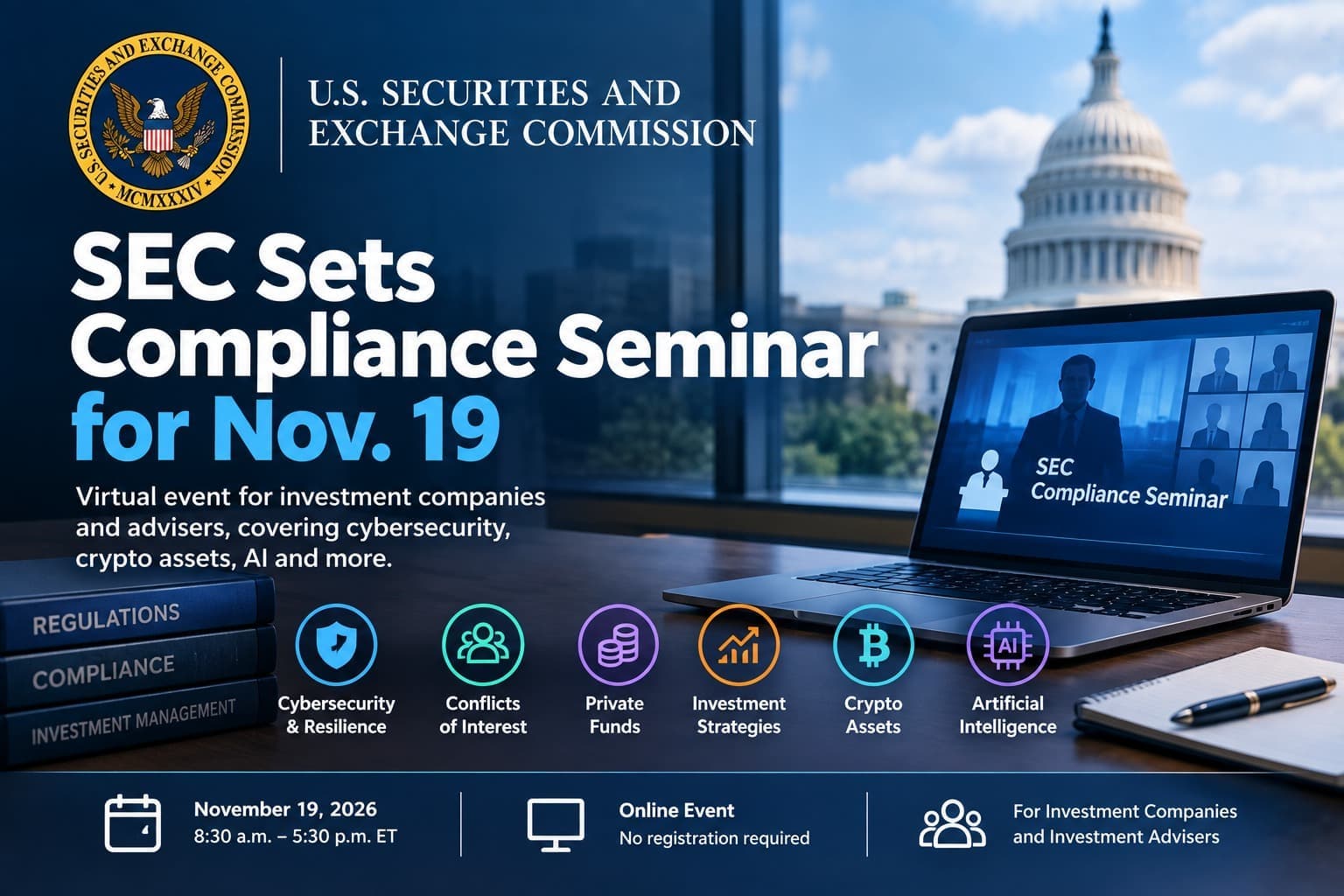
The U.S. Securities and Exchange Commission (SEC) will host a virtual national compliance seminar for investment companies and investment advisers on November 19, bringing regulators and industry compliance professionals together to discuss cybersecurity, operational resilience, conflicts of interest, private funds, emerging investment strategies and crypto assets.
The event is being organized through the SEC’s Compliance Outreach Program and is intended to help chief compliance officers and senior personnel strengthen compliance programs designed to protect investors.
The November 19 event is particularly notable for the breadth of its agenda. Alongside conventional investment-adviser and fund compliance topics, the SEC has scheduled dedicated discussions covering crypto assets, artificial intelligence, internet advisers and marketing.
The agency announced the event on October 6 in Press Release 2026-102.
 Ripple Expands Prime Brokerage With Brevan Howard→
 SEC Warns Investors About Investment Scams During World Investor Week→
 Coinbase and Citi Expand Stablecoin Payments for Businesses→
 Michael Saylor Proposes a Bill of Digital Rights to Fuel a $100 Trillion Digital Economy→
SEC Compliance Seminar Targets Investment Firms
The virtual event will run from 8:30 a.m. to 5:30 p.m. Eastern Time on November 19.
The SEC said advance registration will not be required. A link to the live webcast will be published on SEC.gov on the morning of the event.
The Compliance Outreach Program is jointly sponsored by the SEC’s Division of Examinations, Division of Investment Management and Asset Management Unit of the Division of Enforcement.
According to the SEC, the program is designed to maintain open communication between securities regulators and the financial industry while allowing participants to discuss practical compliance issues and effective controls.
The structure of the November event reflects that objective. Rather than concentrating on a single rule, the program covers the operational, governance and investment risks facing advisers and investment companies.
Cybersecurity and Operational Resilience Take Center Stage
The first substantive panel will focus on information security and operational resiliency.
The agenda includes regulatory compliance and incident response, vendor and third-party risk management, organizational safeguards, business continuity and redundancy.
This focus reflects a broader change in the way regulators view technology risk.
For investment firms, cybersecurity is no longer simply an information-technology issue. A cyber incident can affect customer information, trading operations, financial records, communications and the ability of an adviser or fund to continue operating.
Third-party dependencies add another layer of risk. Investment firms increasingly rely on cloud providers, technology vendors, custodians, administrators, trading platforms and other external service providers. A failure at one of those providers can create operational consequences for the regulated entity.
The SEC’s Division of Examinations describes its examination program as risk-focused, with the objective of improving industry practices, preventing fraud, monitoring risk and informing regulatory policy.
That makes the cybersecurity panel relevant beyond technical teams: senior management and compliance officers are increasingly expected to understand how technology risks interact with regulatory obligations.
Conflicts of Interest Remain a Major Focus
The second panel will examine conflicts of interest involving registered investment advisers.
The agenda identifies trade allocation and execution conflicts, compensation and revenue-sharing arrangements, proxy voting and shareholder rights.
These areas are important because conflicts can arise even when an investment firm’s underlying strategy is legitimate.
For example, an adviser may have relationships with multiple clients whose interests are not identical. Decisions about trade allocation, execution or access to investment opportunities can therefore create questions about whether clients are being treated fairly.
The SEC’s 2026 examination priorities already place significant emphasis on advisers’ compliance programs and adherence to fiduciary standards.
The agency also published a September Risk Alert addressing annual compliance reviews by investment advisers. SEC examination staff said advisers should assess whether their compliance policies and procedures remain adequate and effective, while considering changes in business activities, regulatory developments and significant compliance events.
The upcoming seminar therefore follows a broader regulatory emphasis on whether compliance programs actually work in practice rather than merely existing as written documents.
Private Funds and Alternative Investments
Private-fund advisers will have their own dedicated session.
Topics include alternative investments in the retail market, fees and expenses, conflicts, disclosures, preferential treatment, valuation and marketing.
The combination of these subjects is significant as private-market products become more accessible to a broader range of investors.
For advisers managing private funds, valuation can be particularly complex when portfolios contain assets that do not trade frequently in liquid public markets.
Marketing is another area of regulatory sensitivity. Investors need information that accurately represents a fund’s strategy, risks, fees and performance.
The SEC’s agenda indicates that examiners intend to examine these issues alongside traditional compliance considerations rather than treating them as isolated matters.
Investment Companies Face New Strategy and Disclosure Questions
Another panel will focus on registered investment companies, including mutual funds and ETFs.
The discussion will cover regulatory disclosures and reporting, emerging investment strategies and asset classes, board oversight, risk management and co-investment relief.
The reference to emerging strategies is especially relevant to the evolution of investment products.
Funds are increasingly exploring areas such as digital assets, alternative investments and other strategies that can introduce operational, valuation and risk-management challenges.
The SEC’s 2026 examination priorities identify registered investment companies as an important examination area because of their role in serving retail investors, including people saving for retirement.
The agency’s priorities include compliance programs, disclosures, filings, governance, fees and expenses, portfolio-management practices and funds with complex or less-liquid investments.
Crypto Assets Will Be Discussed at the SEC Event
The most direct connection to the cryptocurrency industry comes in the final substantive panel.
The SEC has listed crypto assets among the current issues to be discussed, alongside super intelligence, internet advisers, TAMPS and marketing.
The panel will include Taylor Lindman, Chief Counsel of the SEC’s Crypto Task Force, as well as officials from the Division of Examinations and Division of Investment Management.
Because the event has not yet taken place, the SEC has not provided substantive conclusions from that discussion. It would therefore be premature to characterize the session as announcing a new crypto rule or policy.
However, its inclusion on the official agenda is itself significant.
It indicates that crypto assets are being incorporated into the SEC’s broader compliance dialogue for investment advisers and investment companies rather than being treated exclusively as a specialized enforcement or technology issue.
This is particularly relevant following the SEC’s recent proposal addressing the custody of crypto assets by investment advisers and investment companies.
CryptoQuorum covered that development in SEC Proposes New Crypto Custody Rules, examining how custody requirements could affect institutional digital-asset strategies.
AI and “Super Intelligence” Enter the Compliance Agenda
The SEC’s decision to include “Super Intelligence” in the current-issues session also deserves attention.
The agenda does not provide detailed information about the subjects that will be discussed under that heading. Consequently, it would be speculative to predict specific regulatory proposals.
Nevertheless, the topic places advanced artificial intelligence alongside crypto assets and internet-based advisory businesses in the SEC’s compliance agenda.
For investment firms, AI can affect multiple areas simultaneously, including investment research, client communications, cybersecurity, data management, marketing and operational controls.
The regulatory challenge is therefore unlikely to be limited to the technology itself. Compliance officers may also need to understand how AI-generated information enters business processes and whether existing supervisory controls remain effective.
The presence of the topic on the November agenda suggests that the SEC expects technology-driven changes to become increasingly relevant to compliance programs.
Expert Perspective Comes From the SEC and Industry
The seminar’s speaker list combines SEC officials with compliance executives from the financial industry.
SEC Division of Examinations Director Keith Cassidy will moderate and provide closing remarks, while SEC Division of Investment Management Director Brian Daly is scheduled to participate in the opening directors’ discussion.
Industry perspectives will include compliance executives from firms including Blackstone, Lido Advisors and Eldridge Capital Management, as well as representatives of the Investment Company Institute.
That mix matters because effective compliance is not simply a question of interpreting regulations.
Investment firms must translate regulatory requirements into policies, technology controls, employee training, supervision, monitoring and escalation procedures.
The SEC’s September Risk Alert reinforces this practical perspective by encouraging advisers to use annual compliance reviews to identify weaknesses and make appropriate changes.
What the November Seminar Could Mean for Crypto Firms
The event does not target cryptocurrency companies exclusively. Its primary audience is investment companies and investment advisers.
Nevertheless, crypto firms serving institutional investors may have reason to follow the discussions closely.
Digital assets increasingly intersect with traditional investment structures through ETFs, registered advisers, custody arrangements, derivatives, tokenized assets and alternative investment products.
That means issues such as cybersecurity, valuation, conflicts of interest, marketing and operational resilience can apply to digital-asset businesses even when the underlying technology is different from traditional securities infrastructure.
The SEC’s inclusion of crypto assets in a national compliance program for investment advisers and investment companies reinforces this convergence.
It also fits into the broader regulatory developments covered by CryptoQuorum, including the SEC’s proposed framework for crypto custody and its recent work on tokenized securities.
A Broader Shift Toward Compliance Infrastructure
The November 19 event is unlikely to produce a single headline rule that changes the investment industry overnight.
Its importance is more structural.
The SEC is bringing together regulators and industry professionals to address how compliance programs operate across technology, investment strategies, governance and investor protection.
For investment advisers and fund managers, the practical message is that compliance programs need to evolve alongside their businesses.
A firm adding crypto assets, artificial intelligence, new distribution channels or alternative investment strategies may also need to reassess its controls, disclosures, conflicts policies, cybersecurity procedures and supervisory framework.
For crypto-market participants, the message is equally relevant: institutional adoption requires more than market access and technological infrastructure. It also requires compliance systems capable of operating within regulated financial markets.
The SEC’s November seminar will provide a public forum for regulators and industry professionals to discuss precisely those challenges.
Disclaimer
This article is for informational and educational purposes only and does not constitute financial, investment, legal or regulatory advice. The November 19 seminar had not taken place at the time of publication, so its future discussions should not be interpreted as announced SEC policy or final regulatory decisions.
Primary source: U.S. Securities and Exchange Commission, Press Release 2026-102 and the official 2026 National Compliance Outreach Seminar agenda.