Crypto Market Today Explained: Navigating the 2026 Digital Asset Landscape
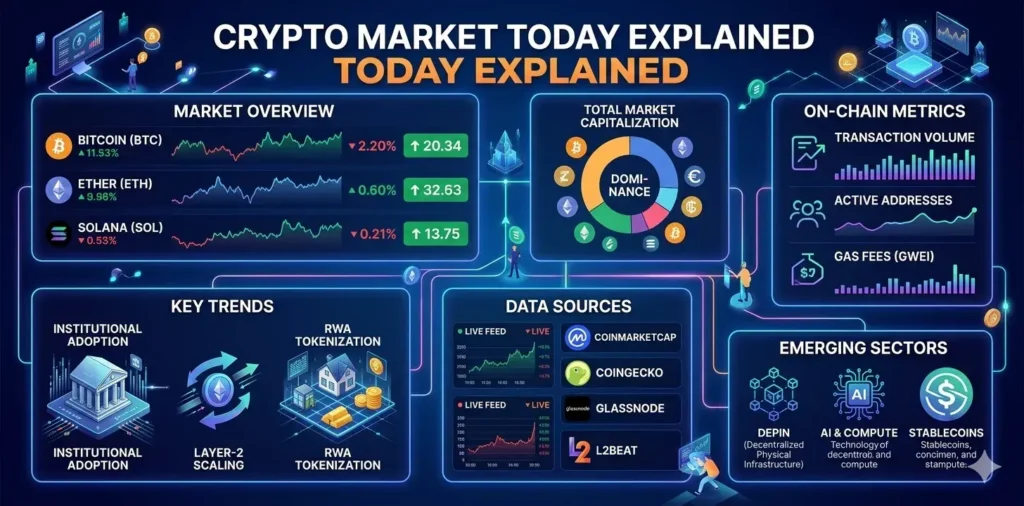
A comprehensive breakdown of the current state of digital assets in 2026. Using data from CoinMarketCap and Glassnode, we analyze Bitcoin’s institutional maturity, the surge in Layer-2 activity, and the macroeconomic factors driving the current price action.
The digital asset ecosystem of 2026 looks remarkably different from the speculative frenzy of years past. We have moved from the “Wild West” into an era of institutional integration, regulatory frameworks, and genuine technological utility. However, for the average investor, the sheer volume of data coming from platforms like CoinMarketCap and Glassnode can be overwhelming.
In this deep dive, we provide the crypto market today explained in a way that balances technical on-chain metrics with high-level market sentiment. Whether you are tracking the “Orange Coin” or hunting for the next breakout in Decentralized Physical Infrastructure Networks (DePIN), understanding the underlying mechanics of the current market is essential.
1. The Macro View: Market Cap and Global Sentiment
According to the latest data from CoinMarketCap, the total cryptocurrency market capitalization is currently oscillating around a pivotal psychological level. Unlike previous cycles, this valuation is no longer driven solely by retail hype. Instead, it is underpinned by “sticky” institutional capital flowing through regulated vehicles.
The Fear & Greed Index in 2026
The sentiment today sits in a state of “Healthy Optimism.” While the Fear & Greed Index remains in the “Greed” territory, it lacks the parabolic “Extreme Greed” that usually signals an immediate market top. This suggests a maturing market where participants are more focused on value accrual than overnight “moon” shots.
Why Liquidity Is Key
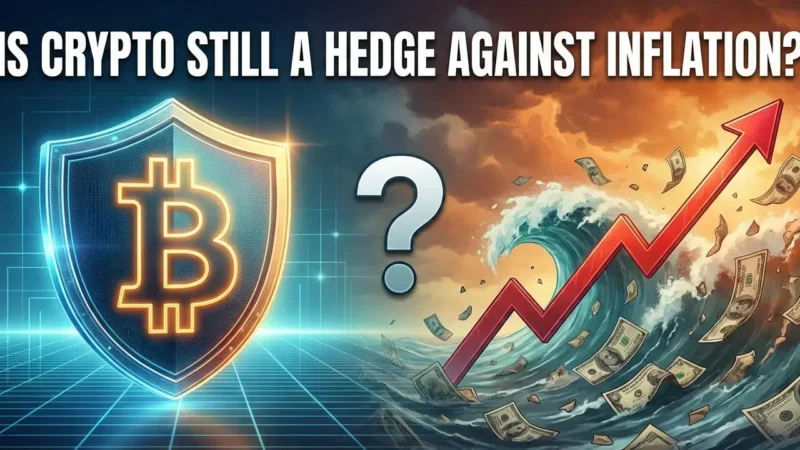
When we look at the crypto market today explained, we must talk about global liquidity. Central bank policies in 2026 continue to influence digital assets. As traditional fiat currencies face ongoing inflationary pressures, the “hard money” properties of Bitcoin have solidified its role as a premier collateral asset in the global financial system.
2. Bitcoin: The Institutional North Star
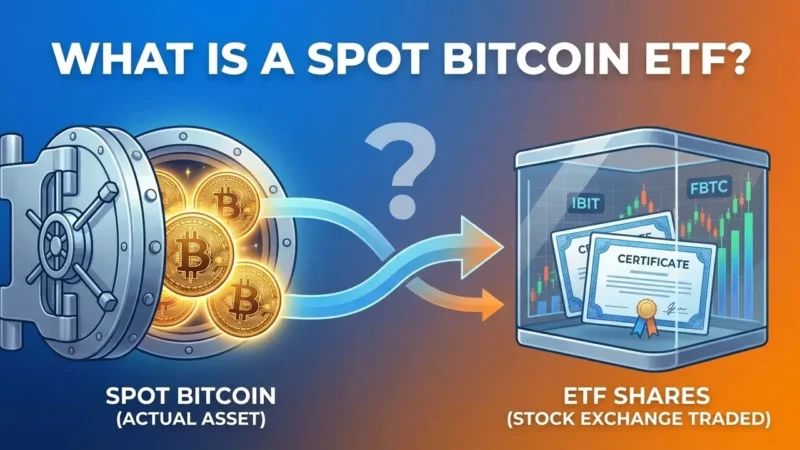
Bitcoin remains the undisputed leader, but its behavior has changed. Per Glassnode’s on-chain analysis, the “illiquid supply”—Bitcoin held by entities that rarely sell—has reached an all-time high. This supply crunch is a direct result of the long-term accumulation by Spot Bitcoin ETFs and sovereign wealth funds.
The Halving Hangover or Harvest?
With the 2024 halving now well in the rearview mirror, we are witnessing the “Harvest Phase.” Miners have stabilized their operations, and the reduced daily issuance is finally meeting the relentless demand of institutional 401(k) allocations. This crypto market today explained wouldn’t be complete without noting that Bitcoin’s volatility has dropped significantly compared to 2021, making it a more viable “store of value” for conservative portfolios.
3. Ethereum and the Scaling Revolution
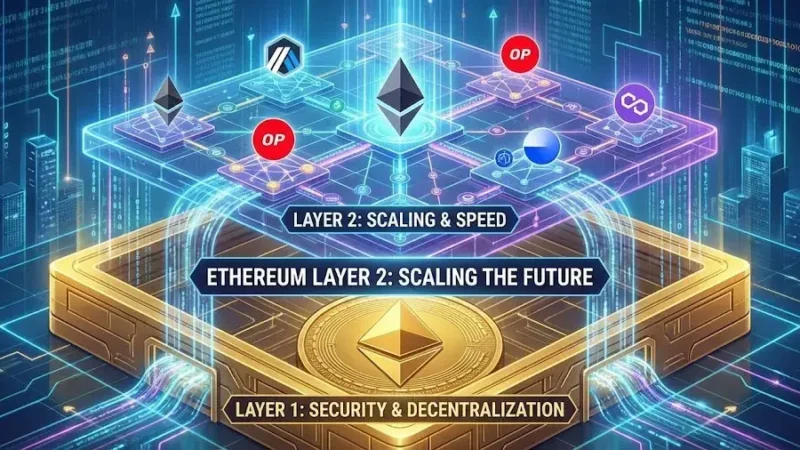
Ethereum continues to pivot toward its role as a settlement layer. As we previously discussed in our analysis of Ethereum Layer 2 networks, the network’s mainnet is now a high-security foundation for a web of faster, cheaper sub-networks.
L2 Dominance and Fee Stability
Data from L2Beat and CoinGecko shows that transaction volume on Layer-2 solutions like Arbitrum, Base, and Optimism now dwarfs the activity on the Ethereum mainnet. This is a positive sign for the crypto market today explained; it proves that the network has successfully scaled without compromising security. Users are enjoying sub-cent fees, which has sparked a resurgence in on-chain social media and micro-payment applications.
4. On-Chain Metrics: What Glassnode is Telling Us
To truly have the crypto market today explained, we have to look “under the hood.” Glassnode’s data provides a transparent view of investor behavior that traditional markets simply cannot match.
Realized Cap vs. Market Cap
The “Realized Cap”—which values each coin at the price it was last moved—is currently trending upward. This indicates that new capital is entering the market at higher price floors, creating a solid support level. When the Market Cap stays comfortably above the Realized Cap, it generally signals a sustained bull market structure.
Exchange Balances
Bitcoin and Ethereum balances on centralized exchanges continue to trend downward. This “Exchange Outflow” suggests that investors are moving their assets into self-custody or institutional cold storage, reducing the immediate “sell-side pressure” that often causes flash crashes.
5. The Rise of the “Utility” Altcoins
The “Altseason” of 2026 is far more selective than in previous years. We are no longer seeing every “meme coin” fly to billions in valuation. Instead, the market is rewarding projects with tangible revenue models.
- DePIN (Decentralized Physical Infrastructure): Projects that use tokens to incentivize the building of real-world hardware networks (like 5G or mapping) are seeing massive traction.
- RWA (Real World Assets): The tokenization of real estate, treasury bills, and private equity is no longer a pilot program; it is a multi-billion dollar sector.
- AI and Compute: As the demand for AI processing power grows, decentralized GPU rendering networks have become a staple of the crypto market today explained.
6. Regulatory Clarity: The MiCA and SEC Impact
In 2026, the regulatory fog has largely cleared. In Europe, the MiCA (Markets in Crypto-Assets) framework has provided a blueprint for how exchanges and issuers should operate. In the U.S., a series of court rulings and legislative shifts have moved the industry away from “regulation by enforcement” toward a more structured environment.
This clarity is perhaps the most important part of the crypto market today explained. It has allowed major banks to offer custody services and enabled traditional fintech apps to integrate crypto features seamlessly, bringing in the “next billion users” who were previously scared off by legal uncertainty.
7. Risks to Watch: The 2026 Warning Signs
No market analysis is honest without addressing the risks. While the long-term outlook is bullish, short-term hurdles remain:
- Systemic Stablecoin Risk: While tether (USDT) and USDC have remained stable, the emergence of new algorithmic experiments always bears watching.
- Cybersecurity Threats: As the value locked in Layer-2 protocols grows, they become increasingly attractive targets for sophisticated exploits.
- Geopolitical Tensions: As a global asset, crypto is sensitive to trade wars and regional conflicts that impact energy prices and internet connectivity.
Stay informed, read the latest crypto news in real time!
Conclusion: A Market of Maturity
To have the crypto market today explained is to recognize that we are no longer in the “early adopter” phase. We are in the “institutional integration” phase. The volatility is still there, but it is increasingly driven by data, adoption metrics, and macroeconomic reality rather than pure tweets and memes.
As you navigate the charts on CoinMarketCap or the deep data on Glassnode, remember that the “signal” is found in the adoption of technology, not just the movement of the price. The foundation for a decentralized financial future has been laid; now, we are simply watching the building rise.