

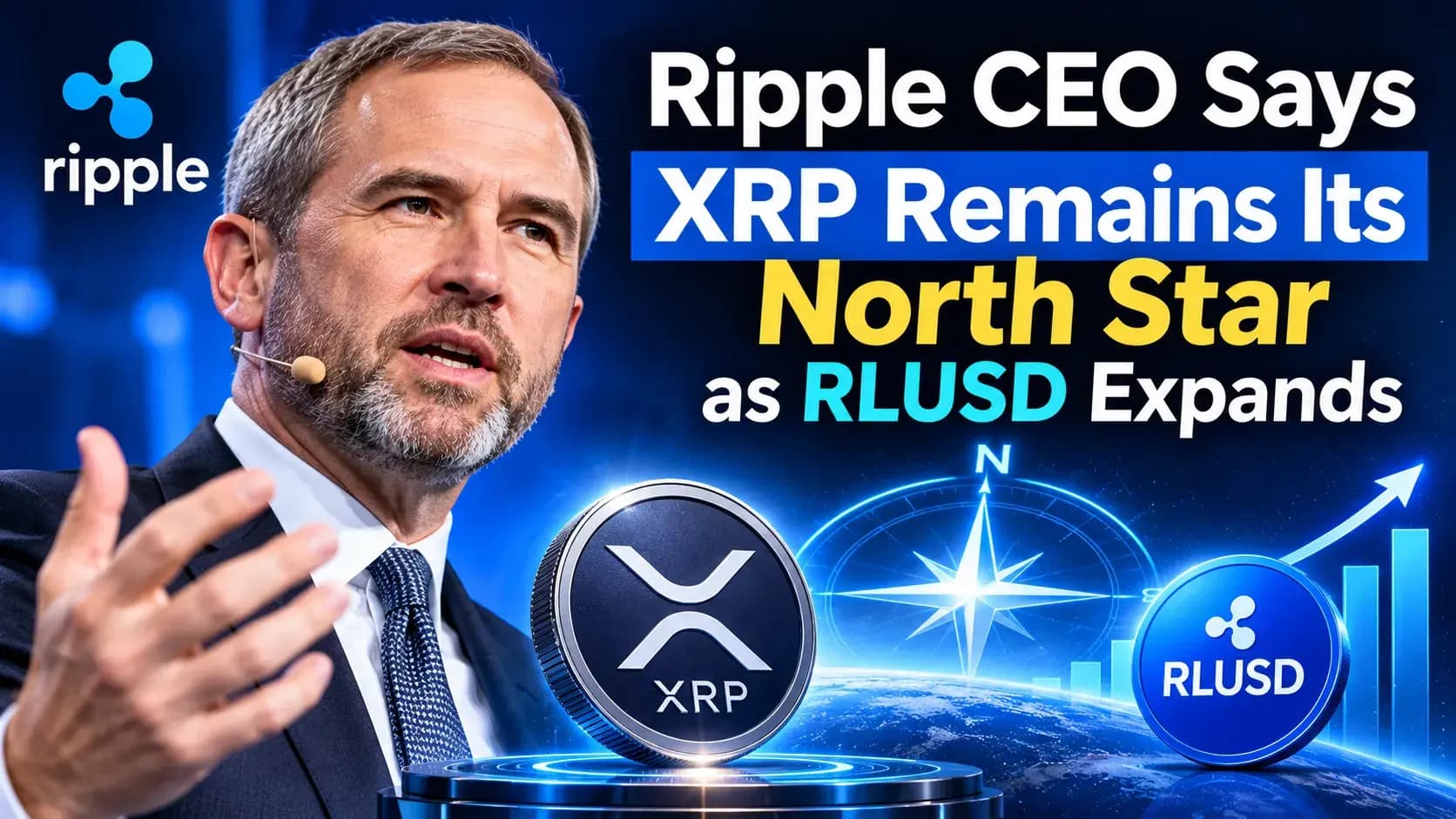
Ripple CEO Brad Garlinghouse has pushed back against concerns that the company’s expanding stablecoin business could overshadow XRP, reaffirming that the digital asset remains central to Ripple’s long-term strategy.
In a video published on YouTube, Brad Garlinghouse’s position is summarized in a clear message: XRP remains Ripple’s “North Star” even as its U.S. dollar-backed stablecoin, RLUSD, gains traction across institutional finance.
BINANCE:XRPUSDT
The distinction matters as Ripple expands beyond its original payments business into stablecoins, digital asset custody, prime brokerage and institutional financial infrastructure. The company is building a broader range of products, but its leadership maintains that the XRP ecosystem remains an important part of that strategy.
The question for the market is whether the growth of Ripple’s enterprise business will translate into greater demand for XRP — and how much of that growth may instead benefit RLUSD or the XRP Ledger as a network.
 Ripple National Trust Bank wins OCC approval→
 Cross River Brings RLUSD Into Core Banking→
 Mastercard and BVNK have launched a new global payments platform→
 Why Crypto Rallied After Clarity Act Failed→
Garlinghouse Addresses Concerns About XRP
The debate intensified as Ripple increased its focus on RLUSD and announced new institutional partnerships.
Some XRP holders have questioned whether a growing stablecoin business could reduce the need for the native digital asset. If financial institutions can settle transactions directly in a dollar-backed token, they may not always need a separate cryptocurrency as an intermediary.
Garlinghouse addressed this issue during an interview with Bloomberg at the Ripple Swell conference on October 28.
Asked whether XRP remained central to Ripple as institutional interest increasingly focused on RLUSD, the CEO rejected the idea that the company had moved away from its original ecosystem.
“Anyone who doesn’t think that XRP is at the heart of everything Ripple does is kind of missing the big picture,” Garlinghouse said.
He explained that RLUSD was introduced to complement the company’s existing activities involving XRP rather than replace them.
The executive also described stablecoins as an entry point for businesses and financial institutions exploring blockchain technology. Corporate treasurers, CFOs and other decision-makers may be more comfortable initially using a token designed to maintain a stable value against the U.S. dollar.
That approach could give Ripple an opportunity to introduce customers to additional blockchain-based services over time.
The full discussion is available in the Bloomberg interview with Brad Garlinghouse, while the original video referenced in this article is available on YouTube.
XRP and RLUSD Have Different Roles
The distinction between the two assets is fundamental to understanding Ripple’s strategy.
RLUSD is designed to maintain a value of one U.S. dollar. Its primary purpose is to provide a stable digital representation of dollar value for payments, settlement, liquidity management and other financial applications.
XRP, by contrast, is the native digital asset of the XRP Ledger. It can be used to pay network transaction fees and can serve as a bridge asset when transferring value between different currencies or markets.
Garlinghouse made this distinction during the Bloomberg interview.
He explained that a dollar-denominated stablecoin cannot necessarily perform every function required of a bridge asset across different currency pairs. In some payment corridors, using XRP as an intermediary may be more appropriate than converting through the U.S. dollar.
Ripple’s broader approach is therefore based on choosing the payment instrument that best fits the customer’s requirements.
This does not mean that every Ripple payment uses XRP. Some transactions may use RLUSD, while others may rely on conventional fiat payment infrastructure.
The company has repeatedly emphasized that its objective is to solve customer payment and liquidity problems rather than force every customer to use a single digital asset.
For the XRP ecosystem, this distinction is important. Adoption of Ripple’s services and adoption of XRP are related possibilities, but they are not interchangeable measurements.
RLUSD Growth Creates a New Institutional Entry Point
Ripple’s stablecoin expansion has become one of the most visible parts of its institutional strategy.
According to Ripple’s official RLUSD transparency dashboard, total circulating supply reached approximately $2.63 billion as of November 5, 2026. The company also reported reserve funds of approximately $2.75 billion.
Ripple says RLUSD is backed by U.S. dollar deposits, government securities and other cash equivalents. Its transparency framework includes monthly reserve attestations conducted by an independent accounting firm.
The stablecoin is available on multiple blockchain networks, including the XRP Ledger and Ethereum. That multi-chain approach expands its potential reach, but it also raises an important question for XRP holders: how much of RLUSD’s growth directly contributes to activity on the ledger where XRP is the native asset?
Recent network-level figures illustrate why the distinction matters.
A November 5 report citing DefiLlama data put approximately $1.72 billion of RLUSD on Ethereum and around $850 million on the XRP Ledger. That suggests Ethereum held roughly two-thirds of the circulating supply at that snapshot.
These figures should be treated as a dated measurement rather than a permanent distribution. Stablecoin supply can move between networks as liquidity requirements, market conditions and institutional integrations change.
Nevertheless, they show that an expanding RLUSD business does not automatically translate into equivalent growth in activity on the XRP Ledger.
Institutional Partnerships Put the Strategy Into Practice
Ripple’s recent announcements show how it is attempting to connect stablecoins, XRP and institutional financial infrastructure.
On October 27, Ripple announced an expanded collaboration with BNY covering digital asset custody and tokenized trade finance.
BNY’s Digital Asset Custody platform now supports XRP and RLUSD for eligible institutional clients. The bank also serves as the primary reserve custodian for RLUSD.
Ripple and BNY said they intend to explore additional support for tokenized assets and investment products issued on the XRP Ledger. They are also exploring a supply-chain finance initiative with C2FO, focusing on approved receivables.
These developments are significant because they connect digital assets with established institutional custody and financial services infrastructure.
However, not every part of the initiative is already operational. Direct RLUSD minting and redemption through BNY remain intended future capabilities, while the trade-finance project is still being explored.
Read more in CryptoQuorum’s coverage: Ripple and BNY Expand Tokenized Trade Finance on XRPL.
Ripple has also strengthened its regulatory infrastructure. On October 26, the Office of the Comptroller of the Currency granted final approval for Ripple National Trust Bank.
The institution is authorized to manage segregated reserves supporting RLUSD, act as collateral trustee for those reserves and provide fiduciary digital asset custody services. RLUSD itself will continue to be issued by Standard Custody & Trust Company under New York regulation.
The approval adds federal supervision to parts of Ripple’s institutional infrastructure, but it does not turn the company into a conventional commercial bank.
CryptoQuorum previously examined the development in Ripple National Trust Bank Wins OCC Approval.
Expert Perspective: Complementary Assets, Different Economics
Brad Garlinghouse’s comments provide a useful explanation of how Ripple sees its two main digital assets. However, they should also be understood in context: he is describing the strategy of the company he leads, not offering an independent assessment of future XRP demand.
The economic relationship between the assets is more complicated than a simple claim that growth in one necessarily benefits the other.
Greater RLUSD usage on the XRP Ledger can increase network activity. Transactions on the ledger require XRP for fees, and the network’s reserve requirements are also denominated in XRP. These are documented protocol functions, not a guarantee of substantial additional market demand.
The XRP Ledger’s official documentation on transaction costs explains that transaction fees are paid in XRP and that the corresponding amount is destroyed. Its account reserve documentation describes the XRP requirements associated with maintaining accounts and ledger objects.
But the network can also process issued tokens such as RLUSD without requiring XRP to serve as the payment asset in every transaction.
This creates two separate questions for investors and analysts:
- Is Ripple expanding the commercial use of its products and infrastructure?
- Is that expansion producing measurable demand for XRP itself?
The first can be assessed through customer adoption, institutional partnerships, payment volumes and product availability. The second requires closer examination of XRP usage, liquidity, network activity and the role of the asset in actual payment flows.
That distinction is essential when evaluating corporate announcements. A partnership involving Ripple or the XRP Ledger should not automatically be presented as direct adoption of XRP as a settlement asset.
What to Watch Next
Several developments could help determine whether Ripple’s expanding institutional business strengthens the role of XRP.
First, the distribution of RLUSD between Ethereum and the XRP Ledger will remain important. A larger share of stablecoin activity on XRPL could support additional network usage, although it would not by itself establish a proportional increase in demand for XRP.
Second, investors will be watching the implementation of Ripple’s institutional partnerships. BNY’s custody support is already available to eligible clients, while planned minting and redemption capabilities and the proposed trade-finance initiative require further development.
Third, the growth of Ripple’s payment services could reveal how frequently customers choose XRP, RLUSD or traditional fiat rails for different transactions.
Finally, the company’s ability to attract institutions while maintaining clear regulatory and reserve standards will influence the long-term development of its stablecoin business.
Bottom Line
Brad Garlinghouse’s message is that Ripple’s expansion into stablecoins and institutional finance does not represent a departure from XRP.
RLUSD gives the company a dollar-based instrument for customers who need price stability, while XRP retains its role as the native asset of the XRP Ledger and a potential bridge currency in cross-border transactions.
The two assets can support different parts of the same financial infrastructure. But their growth should be measured separately.
For XRP holders, the key issue is not simply whether Ripple becomes a larger financial technology company. It is whether that expansion creates sustained, measurable demand for the digital asset itself.
Disclaimer: This article is for informational purposes only and does not constitute investment advice. Cryptocurrency markets are volatile, and readers should conduct their own research before making financial decisions.