

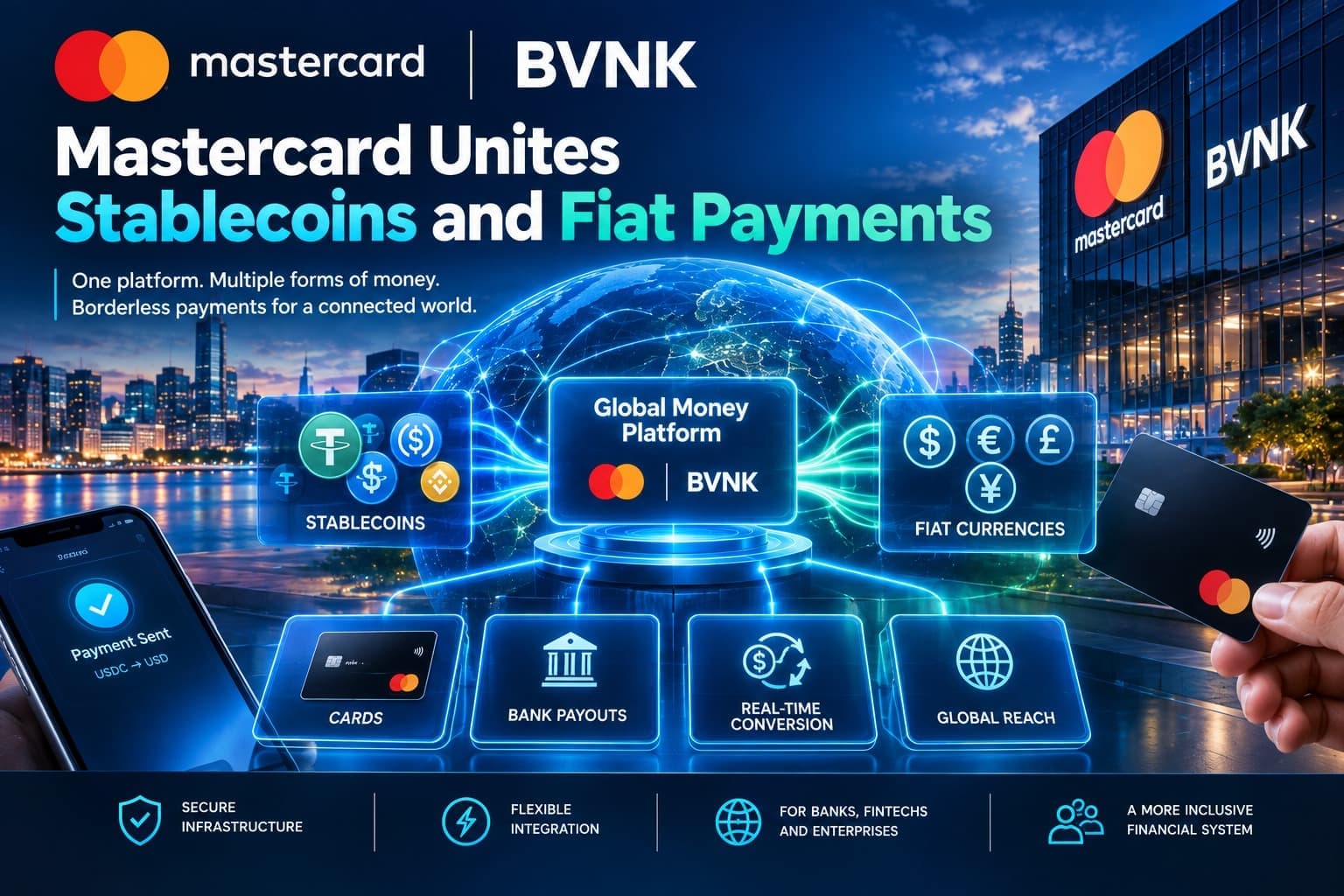
Mastercard and BVNK have launched a new global payments platform that allows banks, fintechs and enterprises to manage traditional currencies and stablecoins through a single infrastructure layer, marking one of Mastercard’s most significant moves yet to connect blockchain-based money with conventional finance.
Announced on October 15, Mastercard Global Money Platform combines Mastercard’s global payment infrastructure with BVNK’s stablecoin technology through a single API.
Businesses can use the platform to offer multi-currency accounts holding both fiat and stablecoins, convert between currencies in real time, issue stablecoin-linked cards and make local bank payouts through Mastercard Move.
The launch is the first major integration of Mastercard and BVNK since Mastercard completed its acquisition of the stablecoin infrastructure company in August.
 Fink: Data Center Moratorium Risks Recession→
 Ripple, Meritz Bring Tokenization to Korea→
 SEC Sets Compliance Seminar for Nov. 19→
 Ripple Expands Prime Brokerage With Brevan Howard→
Rather than building a separate crypto payment network, Mastercard is pursuing an interoperability strategy: allowing different forms of money to move between blockchain networks, bank accounts and its existing payment infrastructure.
One Account for Fiat and Stablecoins
At the center of the new platform is what Mastercard calls the “global money account.”
The account is designed to let fiat currencies and stablecoins exist side by side, with conversion between them available through a single API.
That architecture addresses a practical problem facing businesses operating internationally.
A company receiving payments in multiple currencies may currently need different bank accounts, payment providers, stablecoin infrastructure and pre-funded balances to pay suppliers or employees across markets. Each additional provider can introduce reconciliation requirements, liquidity fragmentation and operational complexity.
Mastercard Global Money Platform attempts to combine those functions into one modular system.
Banks and fintechs can embed the infrastructure into their own products under their own brands. Enterprises can also use it directly for treasury operations, collections, payments and settlement.
The platform is available now through BVNK.
Mastercard’s official announcement describes the system as a full-stack toolkit covering sending, receiving, converting, storing, spending and earning.
Stablecoins Can Move Into Local Bank Accounts
One of the most consequential features is the integration with Mastercard Move.
Mastercard says its money-movement network reaches more than 17 billion endpoints.
Through the new platform, a business can fund a transaction using a stablecoin balance while the recipient receives conventional currency directly into a local bank account.
That means the recipient does not necessarily need to understand blockchain technology, maintain a crypto wallet or manually convert stablecoins into fiat.
Mastercard expects this functionality to expand to more than 40 currencies across more than 200 countries and territories during 2027.
The model illustrates how stablecoin payments may increasingly operate behind the scenes.
A sender could use blockchain-based money while a recipient interacts only with a conventional bank account. The blockchain component becomes infrastructure rather than the product experienced by the end user.
That distinction could prove important for mainstream adoption.
Stablecoin Balances Can Also Be Spent by Card
The platform extends the same interoperability to cards.
Mastercard says customers will be able to spend stablecoin balances through its global acceptance network of hundreds of millions of merchant locations, while card issuance through the platform is available across more than 130 countries.
Again, merchants do not need to become crypto businesses simply because the source of funds may originate from a stablecoin balance.
This approach connects blockchain-based liquidity with existing payment acceptance infrastructure instead of requiring merchants to adopt a new network.
BVNK’s technical overview of Global Money Platform says customers can embed global money accounts, local payouts and card spending into their own products.
The company says the infrastructure supports custodial and self-custodial options and enables conversion between traditional and digital currencies.
Mastercard Is Betting on a “Multi-Money” Future
The launch reflects a broader strategic view inside Mastercard.
Raj Dhamodharan, Mastercard’s executive vice president for Blockchain and Digital Assets, said the company expects the future of commerce to depend on interoperability among different forms of money.
“We believe the future of commerce will be built on interoperability across multiple forms of money,” Dhamodharan said in the announcement.
That is an important distinction from the idea that stablecoins will simply replace conventional currencies or payment networks.
Mastercard’s model assumes coexistence.
Bank deposits, fiat currencies, stablecoins and eventually tokenized deposits may operate across different infrastructure while users expect value to move between them without needing to understand which underlying rail handles each stage of a transaction.
That is also why Mastercard acquired BVNK.
When the acquisition was completed in August, Mastercard Chief Product Officer Jorn Lambert said digital currencies were increasingly addressing practical use cases including cross-border B2B payments, remittances, payouts, settlement and treasury flows.
The company’s strategy is therefore focused less on cryptocurrency speculation and more on making blockchain-based money usable within established financial systems.
BVNK Provides the Stablecoin Infrastructure Layer
BVNK brings the onchain component of the system.
The company has built infrastructure connecting fiat and blockchain-based payments across more than 130 countries. Mastercard says BVNK processes billions of dollars annually.
Chris Harmse, BVNK co-founder and chief business officer, described Global Money Platform as infrastructure intended to support more than stablecoins alone.
“Global Money Platform will become the single infrastructure layer not just for stablecoins, but for every form of money,” Harmse said.
The ambition is substantial, but it should be separated from the platform’s current capabilities.
Today’s product brings together accounts, conversions, cards, stablecoin infrastructure and payouts. Future expansion will determine whether Mastercard can develop it into the broader financial operating layer the companies envision.
Nuvei and Marqeta Among the First Integrators
Mastercard already has customers preparing to use the platform.
Payments company Nuvei and card-issuing platform Marqeta are among the first announced integrators, alongside Ontop, Beem and Almond FinTech.
Nuvei CEO Phil Fayer said stablecoins are becoming an increasingly important component of global commerce.
“The future of global commerce depends on money moving as freely as the businesses and consumers it serves,” Fayer said.
For payment companies, one attraction is the ability to introduce digital-currency services without independently assembling the entire underlying infrastructure.
Instead of separately integrating wallets, stablecoin conversion, local payout providers and card issuance, a fintech can potentially access those capabilities through a single integration.
This does not eliminate compliance, regulatory or operational requirements. But reducing infrastructure fragmentation could lower one of the barriers to deploying blockchain-based financial services at scale.
Tokenized Deposits Are Already on the Roadmap
Mastercard’s plans extend beyond today’s stablecoin market.
The company says Global Money Platform is being designed to support additional regulated forms of money, including tokenized deposits.
Tokenized deposits differ structurally from stablecoins. They generally represent commercial bank deposit claims recorded using tokenization technology rather than privately issued digital tokens backed by reserve assets.
The inclusion of both models reinforces Mastercard’s “multi-money” thesis.
Instead of selecting one form of digital money as the winner, the company wants infrastructure capable of routing value between multiple systems.
The platform is also being prepared for agentic commerce, where AI agents may autonomously initiate transactions on behalf of consumers or businesses under predefined permissions.
That could eventually combine programmable money with machine-initiated commerce, although those capabilities remain a developing use case rather than the central feature of today’s launch.
Why Stablecoins Are Moving Into Mainstream Payments
The Mastercard-BVNK launch is part of a broader shift in how financial institutions view stablecoins.
Early stablecoin adoption was heavily concentrated in cryptocurrency trading. Their role has since expanded toward cross-border transfers, corporate treasury, merchant settlement and international payouts.
Mastercard said when announcing its BVNK acquisition that digital-currency payments for goods and services reached at least $350 billion in volume during 2025.
Stablecoins can be particularly useful when businesses need to move value internationally outside conventional banking windows.
But blockchain speed alone does not solve the entire payment problem.
Businesses still need regulated on-ramps and off-ramps, foreign-exchange conversion, bank connectivity, compliance systems and ways for recipients to actually spend the funds.
Global Money Platform is Mastercard’s attempt to connect those components.
The result is less a replacement for banking infrastructure than a bridge between banking and blockchain infrastructure.
The Real Opportunity May Be Working Capital
The implications extend beyond payment speed.
International businesses often maintain pre-funded balances across multiple countries to ensure they can make payments when needed. Capital sitting idle in those accounts cannot simultaneously be used elsewhere in the business.
Mastercard argues that integrating stablecoins, real-time conversion and local payouts could reduce some of that fragmentation.
If a company can hold liquidity centrally and move value closer to the moment a payment is required, it may be able to use working capital more efficiently.
That benefit will vary by jurisdiction, currency, settlement route and regulatory environment. Stablecoins do not automatically eliminate the need for liquidity management.
But treasury efficiency is increasingly one of the strongest institutional arguments for blockchain-based payments.
It also parallels developments elsewhere in tokenization, where major financial institutions are examining whether blockchain can make collateral and securities more portable.
CryptoQuorum recently examined how Nasdaq CEO Adena Friedman sees tokenization as a way to unlock capital, highlighting the broader institutional shift toward programmable financial infrastructure.
Stablecoins Are Becoming Financial Infrastructure
The most significant aspect of Mastercard Global Money Platform may be how little it requires end users to think about cryptocurrency.
A business can hold stablecoins.
A recipient can receive local fiat.
A customer can spend through a conventional Mastercard credential.
A fintech can offer the entire experience under its own brand.
The underlying infrastructure decides how value moves between the different forms of money.
That is a fundamentally different adoption model from asking consumers or businesses to abandon existing financial systems and migrate entirely onto blockchain networks.
Mastercard is instead inserting blockchain rails into infrastructure people already use.
If that model scales, the future of stablecoin payments may look less like a separate crypto economy and more like another settlement and liquidity layer inside global finance.
Disclaimer: This article is for informational purposes only and does not constitute investment, financial or legal advice. Stablecoins and digital-payment services involve regulatory, operational, counterparty and technology risks that vary across jurisdictions.