

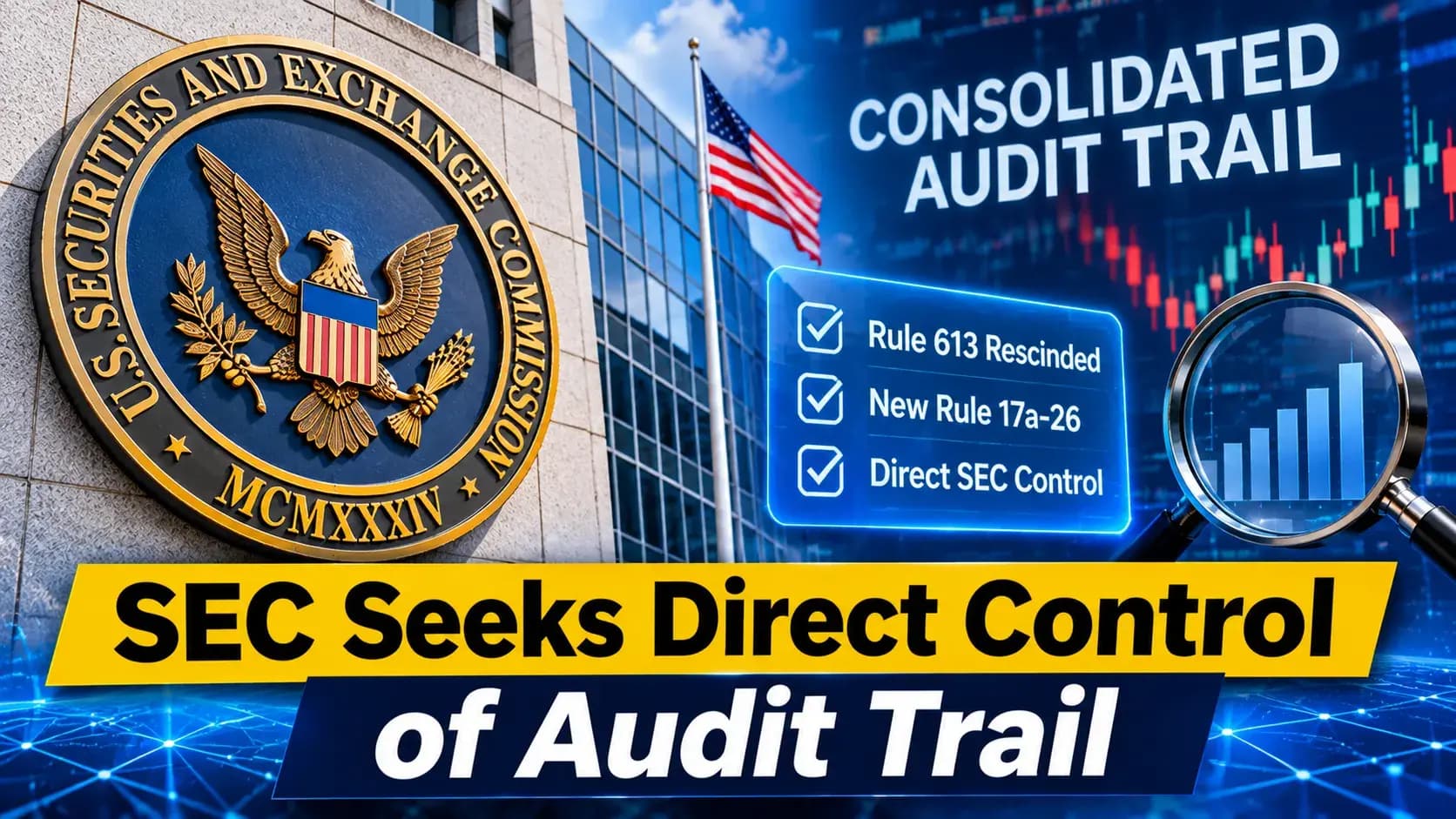
The U.S. Securities and Exchange Commission (SEC) has proposed a major restructuring of the Consolidated Audit Trail (CAT), seeking to bring the market-surveillance system under the agency’s direct control while changing how its operations are funded.
Announced on November 20, 2026, the proposal would rescind Rule 613 of Regulation National Market System (Regulation NMS) and introduce a new Rule 17a-26 under the Securities Exchange Act of 1934.
Under the proposed framework, national securities exchanges, national securities associations and broker-dealers would continue recording and electronically reporting substantially the same market information. The main difference is that they would report the data directly to the SEC or its designated operator rather than to a system administered independently by industry participants.
The initiative follows concerns about the CAT’s governance, operating costs and collection of sensitive investor information. It is part of SEC Chairman Paul Atkins’ broader effort to restructure the system while maintaining its role in securities-market oversight.
 Bitcoin Repeats SpaceX Pre-IPO Sell-Off Before Anthropic Debut→
 Tom Lee and Dan Morehead See Crypto’s Long-Term Potential→
 Fed Governor Waller Outlines the Future of Tokenized markets→
 CFTC Approves Backpack’s Blockchain-Based Derivatives Exchange in the U.S.→
The proposal has implications for the organization of U.S. financial-market infrastructure, although it does not directly change cryptocurrency trading rules or introduce new requirements for digital assets.
What Is the Consolidated Audit Trail?
The CAT is a market-surveillance infrastructure designed to help regulators reconstruct activity across U.S. securities markets.
It collects information about orders and transactions, including how orders are received, routed, modified, canceled and executed. This allows regulators to examine trading activity across different exchanges and market participants.
Before the system was introduced, regulators faced difficulties connecting fragmented trading records held by different market operators. A consolidated system was intended to make it easier to identify suspicious patterns and investigate potential violations of federal securities laws.
The CAT supports regulatory work involving potential insider trading, market manipulation and other forms of misconduct.
Its importance comes from its ability to connect information that might otherwise remain distributed across multiple exchanges and brokerage firms.
However, the scale of the system also created questions about who should manage it, how its expenses should be distributed and how much information it should collect.
These concerns have become central to the SEC’s latest proposal.
Why the SEC Wants to Take Direct Control
Under the existing framework, Rule 613 requires national securities exchanges and national securities associations to establish, implement and maintain the CAT through a national market system plan.
This decentralized structure distributes responsibilities among industry participants.
According to the SEC, the arrangement has created inefficiencies in governance, administration and funding. The agency argues that managing a complex, market-wide technology system through multiple participants can make decision-making more difficult.
The proposed restructuring would give the SEC direct authority over the system’s reporting framework and greater control over its operational requirements.
Chairman Paul Atkins said the agency’s review identified persistent concerns involving costs, governance and funding.
In his November 20 statement, Atkins said the system’s annual operating costs had grown to nearly $250 million, with expenses ultimately passed along to investors in one way or another.
He argued that the CAT should serve market oversight without imposing unnecessary costs or privacy risks on the investors it is intended to protect.
The SEC said earlier reforms had already reduced projected annual operating costs by more than $100 million and permanently eliminated the reporting of personally identifiable information to the system.
The new proposal is intended to build on those changes rather than eliminate the surveillance infrastructure altogether.
Rule 613 Would Be Replaced by Rule 17a-26
The most significant regulatory change involves replacing the current Rule 613 framework.
The SEC proposes to rescind Rule 613 and introduce Rule 17a-26 under the Securities Exchange Act of 1934.
The new rule would require exchanges, national securities associations and broker-dealers to record and electronically report substantially the same information currently required under the CAT framework.
The proposed difference concerns where that information is sent and who controls the system.
Under the existing arrangement, reporting takes place through an industry-administered CAT structure. Under the proposed model, the information would be reported to the SEC or its designated operator.
The agency says this would allow it to manage the system more efficiently while maintaining continuity in market surveillance.
Importantly, the proposal does not mean that exchanges and brokers would stop collecting and reporting trading information.
Instead, their reporting obligations would be reorganized around a new regulatory framework.
The SEC also anticipates coordinating the transition so that reporting obligations and regulatory access to CAT data continue without significant disruption.
Funding Changes Could Reduce Industry Disputes
Funding is another central part of the proposed restructuring.
The current system has faced disagreements over how operating expenses should be allocated among exchanges and other industry participants.
The SEC proposes using funds appropriated by Congress to pay the Commission’s costs associated with operating, maintaining and using the CAT system.
This would replace the current industry-centered funding structure with a model based on congressional appropriations.
According to the SEC, a more defined funding arrangement could reduce disputes among participants and encourage stronger cost discipline.
However, the proposed model also creates a different dependency: the system’s funding would be connected to the federal budget process.
Reuters reported that this raises questions about whether congressional funding interruptions, including government shutdowns, could affect the system’s operation.
The proposal therefore changes the nature of the funding risk rather than necessarily eliminating every potential source of disruption.
The final structure will depend on the rulemaking process and the operational arrangements established if the proposal is adopted.
Privacy Concerns Remain an Important Part of the Reform
The collection of sensitive investor information has been one of the most controversial aspects of the CAT.
A system designed to reconstruct trading activity requires extensive market data. However, collecting personally identifiable information creates additional privacy and cybersecurity considerations.
The SEC has already taken steps to eliminate the reporting of personally identifiable information to the CAT.
Atkins described this as an important part of the agency’s effort to make the system more efficient and reduce unnecessary risks.
The new proposal would retain the revised approach while restructuring the system’s governance.
This distinction is important: the SEC is not proposing to eliminate market surveillance or stop collecting information necessary for regulatory oversight.
Instead, it wants to preserve the core reporting function while changing how the information is administered and funded.
The broader regulatory challenge is balancing effective surveillance with data minimization, security and accountability.
What the Proposal Means for Crypto and Tokenized Securities
The proposal is primarily concerned with U.S. securities-market infrastructure rather than cryptocurrency exchanges or decentralized blockchain networks.
Bitcoin and other digital assets that are not securities do not automatically fall within the CAT reporting framework simply because they trade on digital-asset platforms.
However, the issue is relevant to the broader development of tokenized financial markets.
Tokenized securities represent traditional financial instruments through blockchain-based records. Depending on their legal structure and trading venue, they may remain subject to federal securities laws and applicable market-reporting requirements.
If tokenized securities are traded through regulated U.S. securities-market infrastructure, the reporting obligations applicable to those transactions will remain relevant.
The SEC’s proposed restructuring could therefore matter to the infrastructure supporting traditional and tokenized securities markets, even though it does not establish a new crypto-specific reporting regime.
For more context, see CryptoQuorum’s coverage of CFTC rules for tokenized collateral and its guide to asset tokenization and how it works.
The broader implication is that regulators are continuing to reconsider how market infrastructure should operate as financial products and trading technology evolve.
What Happens Next?
The SEC’s announcement on November 20 represents a proposal, not a final regulatory decision.
The rulemaking is identified as File No. S7-2026-40 and Release No. 34-106950.
The public comment period will remain open for 60 days after publication in the Federal Register.
During this period, exchanges, broker-dealers, investors, industry associations and other interested parties can submit feedback on the proposed framework.
The SEC will then consider the comments before deciding whether to adopt a final rule and whether changes are necessary.
Several issues are likely to attract particular attention:
- Whether direct SEC control will improve operational efficiency.
- How congressional appropriations will provide stable long-term funding.
- Whether the proposed structure can maintain uninterrupted reporting and regulatory access.
- How privacy protections and data-security requirements will be maintained.
- Whether the new framework will reduce costs for market participants and investors.
The outcome will determine how responsibility for one of the most important U.S. securities-market surveillance systems is distributed.
A Governance Overhaul, Not the End of Market Surveillance
The SEC’s proposal represents a significant change in the governance and funding of U.S. securities-market infrastructure.
By replacing Rule 613 with Rule 17a-26, the agency wants to move away from an industry-administered model and assume direct responsibility for the system’s operation and oversight.
The regulator’s stated objectives are to improve accountability, reduce unnecessary costs and preserve the CAT’s ability to support enforcement of federal securities laws.
For investors, the key question is whether the proposed changes can deliver more efficient market oversight without creating new operational or funding vulnerabilities.
For the cryptocurrency industry, the development is relevant mainly through the future of regulated securities and tokenized financial products.
The proposal does not introduce a new crypto surveillance system. Instead, it illustrates how U.S. regulators are adapting existing financial-market infrastructure to changing technology and governance requirements.
The next major milestone will be the conclusion of the public comment period and the SEC’s decision on whether to move forward with a final rule.