

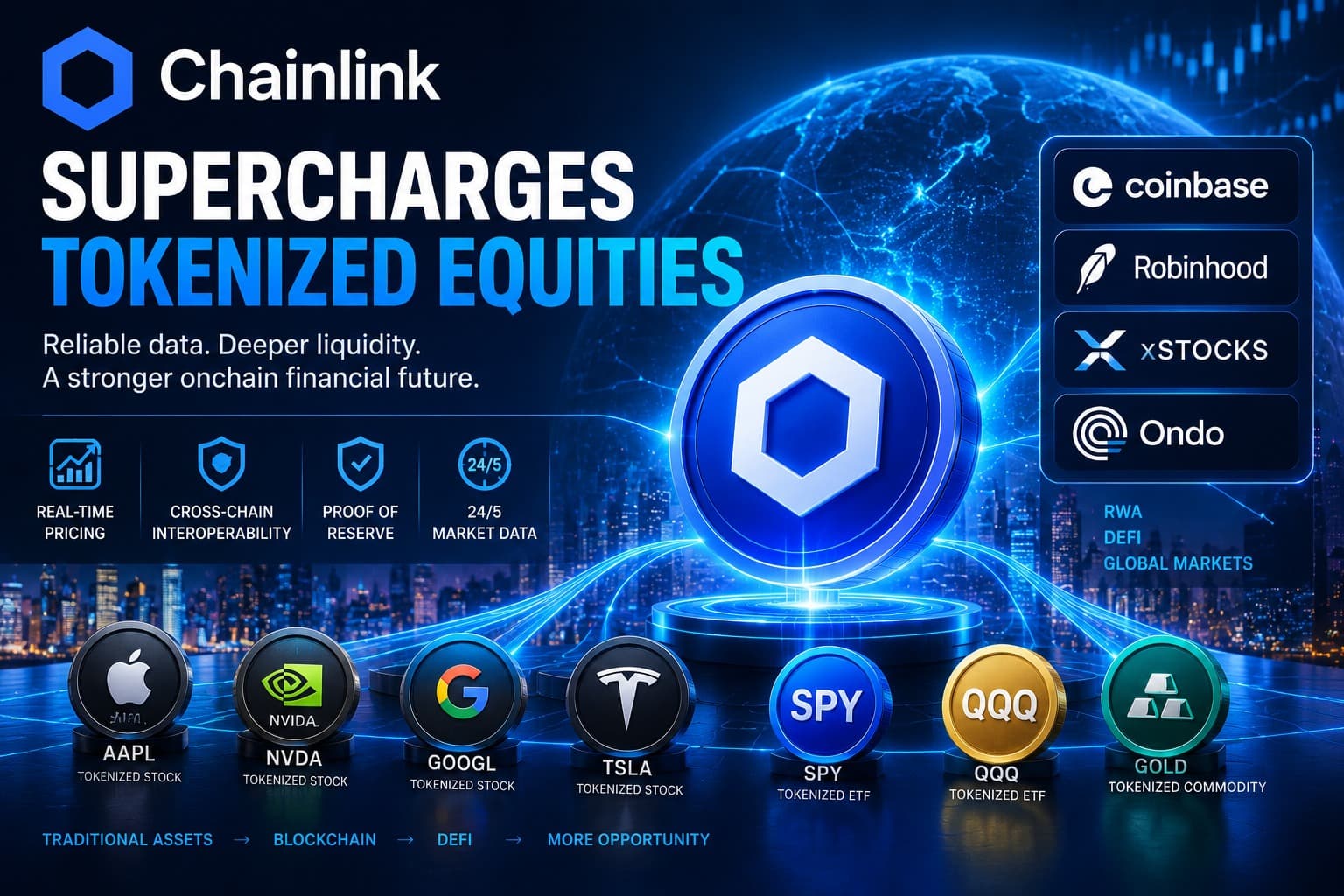
Chainlink is positioning its infrastructure at the center of a rapidly developing market: bringing traditional stocks and exchange-traded funds onto blockchain networks and making those assets usable inside decentralized finance.
In an August 26 update, Chainlink highlighted four major platforms — Coinbase, Robinhood, xStocks and Ondo — as examples of how its oracle, data and interoperability infrastructure is being used to expand the distribution and utility of blockchain-based equities.
CRYPTOCAP:TOTALDEFI Real-Time Chart
The significance goes beyond simply putting a stock on a blockchain.
A token representing Apple, Nvidia or another publicly traded company becomes substantially more useful when smart contracts can reliably access its price, recognize market conditions, value it as collateral and move it between supported blockchain networks.
 XRP Asia Officially Launches in Seoul to Accelerate XRP Ledger Adoption Across the Asia-Pacific Region→
 CFTC Clarifies Tokenized Collateral Rules and On-Chain Recordkeeping→
 Chainlink Bridges Traditional Capital Markets and Decentralized Finance Through Secure Oracle Infrastructure→
 How CFOs Are Transforming Corporate Treasury With Digital Assets, XRP, and RLUSD→
That infrastructure layer is where Chainlink is increasingly competing for a central role.
Why tokenized stocks need more than a blockchain
Traditional equity markets already have sophisticated systems for pricing, settlement, custody and corporate actions.
Blockchain-based markets introduce a different environment. Smart contracts operate continuously, while traditional stock exchanges have defined trading sessions. Tokenized assets can also move between applications and blockchain networks, creating additional requirements for reliable data and interoperability.
This creates a fundamental problem.
A smart contract cannot independently know the current price of Nvidia stock.
It needs an external data source.
Chainlink Data Feeds and Data Streams are designed to provide that connection between traditional market information and blockchain applications.
Chainlink‘s Data Streams for U.S. equities and ETFs provide high-frequency market data together with contextual information such as market status and staleness indicators. The infrastructure is designed to help applications distinguish a fresh market price from information that may no longer be appropriate for execution or risk calculations.
That distinction becomes particularly important as financial applications move toward 24/7 blockchain markets.
The tokenized-equity market is already growing
The underlying market is no longer theoretical.
RWA.xyz data cited by several market researchers showed distributed tokenized-stock value approaching $2 billion by late July 2026, with the broader category growing rapidly during the year. One July 22 snapshot reported approximately $1.94 billion of distributed value, $7.9 billion in monthly transfer volume and more than 683,000 holders.
Other reporting placed the market capitalization of tokenized stocks around $2.3 billion in mid-July.
The numbers differ because market-capitalization and distributed-value methodologies are not identical. That is an important distinction when evaluating the sector.
Nevertheless, the direction is clear: tokenized equities have moved from a niche experiment toward a measurable segment of the onchain asset market.
The challenge now is turning that growth into usable financial infrastructure.
Coinbase: tokenized stocks become DeFi building blocks
Coinbase is one of the clearest examples.
On August 24, Coinbase selected Chainlink as the official oracle infrastructure for its newly launched Tokenized Stocks on Base. Chainlink Data Feeds provide continuous pricing for assets including NVDAc, METAc, AAPLc and GOOGLc.
According to Coinbase and Chainlink, the tokens are real equity securities issued as B20 tokens on Base and backed 1:1 by underlying shares held in regulated custody through Alpaca under the Abu Dhabi Global Market framework.
The important development is what happens after issuance.
With reliable price data available onchain, these assets can potentially be integrated into:
- decentralized lending markets;
- decentralized exchanges;
- structured products;
- collateral systems;
- automated trading strategies.
Coinbase describes its tokenization strategy as allowing users to trade, lend and borrow stocks 24/7 across the Base ecosystem.
That is a significant shift in the role of a tokenized stock.
Instead of being merely a digital representation of an investment, it can become a programmable component of a financial application.
Robinhood: Chainlink is embedded into the network
Robinhood has taken a similar approach, but at the blockchain infrastructure level.
When Robinhood Chain launched its mainnet in July, it adopted Chainlink as its official data and cross-chain oracle infrastructure. Chainlink Data Feeds, Data Streams and CCIP were available from the beginning to support Robinhood’s tokenized real-world assets and cross-chain functionality.
Robinhood’s own documentation provides an important technical detail: its Stock Tokens have live Chainlink price feeds that smart contracts can read directly onchain.
The company describes these Stock Tokens as tokenized debt securities issued by Robinhood Assets (Jersey) Limited that provide economic exposure to underlying shares and ETFs.
That legal structure is important.
A tokenized stock is not necessarily legally identical to directly owning the underlying share.
The economic exposure, ownership rights, custody arrangements and redemption mechanisms depend on the specific product.
For CryptoQuorum readers, this distinction is particularly important when comparing different tokenization platforms.
xStocks: pricing, interoperability and DeFi
xStocks represents another major component of the ecosystem.
Backed, the company behind xStocks, says the platform now offers more than 100 tokenized stocks and ETFs, with the products backed 1:1 by their underlying securities.
Chainlink joined the xStocks Alliance as its official oracle infrastructure provider.
The integration goes beyond a basic price feed.
Chainlink developed a dedicated xStocks data solution designed to provide high-accuracy onchain pricing, sub-second latency and information needed to account for corporate actions. xStocks also adopted Chainlink’s CCIP interoperability infrastructure and Proof of Reserve technology.
This combination is significant because a large tokenized-equity ecosystem needs more than price information.
It needs a way to answer three separate questions:
What is the asset worth?
Is the underlying asset properly backed?
Can the token move securely between blockchain networks?
Chainlink is attempting to provide infrastructure for all three.
Ondo: tokenized equities enter DeFi collateral markets
Ondo provides perhaps the strongest example of how oracle infrastructure can transform tokenized stocks from passive assets into productive capital.
Ondo selected Chainlink as the official oracle infrastructure for its regulated tokenized-stocks platform. Chainlink also became the preferred interoperability solution for financial institutions working with Ondo.
In February, Ondo announced that Chainlink Data Feeds for assets including SPYon, QQQon and TSLAon had gone live in production, enabling DeFi protocols such as Euler to use tokenized equities as collateral.
This is an important milestone.
In traditional finance, equities can be used as collateral for loans and other financial transactions.
For tokenized equities to achieve similar utility onchain, DeFi protocols need reliable valuation data and sufficiently deep liquidity.
Ondo’s integration with Chainlink addresses one part of that infrastructure problem.
The result is a pathway from:
Tokenization → pricing → collateral → lending → broader DeFi utility
Expert opinions: the oracle becomes part of the market structure
The strategic importance of this development is reflected in comments from industry participants.
Ondo CEO Nathan Allman has described Chainlink’s integration as a way to make tokenized assets more composable across DeFi and institutional financial rails.
Chainlink has similarly argued that tokenized equities require more context than a simple price feed.
Its Data Streams infrastructure includes market-status information, timestamps, staleness detection and features designed to support trading halts and other real-world market events.
This matters because blockchain markets do not automatically inherit the rules of traditional exchanges.
Suppose a U.S. exchange halts trading in a stock.
A smart contract operating on a blockchain does not inherently know that the market has stopped.
Without appropriate data and risk controls, an onchain application could potentially continue executing against stale information.
For lending markets, that can become particularly dangerous because incorrect prices can lead to inappropriate liquidations.
Why Chainlink’s 24/5 equity data matters
Chainlink expanded its equity infrastructure in January 2026 with 24/5 U.S. Equities Streams.
The service provides data across regular, after-hours and overnight sessions and is designed to support applications that operate outside conventional exchange hours. Chainlink says the feeds are available across more than 40 blockchains.
The technical architecture provides more than a single mid-market price.
It can include:
- bid and ask prices;
- last trade prices;
- trading volume;
- market-status flags;
- timestamps;
- staleness indicators.
This is important for the next generation of financial applications.
A DeFi protocol needs to know not only what an asset is worth, but also whether the price is current and whether the underlying market is open or experiencing an abnormal event.
That is the difference between simply importing financial data and building financial infrastructure.
Chainlink is building a wider tokenization stack
The four platforms highlighted by Chainlink reveal a broader strategy.
| Platform | Chainlink role | Potential utility |
|---|---|---|
| Coinbase | Data Feeds | Trading, lending and collateral on Base |
| Robinhood Chain | Data Feeds, Data Streams, CCIP | Tokenized assets and cross-chain applications |
| xStocks | Oracle infrastructure, Data Streams, CCIP, Proof of Reserve | Pricing, interoperability and DeFi |
| Ondo | Official oracle infrastructure and CCIP | Tokenized equities, lending and institutional markets |
The common denominator is composability.
The objective is not simply to make stocks available as blockchain tokens.
It is to make them usable by other smart contracts.
That could eventually allow a tokenized equity to move through an ecosystem of decentralized exchanges, lending markets, derivatives platforms, structured products and automated strategies.
Chainlink’s broader tokenization infrastructure also includes its Cross-Chain Interoperability Protocol, Proof of Reserve, NAV data and Chainlink Runtime Environment. The company has been expanding these components as institutions move more financial assets onchain.
The biggest limitation: tokenization is not the same as ownership
There is a critical caveat.
The term tokenized stock describes a broad category of products with different legal and economic structures.
Chainlink’s own educational material distinguishes between natively issued tokens, wrapped or custodial representations and synthetic assets. These structures can provide very different rights to investors.
Robinhood’s documentation, for example, explicitly states that its Stock Tokens provide economic exposure but do not give holders legal or beneficial rights in the underlying securities.
By contrast, Coinbase says its Tokenized Stocks are real equity securities backed 1:1 by underlying shares, with the product structure operating under its applicable regulatory framework.
Therefore, investors should examine the specific issuer, legal structure, jurisdiction, custody arrangement and redemption rights rather than assuming every tokenized equity represents identical ownership.
Why this matters for DeFi
The most important development may not be the number of tokenized stocks available.
It is what those assets can do once they become reliable onchain primitives.
Consider a hypothetical DeFi ecosystem in which tokenized Nvidia shares can be:
- held in a self-custody wallet;
- priced by a decentralized oracle;
- deposited as collateral;
- used to borrow stablecoins;
- transferred across supported networks;
- traded on a decentralized exchange;
- incorporated into an automated portfolio strategy.
That is fundamentally different from simply holding a digital certificate that tracks a stock price.
This is why Chainlink’s role matters.
Data and interoperability are becoming part of the financial product itself.
The market is growing — but remains small compared with traditional equities
The growth should also be kept in perspective.
Even after reaching multi-billion-dollar valuations, tokenized stocks remain tiny relative to the conventional equity markets they represent.
CoinGecko’s 2026 RWA report found that tokenized-stock trading volume had accelerated significantly, but the trading activity of leading tokenized equities remained less than 1% of the corresponding traditional-market volume.
That means the sector has substantial room to grow, but adoption is not guaranteed.
Regulation, investor eligibility, liquidity, custody, interoperability and legal recognition of tokenized securities remain important variables.
The infrastructure may be advancing faster than the market itself.
What comes next for tokenized equities?
The next stage will be measured by utility rather than issuance alone.
Investors and developers should watch:
- tokenized-stock trading volume;
- DeFi lending activity;
- collateral utilization;
- cross-chain transfers;
- oracle adoption;
- institutional participation;
- regulatory developments;
- liquidity during volatile markets.
If tokenized stocks can become widely accepted collateral and composable financial primitives, their economic significance could expand considerably.
Chainlink is positioning itself as one of the infrastructure providers responsible for making that transition possible.
Coinbase brings distribution and access to Base.
Robinhood brings a large consumer-facing financial ecosystem and its own blockchain.
xStocks brings a broad catalog of tokenized equities and ETFs.
Ondo brings regulated tokenization and institutional-market ambitions.
Chainlink sits underneath these developments as a data and interoperability layer.
The bigger picture
The tokenization story is entering a new phase.
The first question was:
Can traditional assets be represented onchain?
The next question is:
Can those assets actually function inside a global, programmable financial system?
The answer will depend on reliable pricing, liquidity, legal structures, custody, interoperability and risk management.
Chainlink’s growing presence across Coinbase, Robinhood, xStocks and Ondo suggests that the infrastructure race is already underway.
The winners of the tokenization era may not simply be the platforms that issue the most assets.
They may be the networks and infrastructure providers that make those assets trusted, liquid, interoperable and useful across the onchain economy.
CRYPTOCAP:TOTALDEFI Real-Time Chart
Disclaimer: This article is for informational and educational purposes only and does not constitute investment, financial, legal or tax advice. Tokenized securities, equities, ETFs, cryptocurrencies and DeFi applications involve significant risks, including market volatility, liquidity risk, smart-contract risk, oracle risk, custody risk and regulatory restrictions. The legal and economic rights attached to a tokenized asset can differ substantially from direct ownership of the underlying security. Readers should review the specific issuer’s legal documentation and conduct independent research before making financial decisions.