

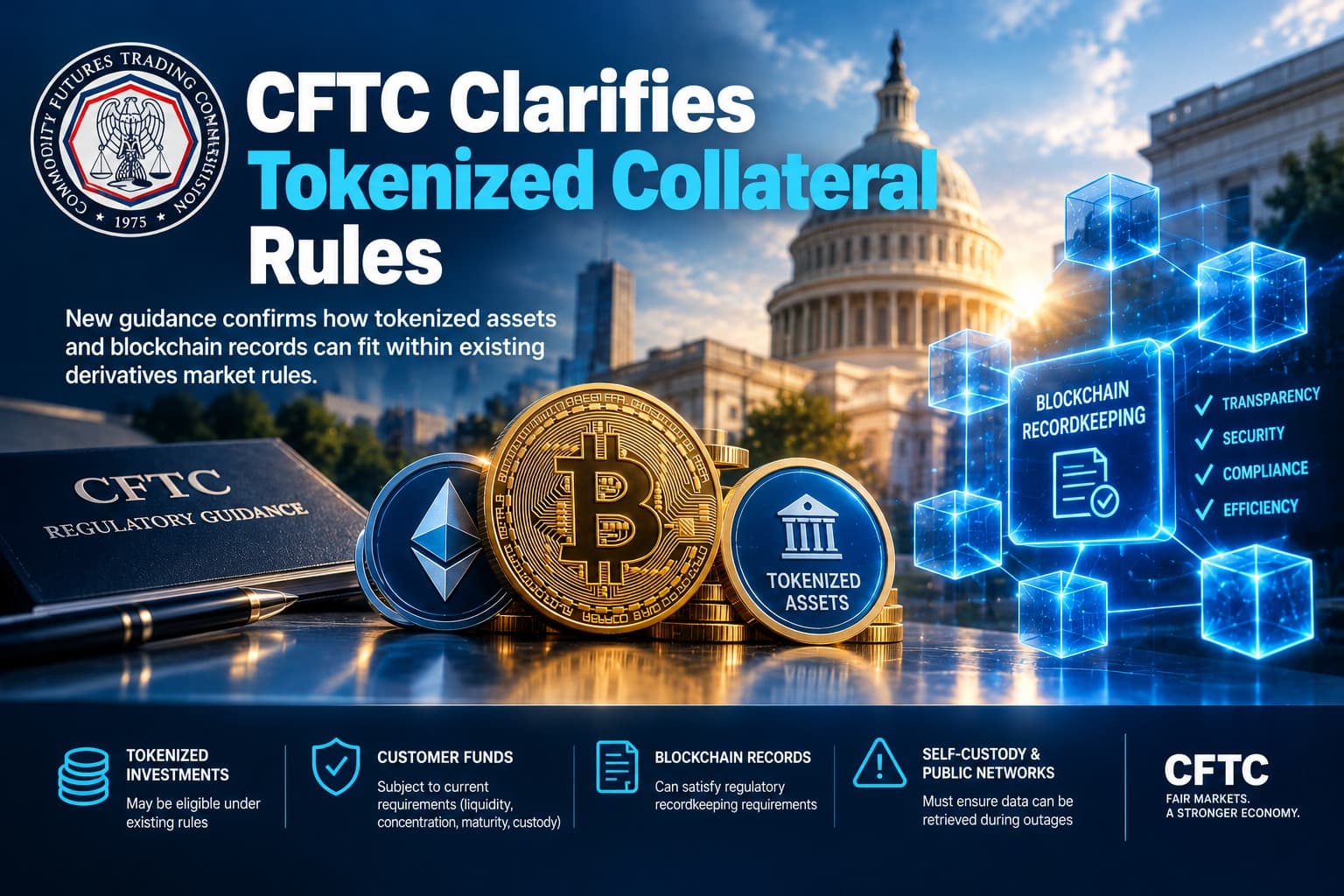
The U.S. Commodity Futures Trading Commission is giving regulated derivatives firms clearer guidance on how blockchain-based assets and records can fit within existing rules. An update published September 24, 2026, addresses two practical questions: whether customer funds may be invested in tokenized versions of already-permitted investments, and whether blockchain or distributed-ledger technology can satisfy regulatory recordkeeping obligations.
The update was issued jointly by the CFTC’s Market Participants Division, Division of Market Oversight and Division of Clearing and Risk. It follows the agency’s March 2026 crypto and blockchain FAQ and builds on Staff Letter 25-39, the December 2025 Tokenized Collateral Guidance, and Staff Letter 26-05 concerning certain digital assets accepted as margin collateral.
The significance is less about creating a new asset class than about applying existing derivatives-market rules to a different technological representation of an asset.
What changed on September 24?
The CFTC’s official announcement is deliberately concise. It says the updated FAQs address investments of customer funds in tokenized forms of permitted investments and the use of blockchain technology to satisfy a registrant’s recordkeeping requirements.
 Ripple, Meritz Bring Tokenization to Korea→
 IMF Sees Global Growth at 3.1% in 2026 as AI Boom Offsets Energy Shock→
 Morgan Stanley Sees $10T Tokenized Asset Market→
 Nasdaq CEO: Tokenization Could Unlock Billions→
Secondary reporting on the updated FAQ identifies four new questions, Q12 through Q15, and a revision to Q5. Q12 concerns investments of customer funds in tokenized versions of permitted investments, while Q13 through Q15 address blockchain-based recordkeeping.
That distinction is worth preserving because the press release itself does not reproduce the full text of those new answers.
The practical message, however, is clear: CFTC staff is increasingly addressing blockchain as a potential technology layer for conventional regulated activities, rather than automatically treating the use of a distributed ledger as a separate regulatory category.
Tokenization does not change the underlying asset by itself
The foundation for the new clarification was established in CFTC Staff Letter 25-39, issued in December 2025.
That guidance defines a tokenized asset as a digital representation of a real-world asset recorded on a blockchain. Examples include U.S. Treasury or agency securities, corporate bonds, money-market-fund shares and equity securities.
The key principle in that guidance was that tokenization does not necessarily change the fundamental characteristics of the underlying asset.
But the legal details matter.
CFTC staff said market participants must analyze whether a tokenized asset gives the holder legal and economic rights that are the same as or functionally equivalent to those associated with the traditional asset.
That principle now extends into the customer-funds context through the updated FAQ.
A company cannot simply take an asset that qualifies under existing rules, create a blockchain token and assume the token automatically qualifies.
The token itself must satisfy the relevant legal, custody and risk requirements.
Customer funds can potentially use tokenized permitted investments
The most important new clarification concerns Regulation 1.25, which governs permitted investments of customer funds held by futures commission merchants and derivatives clearing organizations.
According to reporting on the updated FAQ, CFTC staff says an FCM or DCO may invest customer funds in a tokenized form of an asset that already qualifies under Regulation 1.25, provided several conditions are satisfied.
The key conditions include:
| Requirement | What it means |
|---|---|
| Underlying asset eligibility | The traditional investment must already qualify under Regulation 1.25 |
| Equivalent rights | The token must provide the same or functionally equivalent legal and economic rights |
| Existing investment rules | Liquidity, concentration, maturity and instrument requirements remain applicable |
| Custody | The tokenized investment must be held with an acceptable depository or custodian |
| Risk controls | Existing regulatory and internal risk-management requirements continue to apply |
Source: CFTC staff guidance and reporting on the September 24, 2026 FAQ update.
This is a significant boundary.
The CFTC is not saying that any tokenized asset can be used for customer funds. It is saying that tokenization itself does not automatically disqualify an otherwise permitted investment, provided the existing safeguards continue to be met.
Payment stablecoins remain a separate issue
The new clarification should not be interpreted as a blanket approval for customer funds to be invested in stablecoins.
The March CFTC FAQ states explicitly that Staff Letter 26-05 does not change Regulation 1.25’s list of permitted investments, and an FCM may not invest customer funds in payment stablecoins under that no-action position.
The distinction is important:
Tokenized permitted investment ≠ payment stablecoin automatically becoming a permitted investment.
The September update addresses the form in which an otherwise permitted investment can be held. It does not eliminate the underlying eligibility test.
That prevents the latest development from being misread as a wholesale expansion of the permitted-investments list.
The same legal principle applies to margin collateral
The CFTC’s December 2025 Tokenized Collateral Guidance already stated that blockchain-based versions of eligible collateral could retain their eligibility when legal enforceability, custody, segregation and risk-management requirements are satisfied.
The guidance also said haircuts for tokenized assets can generally use the same risk-based framework applied to the underlying asset, adjusted for differences in settlement time or credit, market and liquidity risk.
For derivatives markets, that creates a relatively simple regulatory concept:
The blockchain representation may change; the risk standard does not.
That approach is consistent with the CFTC’s broader emphasis on technology neutrality.
A tokenized Treasury, for example, would still have to meet the applicable requirements for the underlying Treasury exposure. The fact that ownership is represented on a distributed ledger does not by itself remove liquidity, custody or valuation obligations.
Blockchain records can now serve a regulatory function
The second major development concerns recordkeeping.
According to reporting on Q13 and Q14 of the updated FAQ, CFTC staff considers the relevant recordkeeping frameworks under Regulations 1.31 and 45.2 to be technology neutral. This means covered entities can create and maintain certain required records directly on a blockchain or distributed ledger as long as all substantive regulatory requirements are satisfied.
That could have substantial operational consequences.
Traditional financial firms often maintain multiple databases and reconciliation systems because regulatory records must be preserved, authenticated and made available for examination.
If an on-chain record itself can satisfy the applicable requirements, firms may be able to reduce some duplication between blockchain infrastructure and legacy recordkeeping systems.
But the CFTC is not lowering the standard for the record.
The technology has to support the same regulatory objectives.
A public blockchain still needs an emergency-access plan
The most important qualification is contained in the reported Q15.
The updated guidance indicates that staff would not object solely because a covered entity chooses not to maintain an off-chain version of a required record. That does not mean the firm can simply rely on a blockchain and ignore operational resilience.
For public, permissionless networks, firms must retain the capability to retrieve and produce required records even if the network or an associated block explorer experiences an outage or disruption.
This creates an important compliance principle:
On-chain storage can replace duplication, but it cannot replace recoverability.
A regulated institution must still demonstrate that records are authentic, reliable, accessible and capable of being produced to regulators.
That shifts some compliance attention from “Where is the backup database?” toward “Can the firm prove it can recover and produce the authoritative record under adverse conditions?”
Expert opinions: CFTC is extending existing rules rather than creating a crypto-only regime
CFTC Chairman Michael S. Selig welcomed the FAQ update, saying the staff action was consistent with the agency’s efforts to provide greater regulatory clarity for the crypto industry.
The structure of the guidance is also consistent with the approach the CFTC took in its 2025 Tokenized Collateral Guidance.
That earlier document emphasized that CFTC regulations generally do not require a particular technology or operational infrastructure for transferring or holding eligible collateral. Instead, the focus is on legal enforceability, custody, segregation, valuation and risk management.
Independent reporting on the September update has highlighted the same practical distinction: the CFTC is allowing the technology to change without removing the compliance obligations attached to the underlying financial activity.
This is arguably the central feature of the development.
The CFTC is not establishing a special “blockchain exemption” from derivatives regulation.
It is clarifying how existing rules can operate when assets and records are represented on distributed ledgers.
Why on-chain recordkeeping could matter to derivatives markets
Recordkeeping is not merely an administrative requirement.
Derivatives regulators depend on accurate records for trade reconstruction, surveillance, compliance examinations and enforcement.
Blockchain systems can provide timestamped and tamper-evident transaction histories, potentially making some aspects of auditability easier.
The challenge is that not every record is purely transactional.
A regulated entity may still need information about counterparties, approvals, communications, valuation methodologies or events that do not naturally exist on-chain.
The updated FAQ therefore should not be interpreted as saying that every regulatory record must now be placed on a blockchain.
Instead, the guidance provides a pathway for blockchain technology to satisfy requirements where the underlying rule and the firm’s implementation support that result.
That makes the distinction between an on-chain transaction record and the full compliance record particularly important.
Interoperability remains an unresolved issue
The CFTC’s December guidance identified interoperability as a significant factor in tokenized collateral because the ability to move assets between systems affects liquidity, collateral management and operational risk.
That issue becomes even more relevant if tokenized permitted investments begin appearing across multiple networks.
A Treasury token on one blockchain may not be immediately interchangeable with another representation on a different blockchain.
For regulated firms, this can create new questions around custody, settlement finality, transfer restrictions and reconciliation.
The CFTC’s current approach does not solve interoperability.
Instead, it makes clear that distributed-ledger technology can be considered within existing regulatory frameworks while firms continue addressing those infrastructure questions.
The development fits a broader U.S. tokenization trend
The CFTC update arrives alongside a broader move by U.S. regulators and financial-market infrastructure providers toward tokenized assets.
The SEC has established a temporary framework for certain tokenized NMS stock trading, while DTCC is preparing its Tokenization Service for institutional securities infrastructure.
CryptoQuorum recently covered the SEC’s five-year framework for tokenized NMS stock and DTCC’s planned tokenization service.
The CFTC’s role is different.
Its focus is on derivatives markets, collateral, customer funds and regulatory records.
Together, the developments show tokenization progressing through different layers of financial infrastructure:
custody → collateral → trading → settlement → recordkeeping.
The regulatory framework is evolving at each layer rather than through one single comprehensive tokenization rule.
What this means for institutional adoption
The immediate effect may be most relevant for FCMs, DCOs, swap entities and other registered market participants rather than retail crypto users.
For these firms, the ability to use tokenized representations without automatically creating a new regulatory problem could reduce uncertainty when evaluating blockchain infrastructure.
Potential applications include:
- tokenized Treasury and money-market investments;
- blockchain-based collateral management;
- on-chain regulatory records;
- automated reconciliation;
- programmable settlement;
- digital custody infrastructure.
The economic benefit will depend on actual implementation.
Tokenization may improve transfer speed, automation or transparency in some workflows, but it can also introduce smart-contract, cybersecurity, network and operational risks.
The CFTC’s guidance essentially leaves firms with the responsibility to demonstrate that those risks are controlled.
The FAQ is guidance, not a new binding rule
This point is especially important for accurate reporting.
The March FAQ states that the document represents the views of CFTC divisions and does not create new enforceable rights, new binding rules or amendments to existing regulations. It also says the views do not necessarily represent the Commission or other CFTC divisions.
The September update is therefore best characterized as staff clarification of how existing rules can apply to blockchain-based structures.
That is different from the CFTC formally amending Regulation 1.25, Regulation 1.31 or Regulation 45.2.
For firms planning major infrastructure deployments, the distinction matters because a staff FAQ does not have the same legal status as a Commission rulemaking.
What to watch next
The next test will be actual implementation.
First, whether FCMs and DCOs begin using tokenized versions of permitted investments in production.
Second, whether regulated entities deploy blockchain-based recordkeeping without maintaining parallel off-chain databases.
Third, how regulators respond to real-world failures, network disruptions and cybersecurity incidents.
Fourth, whether different tokenization platforms develop compatible standards.
Fifth, whether the CFTC eventually converts parts of its staff guidance into formal regulations.
The answers will determine whether tokenization becomes a routine component of derivatives infrastructure or remains concentrated in specialized institutional pilots.
Bottom line
The CFTC’s September 24 update represents another step toward integrating blockchain technology into regulated derivatives markets.
The core clarification is that tokenization does not automatically change the regulatory treatment of an eligible underlying investment. Where an investment already qualifies, its tokenized form can potentially be used under the same framework when it preserves equivalent legal and economic rights and satisfies the existing liquidity, custody, concentration, maturity and risk requirements.
The agency also indicated that certain required records can be maintained directly on blockchain infrastructure, without an off-chain duplicate being required merely because the record is on-chain. But firms still have to ensure records remain authentic, reliable, retrievable and available for regulatory inspection, including when public networks or block explorers experience disruptions.
The development is therefore not a blanket crypto exemption.
It is a technology-neutral clarification of existing financial-market rules.
For institutional digital-asset infrastructure, that distinction may be more important than the headline itself. As tokenized Treasuries, funds, collateral and securities move closer to traditional financial markets, regulators increasingly have to answer a practical question: not whether blockchain can be used, but how existing investor-protection, custody, liquidity and recordkeeping standards apply when blockchain becomes part of the infrastructure.
Disclaimer
This article is provided for informational and educational purposes only and does not constitute financial, legal, regulatory, investment, trading or other professional advice. The September 24, 2026 CFTC FAQ update represents staff views and does not create new binding rules or enforceable rights. The availability of tokenized investments or blockchain-based recordkeeping depends on the specific asset, entity, custody structure, applicable regulation and compliance controls. Readers and institutions should review the official CFTC materials and obtain qualified professional advice before acting on the information presented here.