

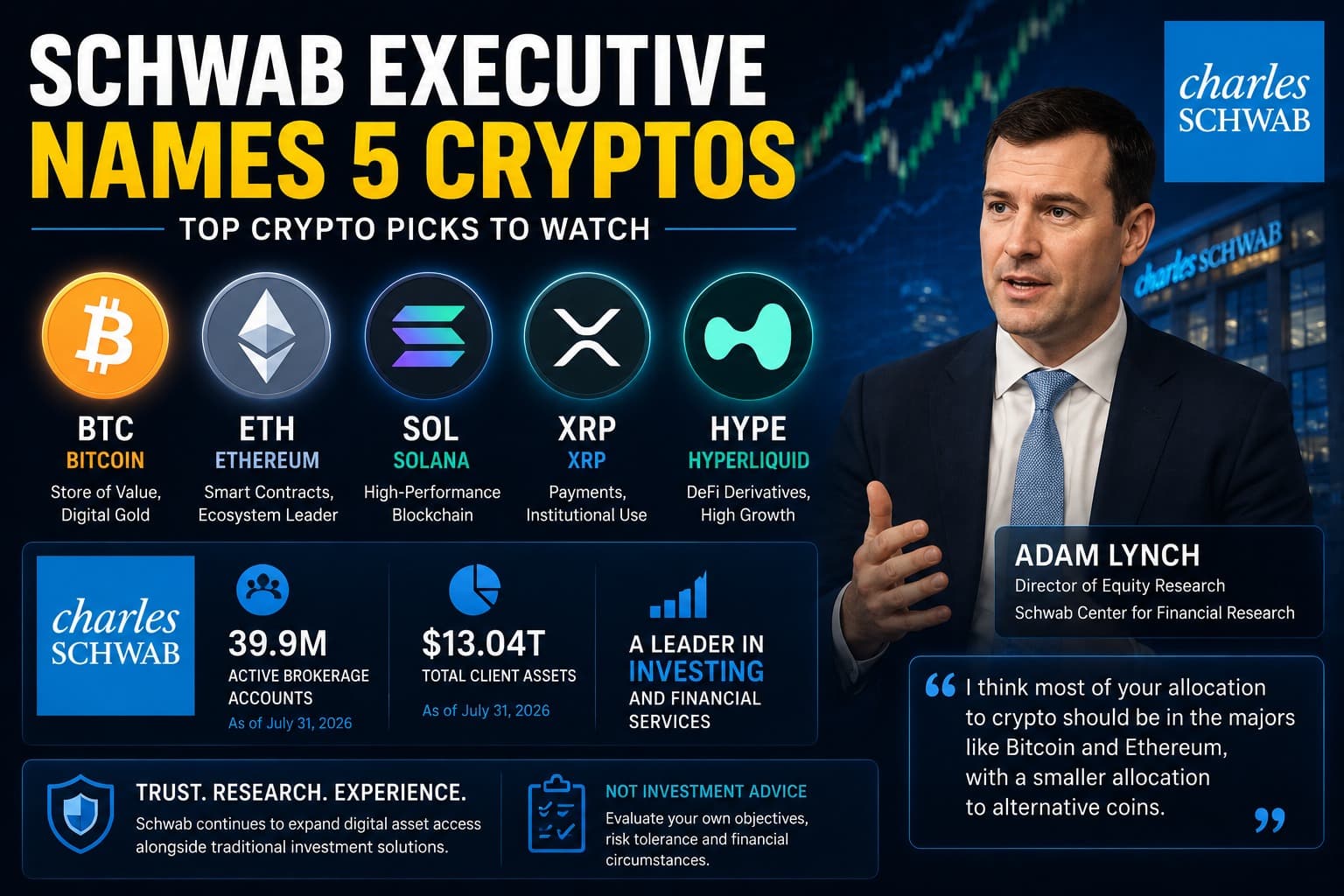
A senior Charles Schwab research executive has highlighted five digital assets he is watching as cryptocurrency becomes increasingly integrated into traditional investment markets.
The list includes Bitcoin (BTC), Ethereum (ETH), Solana (SOL), XRP and Hyperliquid (HYPE).
The comments came from Adam Lynch, Director of Equity Research at the Schwab Center for Financial Research, during a recent interview. Lynch is responsible for a team supporting Schwab Equity Ratings and other research products. Schwab’s official profile confirms his role and background in quantitative portfolio management.
The list is notable because it combines the two largest established crypto assets with three networks or tokens representing different parts of the digital-asset market.
 SEC Proposes Expanding Cross-Trading for Funds→
 XRP Asia Officially Launches in Seoul to Accelerate XRP Ledger Adoption Across the Asia-Pacific Region→
 SEC Proposes New Crypto Custody Rules→
 Why Crypto Rallied After Clarity Act Failed→
However, there is an important distinction for investors: this should not be interpreted as an official Charles Schwab investment recommendation or a formal Schwab crypto portfolio.
Lynch was discussing how investors might think about different crypto assets and their risk characteristics.
That distinction matters, particularly because Schwab itself emphasizes that cryptocurrency exposure should be evaluated according to an investor’s objectives, risk tolerance and financial circumstances.
The five assets on Lynch’s radar
| Asset | Ticker | Role in Lynch’s discussion |
|---|---|---|
| Bitcoin | BTC | Store-of-value / major crypto asset |
| Ethereum | ETH | Functionality and blockchain utility |
| Solana | SOL | Higher-risk alternative |
| XRP | XRP | Higher-risk alternative |
| Hyperliquid | HYPE | Higher-risk alternative |
The composition of the list provides an interesting snapshot of how cryptocurrency is increasingly being viewed from within traditional financial research.
Bitcoin and Ethereum represent the established core.
Solana, XRP and HYPE represent a more aggressive part of the market.
Lynch’s comments suggest that the distinction between those groups is at least as important as the individual assets themselves.
Bitcoin remains the anchor
According to reporting on Lynch’s interview, he described Bitcoin as the classic cryptocurrency and primarily a store-of-value type of investment.
That positioning is consistent with the way Bitcoin has increasingly been discussed by institutional investors.
Rather than focusing exclusively on its use as a payment network, many investors view Bitcoin through the lens of scarcity, monetary policy, portfolio diversification and potential protection against currency debasement.
Lynch linked the Bitcoin thesis to concerns about fiat-currency debasement.
That theme has recently returned to the center of financial-market discussions as investors assess government debt, monetary policy and the potential effects of fiscal intervention.
Reuters recently reported that Bitcoin’s August rally was supported partly by a weaker U.S. dollar and renewed investor interest connected to concerns about currency debasement.
That does not make Bitcoin a guaranteed hedge.
It simply explains why the asset continues to attract attention from investors concerned about the long-term purchasing power of fiat currencies.
Ethereum offers a different investment thesis
Ethereum occupies a different position in Lynch’s framework.
He described Ethereum as offering more functionality than Bitcoin.
That distinction reflects Ethereum’s role as a general-purpose smart-contract platform.
Ethereum supports decentralized applications, stablecoins, tokenized assets, decentralized finance and other blockchain-based services.
For investors, this creates a different thesis.
Bitcoin’s investment narrative is heavily connected to monetary scarcity and store-of-value characteristics.
Ethereum’s narrative is more closely connected to the growth of an underlying digital financial infrastructure.
The two assets therefore do not necessarily compete for exactly the same role in a portfolio.
An investor could view Bitcoin as a monetary asset and Ethereum as exposure to the expansion of blockchain-based applications.
That difference helps explain why both remain prominent in institutional crypto discussions.
Solana moves further out on the risk curve
Solana is one of the three assets Lynch placed further out on the risk spectrum.
The network has developed into one of the most active ecosystems for decentralized finance, stablecoins and tokenized real-world assets.
Its recent growth in tokenized financial products has attracted particular attention.
Solana’s ecosystem includes tokenized equities, Treasury products, commodities and other real-world assets. The Solana Foundation has reported billions of dollars in non-stablecoin RWA value on the network.
CryptoQuorum recently covered this trend in Solana Breaks Records in Q2 2026.
The investment case for SOL is therefore broader than simply blockchain transaction activity.
It increasingly includes the possibility that Solana becomes a significant infrastructure layer for tokenized finance.
But the higher potential growth comes with higher risk.
Solana’s value remains exposed to crypto-market cycles, network competition, regulatory developments and changing investor demand.
That is consistent with Lynch’s description of SOL as an alternative cryptocurrency rather than part of the same lower-risk category as Bitcoin.
XRP has a distinct institutional narrative
XRP is another asset Lynch identified as being further out on the risk curve.
Its investment thesis is different from both Bitcoin and Ethereum.
XRP is closely associated with the XRP Ledger, which is designed for fast settlement and financial applications.
The ecosystem has increasingly focused on payments, stablecoins, tokenization and institutional infrastructure.
Ripple’s expansion into institutional prime brokerage has added another dimension to the broader XRP ecosystem.
CryptoQuorum recently reported on Ripple Prime’s launch of a Delta One business offering Total Return Swaps across U.S.-listed equities, indices and digital assets.
That development illustrates the broader convergence between traditional finance and digital assets.
XRP’s investment narrative therefore increasingly depends not only on retail cryptocurrency adoption but also on whether institutional use cases for the XRP Ledger and Ripple’s broader infrastructure continue to expand.
That remains an investment thesis rather than a guaranteed outcome.
HYPE represents the most experimental name on the list
The inclusion of Hyperliquid’s HYPE token is arguably the most interesting part of the five-asset list.
Unlike Bitcoin or Ethereum, HYPE is associated with a relatively newer ecosystem focused heavily on decentralized trading infrastructure.
Hyperliquid has become one of the most prominent decentralized perpetual-futures platforms.
Its growth has demonstrated that traders are willing to use onchain infrastructure for sophisticated derivatives markets.
That makes HYPE a very different type of crypto exposure.
Bitcoin represents monetary scarcity.
Ethereum represents programmable blockchain infrastructure.
Solana represents a high-performance application ecosystem.
XRP represents a blockchain and payments-oriented institutional narrative.
HYPE provides exposure to the growth of decentralized trading infrastructure.
The inclusion of HYPE therefore suggests that Lynch is not simply looking at the largest cryptocurrencies by market capitalization.
He is also watching emerging financial applications built on blockchain networks.
That makes it the highest-risk name among the five.
Expert opinions: Lynch favors majors for the core
The most important part of Lynch’s comments may actually be his portfolio construction view rather than the five names themselves.
According to the interview reporting, Lynch said that most of a crypto allocation should be concentrated in the major assets, with a smaller allocation potentially going toward alternative cryptocurrencies such as Solana, XRP and Hyperliquid.
This is a materially different message from simply saying that five cryptocurrencies are attractive.
The emphasis is on risk allocation.
The idea can be represented conceptually as:
Core crypto exposure → BTC / ETH
Higher-risk satellite exposure → SOL / XRP / HYPE
This framework is familiar in traditional portfolio management.
A portfolio can combine larger, more established assets with smaller positions in higher-volatility opportunities.
It does not eliminate risk, but it can prevent the entire allocation from being concentrated in the most speculative part of the market.
Importantly, Lynch was not providing a personalized portfolio recommendation for individual investors.
Why the list matters now
The timing of the comments is significant.
Cryptocurrency is becoming increasingly integrated into mainstream financial infrastructure.
Charles Schwab itself began rolling out direct Bitcoin and Ethereum trading through Schwab Crypto in May 2026.
On August 27, the company announced plans to add Solana, Avalanche and Chainlink to the platform in the coming months.
That means Schwab is expanding the number of digital assets available through its own brokerage ecosystem at the same time that one of its senior research executives is discussing a broader group of cryptocurrencies.
The two developments should not be conflated.
Schwab’s decision to offer an asset for trading does not mean Schwab formally endorses that asset as an investment.
Likewise, Lynch’s comments do not constitute an official Schwab portfolio.
But together they demonstrate that cryptocurrency has become a more established part of the firm’s research and product strategy.
Schwab is building a bridge between TradFi and crypto
The significance of Schwab’s crypto expansion goes beyond the number of tokens available.
Schwab operates at enormous scale.
The company reported 39.9 million active brokerage accounts and $13.04 trillion in total client assets at the end of July 2026.
A crypto product inside that ecosystem gives digital assets exposure to investors who may have little interest in using a specialized cryptocurrency exchange.
That changes the distribution model.
Instead of:
Traditional investor → opens crypto exchange account → transfers funds → buys crypto
the process can increasingly become:
Traditional investor → existing brokerage relationship → accesses digital assets
That may be one of the most important drivers of mainstream crypto adoption.
What the five assets reveal about institutional thinking
The list also reveals how the crypto market is becoming more segmented.
Bitcoin: monetary asset
Bitcoin is increasingly evaluated through the lens of scarcity, monetary policy and store-of-value characteristics.
Ethereum: programmable finance
Ethereum represents exposure to smart contracts, decentralized applications, stablecoins and tokenized assets.
Solana: high-performance applications
Solana’s thesis is increasingly connected to DeFi, consumer applications, stablecoins and real-world assets.
XRP: payments and institutional infrastructure
XRP’s narrative is closely tied to the XRP Ledger, payments and the broader institutional digital-asset ecosystem.
HYPE: decentralized trading
Hyperliquid represents a newer generation of blockchain-based financial-market infrastructure.
The five therefore cover several distinct investment narratives.
That diversification of crypto investment theses may be more meaningful than the number of assets itself.
The debasement argument has become a major market theme
Lynch’s comments also connect the crypto discussion to macroeconomics.
He argued that if governments increasingly respond to fiscal and debt pressures through monetary or financial intervention, the debasement trade could continue to benefit assets such as Bitcoin and gold.
This is not a prediction that monetary debasement will necessarily occur.
It is a scenario.
And scenario analysis is important because cryptocurrency valuations can be highly sensitive to liquidity conditions.
When financial conditions become easier, risk assets can benefit.
When liquidity contracts, speculative assets can experience sharp declines.
Crypto therefore remains deeply connected to broader financial markets despite its decentralized architecture.
Regulation remains a key variable
Another important part of Lynch’s discussion concerns regulation.
He expressed a preference for legislation over rules created solely by regulators, arguing that legislation can provide a more durable framework.
The distinction matters because cryptocurrency businesses and investors need clarity around:
- which tokens are securities;
- how exchanges are regulated;
- derivatives requirements;
- stablecoin rules;
- custody;
- market structure;
- institutional participation.
Regulatory clarity could reduce uncertainty for financial institutions.
But legislation can also impose new compliance requirements.
For investors, the key issue is not whether regulation is simply “good” or “bad.”
It is whether the framework creates predictable rules that allow legitimate businesses and investors to operate while addressing market risks.
Five names do not mean five equal opportunities
One of the easiest ways to misinterpret Lynch’s comments would be to treat BTC, ETH, SOL, XRP and HYPE as equivalent recommendations.
They are not.
They have very different:
- market capitalizations;
- volatility profiles;
- use cases;
- network economics;
- regulatory considerations;
- liquidity;
- development ecosystems.
Lynch’s own comments reinforce this distinction.
The majority of a hypothetical crypto allocation, in his framework, would remain concentrated in major assets, while alternative cryptocurrencies would represent a smaller and more volatile component.
That is a risk-management observation, not a price forecast.
What investors should watch next
The five assets will likely respond differently to the next phase of the crypto cycle.
For Bitcoin, investors will watch institutional flows, macroeconomic policy, ETF activity and the dollar.
For Ethereum, attention will remain on network activity, stablecoins, tokenization and institutional adoption.
For Solana, real-world assets, DeFi liquidity and application growth will remain important.
For XRP, institutional use of the XRP Ledger, payments infrastructure and regulatory developments will matter.
For HYPE, the critical question is whether decentralized derivatives trading can maintain its growth while managing smart-contract, market and regulatory risks.
The common denominator is institutional adoption.
The more digital assets become integrated into traditional financial infrastructure, the less isolated the crypto market becomes from the broader investment system.
A changing role for Wall Street
The significance of the Schwab discussion is ultimately larger than five cryptocurrency tickers.
Traditional financial institutions are increasingly researching, distributing and integrating digital assets.
At the same time, crypto-native companies are building products that resemble traditional financial infrastructure.
The boundary between the two markets is becoming less distinct.
Charles Schwab’s direct crypto offering is one example.
Ripple Prime’s expansion into equity derivatives is another.
The growth of tokenized equities on Solana is another.
And Chainlink’s expanding role in tokenized financial markets provides another piece of the same puzzle.
The emerging financial system is increasingly multi-asset, programmable and connected.
The bottom line
Adam Lynch’s five-asset watchlist — Bitcoin, Ethereum, Solana, XRP and Hyperliquid — provides an interesting snapshot of how a traditional financial research professional is viewing the cryptocurrency landscape.
But the most important message is not that these are five guaranteed winners.
It is the hierarchy behind them.
Bitcoin and Ethereum occupy the core of the discussion, while Solana, XRP and HYPE represent higher-risk opportunities tied to different areas of blockchain adoption.
That framework is consistent with Schwab’s broader approach to cryptocurrency: digital assets are becoming part of mainstream investment markets, but investors still need to consider volatility, diversification, suitability and risk.
As major brokerages increasingly bring crypto into familiar investment platforms, the question is shifting from whether Wall Street will participate in digital assets to how deeply digital assets will become integrated into Wall Street’s existing infrastructure.
That transition may prove more important than any individual crypto price prediction.
Disclaimer: This article is for informational and educational purposes only and does not constitute investment, financial, legal or tax advice. The cryptocurrencies discussed are highly volatile and may result in substantial or total loss of capital. References to Adam Lynch’s views represent comments reported from an interview and should not be interpreted as an official Charles Schwab investment recommendation. Investors should conduct their own research and consider their objectives, risk tolerance and financial circumstances before making any investment decision.