

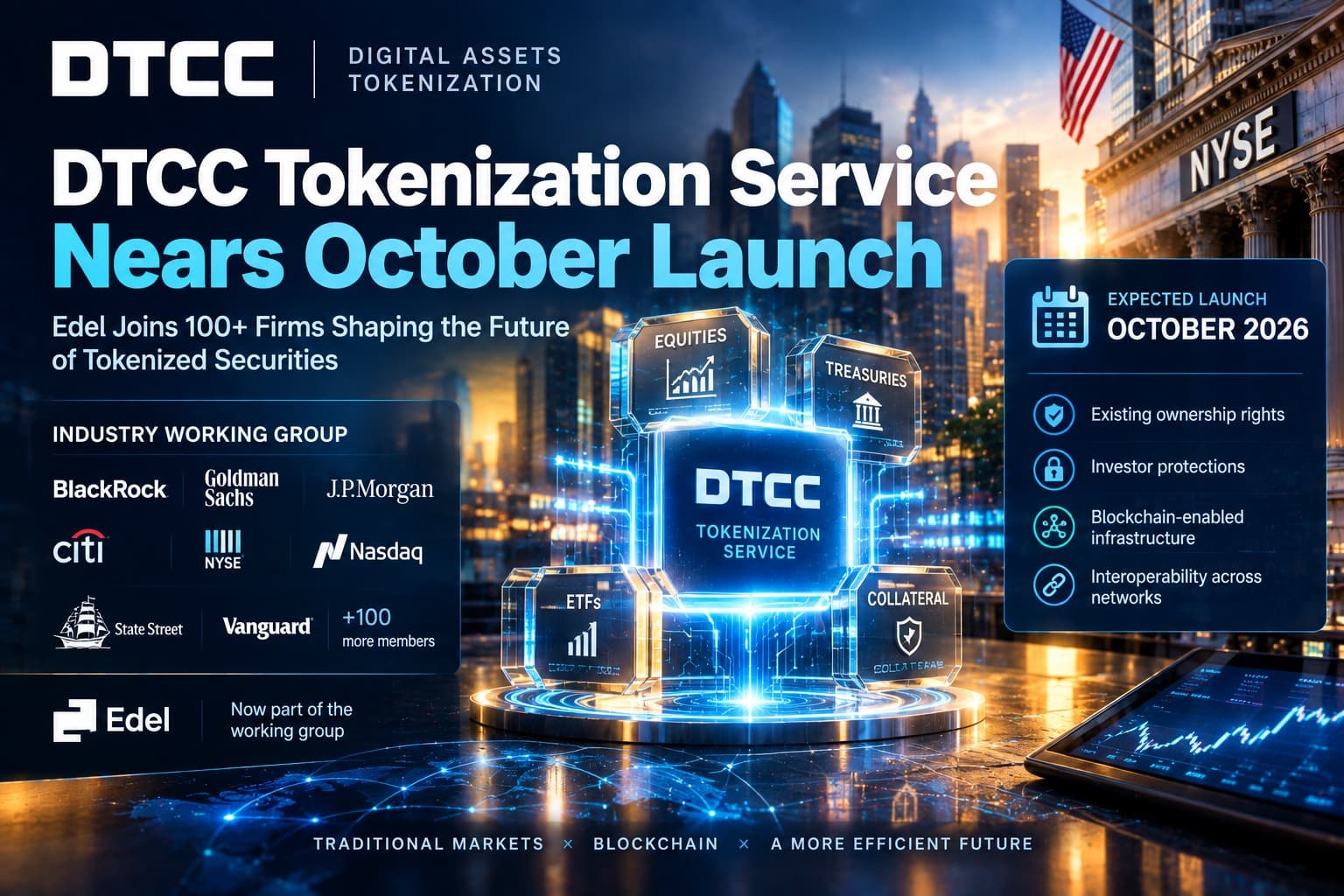
The DTCC Tokenization Service is moving toward its planned October 2026 launch, with Edel Finance joining an industry working group helping shape the infrastructure for tokenized securities. The initiative has expanded to more than 100 members and partners, bringing together major banks, asset managers, exchanges, fintech firms and digital-asset companies.
Edel announced that it had joined the DTC Digital Assets Solutions Industry Working Group, which was convened to provide feedback on the development of the tokenization service.
The significance extends beyond one additional participant.
The Depository Trust & Clearing Corporation (DTCC) is one of the core pieces of U.S. financial-market infrastructure. Its tokenization project is designed to bring selected DTC-custodied securities into blockchain-based environments while preserving the legal rights, investor protections and operational controls associated with traditional securities.
 SEC Sets Compliance Seminar for Nov. 19→
 Ripple Expands Prime Brokerage With Brevan Howard→
 SEC Warns Investors About Investment Scams During World Investor Week→
 Coinbase and Citi Expand Stablecoin Payments for Businesses→
That approach could make tokenization less about creating parallel crypto markets and more about modernizing existing capital-market infrastructure.
What is the DTCC Tokenization Service?
The project is being developed by The Depository Trust Company (DTC), a DTCC subsidiary and central securities depository.
Its purpose is not simply to place financial assets on a blockchain.
Instead, DTC intends to create tokenized representations of assets it already holds in custody. Those tokenized representations can then be used in digital-market workflows while remaining connected to the conventional securities infrastructure.
DTCC says the service is designed around several objectives:
- interoperability between traditional and blockchain-based environments;
- improved asset mobility;
- greater capital efficiency;
- programmability;
- extended market access;
- transparency and operational controls.
The underlying idea is that tokenization can add new functionality without requiring the financial system to abandon established custody, settlement and investor-protection structures.
That distinction is important.
A token representing a DTC-custodied security is not necessarily the same thing as a freely circulating crypto token. DTCC’s model is closer to a digital representation of an existing financial claim within a controlled market infrastructure.
Edel joins a rapidly expanding institutional group
Edel’s participation adds another digital-asset infrastructure company to a working group that already includes a broad cross-section of traditional finance and blockchain firms.
DTCC initially announced the industry working group with more than 50 firms in May 2026. By July, the organization said the group had grown to more than 100 members and partners.
The list includes firms at the center of the existing financial system, including BlackRock, Goldman Sachs, J.P. Morgan, Citi, Citadel Securities, NYSE Group, Nasdaq, State Street, Vanguard and Wells Fargo. It also includes blockchain and digital-asset infrastructure companies such as Chainlink, Circle, Fireblocks, BitGo and Digital Asset.
The diversity of the group is itself significant.
Tokenization requires more than a blockchain. It requires custodians, brokers, exchanges, asset managers, compliance systems, wallets, settlement networks, data providers and legal frameworks.
By bringing these parties together, DTCC is effectively testing whether tokenized securities can work across the full financial-market lifecycle.
The project has already moved beyond experimentation
One of the strongest signals is that DTCC has already conducted real production transactions.
On July 15, 2026, DTC successfully converted securities held in its custody into tokenized representations and used those tokens in production trades. More than 30 firms participated in that milestone.
The transactions included:
- U.S. Treasury repo;
- Treasury buy/sell transactions;
- equity delivery-versus-payment;
- collateral pledges;
- security lending;
- equity token transfers;
- central-counterparty margin workflows.
The tests were conducted across DTC’s private Besu-based environment and the Canton network as part of DTCC’s multi-chain strategy.
That matters because the industry has spent years demonstrating tokenization in isolated pilot programs.
DTCC’s approach is different.
The organization is testing whether tokenized assets can participate in real financial workflows under institutional operational controls.
Expert opinions: infrastructure is more important than the token itself
DTCC executives have repeatedly emphasized that the key to institutional tokenization is not simply issuing digital assets.
Brian Steele, DTCC’s President of Clearing & Securities Services, said the July production tests demonstrated potential for real-time collateral mobility, enhanced liquidity and capital efficiency, while maintaining the protections associated with traditional securities.
Nadine Chakar, DTCC’s Global Head of Digital Assets, has taken a similar position, describing tokenization as an evolution of financial infrastructure rather than an attempt to eliminate existing systems.
The broader point is important.
Institutional tokenization only becomes commercially meaningful when the token can be used in the same processes that institutional investors already rely on.
That includes custody, collateral management, settlement, corporate actions, reconciliation and compliance.
In this model, blockchain technology is a new layer of infrastructure rather than the entire financial system.
Why the October launch matters
DTCC has stated that the tokenization service is expected to launch in October 2026 following the July production trials.
The planned launch represents an important transition from testing to actual service availability.
The initial eligible asset universe is deliberately constrained.
Under the SEC‘s December 2025 No-Action Letter, DTC was authorized to provide a defined tokenization service covering certain highly liquid assets, including securities represented in the Russell 1000, qualifying ETFs and U.S. Treasury bills, bonds and notes.
This is a relatively conservative starting point.
Rather than tokenizing every type of security at once, DTCC is beginning with instruments that already have substantial liquidity and established market infrastructure.
That approach could make institutional adoption easier because firms do not have to build an entirely new market around unfamiliar assets.
Tokenized securities could improve collateral mobility
One of the more consequential use cases may not be retail trading.
It is collateral.
Traditional financial markets often involve assets being trapped within specific custody and settlement systems. Moving those assets between counterparties, markets and jurisdictions can take time and create operational friction.
A tokenized representation can potentially move through approved digital networks much more quickly.
DTCC’s broader digital-assets program has repeatedly focused on this issue. Its earlier collateral experiments demonstrated on-chain asset movement, automated rules and compressed settlement times.
The tokenization service therefore could have implications for:
- repo markets;
- securities lending;
- margin;
- collateral optimization;
- liquidity management.
These are areas where even incremental improvements can have large economic consequences because the underlying capital pools are enormous.
Interoperability is becoming central to institutional tokenization
A major risk in tokenization is fragmentation.
If every bank, exchange or asset manager creates its own blockchain ecosystem, financial assets could become divided across incompatible networks.
DTCC has repeatedly identified interoperability as a central requirement.
The service is therefore being developed as part of a multi-chain strategy.
DTCC has announced plans involving both Canton and Stellar, while its service architecture is designed to support selected public and private blockchain networks that meet its requirements.
DTCC expects tokenized assets to be usable across approved networks rather than permanently locked into one blockchain.
That is an important distinction because institutional investors are unlikely to accept a system that creates new forms of liquidity fragmentation.
The role of Stellar and public blockchains
In May 2026, DTCC announced plans to connect its tokenization service to Stellar, with DTC-tokenized assets expected to become available on the network during the first half of 2027.
This demonstrates the broader architecture DTCC is pursuing.
The institution does not appear to be choosing between private and public blockchain infrastructure. Instead, it is building a framework where different networks can perform different roles as long as they meet the required standards.
That could eventually create a market in which tokenized securities move between institutional and public-chain environments while remaining linked to the same underlying custody and ownership framework.
For the digital-asset industry, that is potentially more important than any individual token launch.
What Edel’s participation means
Edel’s participation should be interpreted carefully.
Joining the working group means the company is contributing to the industry-development process around the service. It does not by itself mean that DTCC has endorsed Edel’s products, that Edel will operate the service or that the company has received a privileged position in the future market.
The more meaningful signal is strategic.
Edel describes itself as infrastructure for tokenized equity markets, including liquidity, access, exposure and settlement networks.
Participation in DTCC’s working group potentially gives companies such as Edel an opportunity to understand and influence technical and operational standards as institutional tokenization moves toward production.
That could become increasingly valuable as tokenized equities develop beyond isolated platforms.
How this fits the broader tokenized-asset market
The DTCC initiative arrives as banks and asset managers accelerate work on tokenized securities, funds and collateral.
BlackRock, Franklin Templeton, J.P. Morgan, Goldman Sachs and other institutions have already explored blockchain-based representations of traditional financial assets.
But the DTCC project addresses a different layer.
Rather than creating another private tokenization platform, it attempts to connect tokenized assets directly to one of the central pieces of U.S. securities infrastructure.
That could reduce one of the biggest barriers to institutional adoption: uncertainty over whether tokenization can coexist with existing market protections and post-trade processes.
CryptoQuorum has covered this shift in its recent analysis of tokenized equities and institutional blockchain infrastructure, including the growing role of Chainlink, public blockchains and traditional financial institutions.
Risks remain despite the institutional momentum
The October launch should not be treated as proof that tokenization will immediately transform U.S. markets.
Several challenges remain.
Regulatory scope is still evolving. The initial service applies only to defined assets and participants.
Interoperability remains technically complex, especially when multiple blockchains have different standards, privacy models and operational requirements.
Cybersecurity and operational resilience become even more important when tokenized assets can move programmatically.
Liquidity also matters. A tokenized security is not automatically more liquid than its traditional equivalent.
Finally, institutional adoption will depend on whether firms see measurable improvements in settlement, collateral management, capital efficiency and operational costs.
What to watch before October
With the launch approaching, several developments will be particularly important.
First, which assets and networks are included at launch.
Second, how DTC Participants will integrate tokenized securities with existing custody and trading systems.
Third, whether additional major financial institutions move from working-group participation to live usage.
Fourth, how tokenized assets interact with collateral, repo and settlement workflows.
Fifth, whether the service can create genuine interoperability rather than another isolated blockchain ecosystem.
The answer to these questions will determine whether October’s launch becomes a technical milestone or the beginning of a broader market transition.
Bottom line
The planned October launch of the DTCC Tokenization Service represents one of the clearest signs yet that institutional tokenization is moving from pilot projects toward production infrastructure.
Edel’s addition to the working group is notable because the group now includes more than 100 firms and partners spanning traditional finance and digital assets.
More importantly, DTCC has already demonstrated that DTC-custodied securities can be tokenized and used in live production workflows involving collateral, repo, equities and other financial-market transactions.
The initiative is not attempting to replace traditional market infrastructure.
Its strategy is almost the opposite: use blockchain and tokenization to extend existing infrastructure while preserving legal ownership rights, investor protections and institutional controls.
If that model succeeds, tokenization could move from a niche digital-asset concept into a standard component of securities settlement and collateral management.
For the crypto industry, the most important development may therefore not be the creation of new tokens.
It may be the arrival of institutional-grade digital representations of assets that already dominate global financial markets.
Disclaimer
This article is provided for informational and educational purposes only and does not constitute financial, investment, legal, tax or other professional advice. Tokenized securities, blockchain infrastructure and digital assets involve regulatory, technological, operational and market risks. References to companies, institutions or projected launch dates do not constitute endorsements or guarantees of future performance. Readers should conduct independent research and consult qualified professionals before making financial or investment decisions.