

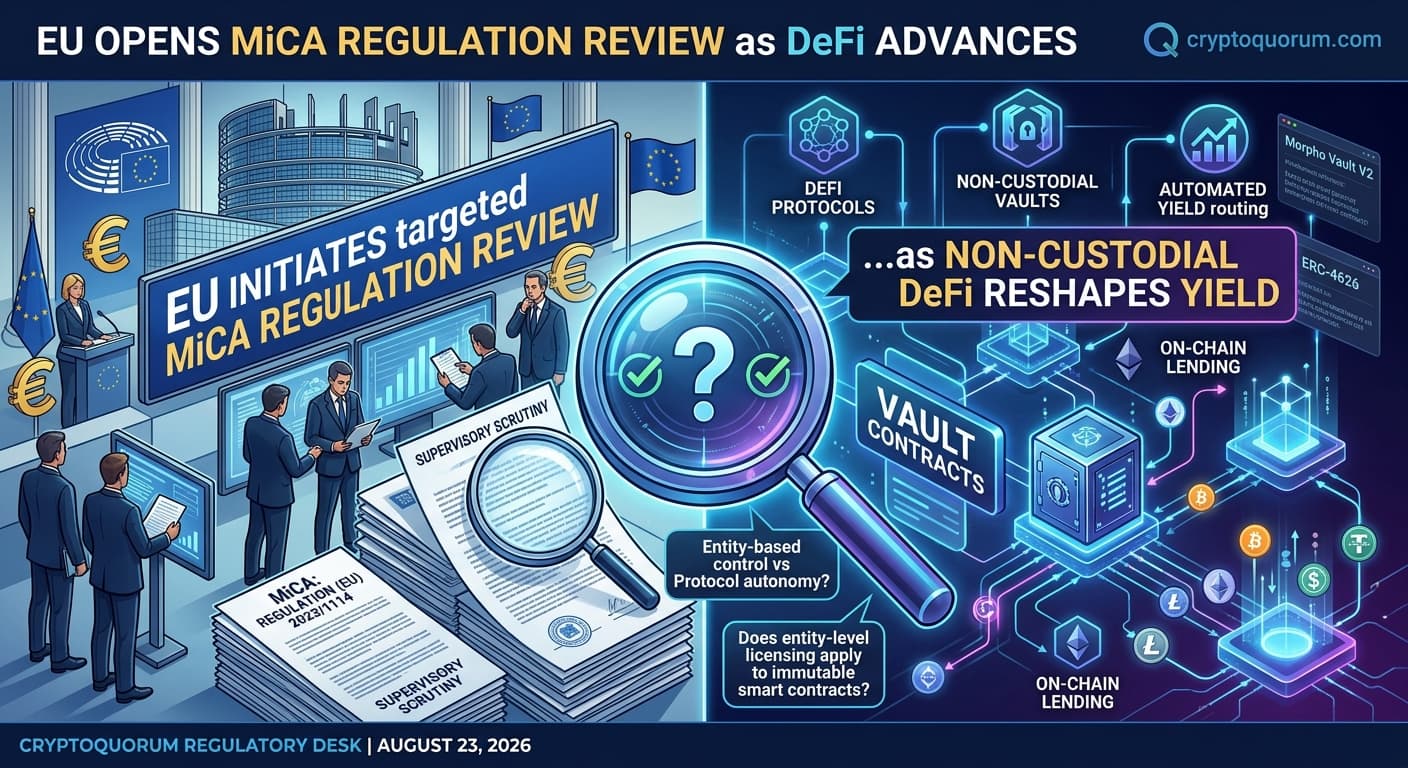
The European Commission has officially initiated a targeted consultation regarding the comprehensive MiCA regulation review, setting a critical deadline for financial authorities, market participants, and blockchain architects. Operating under mandatory review obligations set out in Regulation (EU) 2023/1114, the European Commission is assessing whether the Markets in Crypto-Assets framework requires structural revisions to address rapid market developments.
With the public and targeted consultation period concluding on August 31, 2026, European regulators are turning their focus toward sectors initially deferred during the original legislative drafting: fully decentralized finance (DeFi), non-custodial lending, automated yield routing, and algorithmic asset management. As institutional participation in crypto markets deepens, the MiCA regulation review seeks to resolve a fundamental question: how can traditional regulatory oversight apply to immutable, non-custodial smart contracts designed to operate without centralized intermediaries?
CRYPTOCAP:TOTAL Real-Time Chart
The Scope of the Targeted MiCA Consultation
When Regulation (EU) 2023/1114 was enacted, European lawmakers established a harmonized framework for Crypto-Asset Service Providers (CASPs), asset-referenced tokens (ARTs), and electronic money tokens (EMTs). However, Articles 140 and 142 mandated that the Commission deliver a detailed assessment report accompanied, if necessary, by new legislative proposals to address technological evolution.
The current targeted consultation contains 86 technical questions designed to stress-test the existing legal boundaries. Primary evaluation areas within the MiCA regulation review include:
 RLUSD stablecoin and the New Standard for Regulation→
 MoneyGram Unveils the Stablecoin-Backed MoneyGram Card to Revolutionize Global Financial Freedom→
 Zebec and MoneyGram Expand Stablecoin Payroll Through Stellar→
 BIS Tests XRP Ledger to Verify Official Statistics Onchain→
- Decentralized Finance & Staking: Determining whether decentralized protocols that function without identifiable human operators fall outside the CASP licensing regime.
- Lending & Borrowing Mechanics: Evaluating systemic risks associated with automated yield generation, liquidation protocols, and credit markets.
- Asset Classification Standards: Aligning national supervisory guidance with ESMA standards for hybrid digital assets and liquid staking tokens.
- Cross-Border Interoperability & Systemic Stability: Analyzing how European crypto rules interface with global regulatory standards and traditional banking integration.
Technical Modular Architectures: The Case of Morpho Vault V2
To understand the challenge facing European regulators, market observers point to modern decentralized financial infrastructure. Traditional regulatory models assume the existence of a centralized custodian or order-matching engine. In contrast, modular protocols present an entirely different architectural paradigm.
A prime example is Morpho Vault V2, an infrastructure primitive designed around immutable smart contracts and role-segregated capital allocation. Morpho Vault V2 enables creators to build non-custodial yield vaults that deploy assets across multiple underlying liquidity markets.
| Architecture Tier | Component / Smart Contract | Functional Execution |
|---|---|---|
| Tier 1: Entry Gateway | Depositors → Morpho Vault V2 (ERC-4626) | Asset deposits and minting of ERC-4626 yield-bearing vault tokens. |
| Tier 2: Adapters & Accounting | Adapter A (Market 1) & Adapter B (Market 2) | Liquidity routing and automated execution of realAssets() reporting calls. |
| Tier 3: Liquidity Markets | Underlying Protocol Markets | Final target markets deployed for on-chain yield generation. |
The core innovations governing Morpho Vault V2 illustrate why applying legacy compliance models remains complex:
- The Adapter Gateway Model: Vault V2 uses smart contract adapters as universal translators to interact with yield sources. Adapters feature an automated
realAssets()reporting function that calculates total managed assets in real time across positions without requiring centralized accounting. - Strict Operational Role Separation: Management responsibilities are split between Owner, Curator, Allocator, and Sentinel roles. While Curators select authorized adapters and set exposure caps, Allocators shift liquidity between approved markets. Crucially, none of these roles hold custody of underlying funds.
- Guaranteed In-Kind Exits via
forceDeallocate: If underlying markets become illiquid, depositors are never locked inside the vault. Through the permissionlessforceDeallocatefunction, users can execute flashloan-enabled in-kind redemptions, transferring their position from the vault directly into the underlying protocol markets.
Because the deployment contracts deployed via VaultV2Factory are immutable, no administrative entity can alter the core smart contract logic once launched. This structural non-custodiality creates a clear tension during the MiCA regulation review, as supervisors evaluate whether permissionless code execution can be subjected to entity-level licensing.
Expert Perspectives: Balancing Financial Integrity and On-Chain Innovation
The intersection of European legal mandates and autonomous smart contracts has sparked intense debate among regulatory scholars, compliance specialists, and blockchain architects.
The Regulatory View: Entity-Based Control vs. Protocol Autonomy
Speaking on the scope of European digital asset oversight, regulatory policy analysts emphasize the necessity of clear boundary definitions during the MiCA regulation review:
“The European Commission’s targeted consultation acknowledges that static regulation quickly becomes outdated when confronted with modular protocols. The challenge for Brussels is identifying where genuine centralization exists. If a protocol relies on administrative multisigs or centralized curators who exercise discretionary control over user funds, regulators will likely classify them as service providers. However, imposing CASP obligations on truly autonomous, non-custodial code risks driving open-source development out of the EU entirely.”
The Technical View: Smart Contract Risk Mitigation
From a protocol engineering standpoint, researchers stress that permissionless mechanisms offer built-in consumer protection superior to opaque traditional financial institutions:
“In traditional finance, user protection relies on post-facto legal recourse against custodians. In modular protocols like Morpho Vault V2, protection is hardcoded into the architecture. Mechanisms like automated asset reporting via realAssets() and permissionless forceDeallocate functions mean depositors maintain mathematical guarantees of exit liquidity even under extreme stress. Regulators conducting the MiCA regulation review should recognize that code-level transparency often achieves the same risk-reduction goals that supervisory reporting attempts to enforce manually.”
Comparing Regulatory Scope: CASPs vs. Non-Custodial Vault Systems
To illustrate how protocol architecture interacts with existing EU laws, the following table compares traditional Crypto-Asset Service Provider (CASP) requirements under Regulation (EU) 2023/1114 with the operational realities of non-custodial vault protocols.
| Regulatory Domain | Traditional CASP Requirement (MiCA) | Modular Non-Custodial Vault (e.g., Morpho V2) |
| Custody & Asset Safekeeping | Mandatory segregated accounts & custodial liability | Non-custodial smart contracts; funds held in immutable vaults |
| Governance & Roles | Board of directors, compliance officers & legal entities | Segregated roles (Curators, Allocators) without fund custody |
| Reporting & Valuations | Periodic audited financial statements to national regulators | Real-time automated reporting via on-chain realAssets() calls |
| Withdrawal & Liquidity Risk | Contractual withdrawal windows subject to operational limits | Permissionless in-kind redemptions via forceDeallocate |
| Contract Immutability | Modifiable terms of service & manual execution | Immutable deployed contracts (e.g., via VaultV2Factory) |
The Road Ahead for EU Digital Asset Policy
As the targeted consultation deadline of August 31, 2026, passes, the European Commission will synthesize stakeholder feedback to prepare its formal report for the European Parliament and Council. The conclusions drawn from the MiCA regulation review will dictate whether the EU adopts a dedicated “DeFi Annex” or maintains a strict exemption for genuine peer-to-peer protocols.
For Web3 developers and institutional asset managers alike, the outcome will define the future of European digital finance. Protocols that combine rigorous technical non-custodiality with transparent risk boundaries—such as adapter-based vault systems—offer a template for how decentralized execution can align with market integrity without sacrificing censorship resistance.
CRYPTOCAP:TOTALDEFI Real-Time Chart
Disclaimer: This article is for informational purposes only and does not constitute legal, financial, or regulatory advice. Stakeholders should consult qualified legal counsel regarding compliance obligations under Regulation (EU) 2023/1114.