

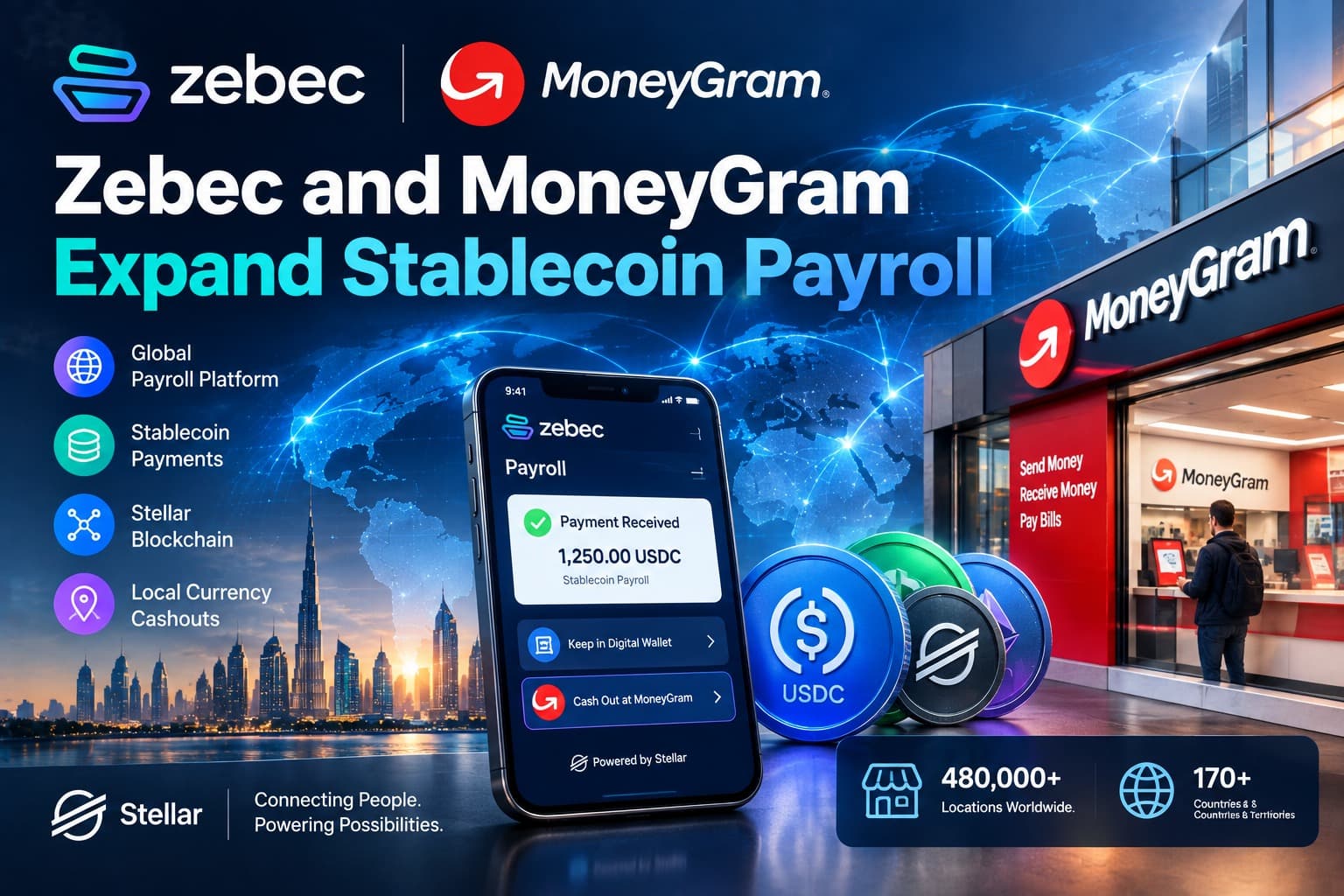
Zebec Network and MoneyGram are expanding enterprise payroll infrastructure on the Stellar blockchain, giving employees and contractors a route from stablecoin-denominated earnings to local-currency cash through MoneyGram’s international retail network.
The partnership connects Zebec’s enterprise payroll platform on Stellar with MoneyGram Ramps, which supports USDC cash-in and cash-out through participating MoneyGram locations. According to MoneyGram’s current Stellar documentation, its Ramps service supports more than 470,000 locations across 170+ countries for off-ramp transactions. Stellar separately lists more than 480,000 locations in its MoneyGram case study.
BINANCE:XLMUSDT
The development is significant because it addresses one of the biggest practical obstacles to blockchain-based payroll: an employee may be paid digitally, but still need conventional local currency for rent, groceries, bills and other everyday expenses.
The new integration attempts to connect those two environments without requiring the worker to manage a separate crypto-to-fiat conversion process.
 Cross River Brings RLUSD Into Core Banking→
 MoneyGram Joins XDC Network as Institutional Validator→
 Mastercard and BVNK have launched a new global payments platform→
 Fink: Data Center Moratorium Risks Recession→
How the new payroll flow works
At a technical level, the arrangement connects three previously separate parts of the payment process.
First, an employer uses Zebec’s enterprise payroll infrastructure to distribute compensation in stablecoins. Zebec launched its native enterprise payroll deployment on Stellar earlier in 2026, allowing employers to stream salaries and contractor payments while recipients receive funds in digital wallets.
Second, the employee can retain those digital funds, spend them through supported products or use the available payout infrastructure.
Third, MoneyGram provides the physical cash-out mechanism. Its Stellar Ramps implementation allows a supported wallet or application to initiate an off-ramp, send USDC on Stellar and ultimately receive a MoneyGram reference number for cash pickup.
This is more than a conventional cryptocurrency exchange integration.
The goal is to make the blockchain transaction largely invisible to the end recipient. An employee may simply see a payment arrive digitally and then choose whether to keep it in digital form or convert it into local currency.
That distinction could be particularly relevant for contractors and globally distributed employees who work for companies in one country while living in another.
Why Stellar is central to the strategy
The integration builds on Stellar’s long-standing focus on cross-border payments and financial access.
Stellar’s network uses anchors, which connect blockchain assets to traditional financial rails. MoneyGram is one of the best-known examples of this model. Stellar says MoneyGram Ramps allows wallets and exchanges to connect to MoneyGram’s cash-in and cash-out infrastructure without building separate integrations for every financial provider.
MoneyGram’s current developer documentation describes the Stellar implementation as a system for USDC on Stellar, with authentication and transaction flows based on Stellar’s SEP-10 and SEP-24 standards.
For payroll providers, this architecture is useful because the blockchain can act as the settlement layer while a conventional financial network handles the final local-currency transaction.
The result is a hybrid system rather than an attempt to replace fiat infrastructure entirely.
MoneyGram provides the missing local-currency layer
The practical value of the partnership lies in what happens after the blockchain payment.
Zebec’s earlier Stellar payroll announcement described a model in which workers could receive stablecoins into digital wallets, spend them through Zebec’s supported card infrastructure or convert digital dollars into local currency through Stellar’s global payout network.
MoneyGram adds a familiar physical access point.
Its current Stellar integration documentation says users can send USDC to MoneyGram and collect cash at participating agent locations. The same service supports the reverse direction, allowing users to pay cash at an agent and receive USDC in a Stellar wallet.
This two-way capability is important for emerging payment applications.
A digital worker economy does not necessarily eliminate the need for cash. In many markets, people still rely on physical currency or local financial intermediaries for daily spending.
Blockchain payroll can therefore be successful without requiring every user to become a long-term cryptocurrency holder.
Expert opinions: payroll needs an off-ramp
The broader payments industry increasingly treats on-ramp and off-ramp infrastructure as essential components of mainstream digital-asset adoption.
Stellar’s own documentation describes anchors as the bridge between blockchain networks and traditional financial rails. The organization’s MoneyGram case study argues that cash-to-crypto and crypto-to-cash services can extend blockchain utility into cash-based economies.
Zebec’s own strategy is consistent with that approach.
In its Q1 2026 report, the company said its enterprise and individual payroll infrastructure was processing approximately $49 million in monthly payroll volume, serving 13,100 employees across 243 enterprise clients at that point in the year. It also identified Stellar as its first major payroll deployment outside Solana.
Those figures are company-reported rather than independently audited, but they demonstrate that Zebec is attempting to build a payroll product around operational scale rather than a purely experimental blockchain use case.
Simon Babakhani, CEO of Zebec Network, previously said the company’s Stellar deployment was designed to bring enterprise-grade payroll infrastructure to the network and emphasized Stellar’s connection to real-world financial applications and traditional payment infrastructure.
The economics of stablecoin payroll
Traditional international payroll can involve multiple banking intermediaries, pre-funded accounts, local payment providers and currency conversions.
Those layers can introduce delays and operational costs, particularly when companies pay contractors in multiple countries.
A stablecoin-based system potentially compresses part of that chain.
The employer can distribute a digital dollar asset. The blockchain provides settlement. The recipient can then decide whether to hold the stablecoin, spend it digitally or convert it through an off-ramp.
The model is particularly compelling where banking access is uneven or cross-border transfers remain expensive.
However, the blockchain does not eliminate the cost of the entire payment system.
Off-ramp providers still need compliance procedures, liquidity, foreign-exchange capabilities and local payout infrastructure. MoneyGram’s developer documentation explicitly identifies KYC, compliance and settlement as part of its Ramps service.
That means the real competitive question is not simply whether blockchain settlement is faster. It is whether the entire end-to-end payroll process is cheaper, more reliable and easier for employers and recipients.
USDC rather than a volatile crypto asset
Another important detail is the choice of settlement asset.
MoneyGram’s current Stellar Ramps integration supports USDC, rather than a volatile cryptocurrency such as BTC or XLM.
For payroll, that distinction is fundamental.
Employees generally expect a predictable compensation amount. A salary denominated in an asset that can move 10% in a few hours creates unnecessary income volatility.
A dollar-backed stablecoin can therefore act as the bridge between blockchain settlement and conventional payroll accounting.
The trade-off is that stablecoins introduce their own dependencies, including issuer risk, redemption arrangements, regulatory requirements and reliance on the underlying payment infrastructure.
CryptoQuorum has examined this broader issue in its recent analysis of the stablecoin market and real-world payment use cases.
What this means for employers
For multinational businesses, the most attractive feature may be the possibility of creating a standardized payroll workflow across several countries.
Instead of maintaining a separate payment architecture for every market, a company could potentially manage a stablecoin-based compensation system while using regional off-ramps for final delivery.
That does not mean every employee has to receive cash.
A recipient may choose to maintain a digital balance, use a card or conduct another digital transaction. The off-ramp simply adds a local fiat option.
This flexibility could matter for businesses employing remote teams, independent contractors, international developers and cross-border service providers.
The concept also fits into the broader convergence between payroll and programmable money.
Zebec has positioned its platform around streaming compensation rather than only periodic transfers. Its Stellar materials describe a model in which employees and contractors can receive earnings continuously rather than waiting for a conventional payroll date.
That creates a different model of cash flow.
A challenge for traditional payment rails
The Zebec-MoneyGram integration also illustrates how blockchain companies increasingly compete with traditional payment providers on infrastructure, rather than simply on asset ownership.
MoneyGram is not being replaced. Its physical network becomes part of the blockchain payment stack.
The same pattern is visible across Stellar’s broader ecosystem. The network highlights enterprise applications involving MoneyGram, Franklin Templeton, WisdomTree and other financial institutions as examples of blockchain infrastructure being connected to conventional finance.
This model may be more realistic for mainstream adoption than the idea of consumers abandoning fiat entirely.
Blockchain networks can instead provide the settlement layer while established financial institutions handle compliance, cash distribution and local-market access.
Remaining risks
The new payroll infrastructure also has limitations.
Regulatory requirements vary significantly by jurisdiction. A worker’s ability to receive or cash out stablecoins can depend on local law and service availability.
Liquidity and foreign exchange remain important. A digital balance may be available instantly, but local-currency delivery still depends on the relevant payout corridor.
Stablecoin risk also remains. USDC is designed as a fiat-backed digital asset, but users and businesses remain dependent on its issuer, reserve arrangements and redemption infrastructure.
Operational concentration is another factor. Combining Zebec, Stellar and MoneyGram creates a powerful network effect, but it also means that disruptions at any layer could affect the complete payroll journey.
These considerations make the integration an infrastructure development rather than proof that blockchain payroll has already reached mass adoption.
The broader shift toward programmable global payroll
The significance of the announcement extends beyond one partnership.
Global employment is becoming increasingly distributed. Companies routinely hire workers and contractors across borders, while payment systems remain fragmented by banking jurisdictions, currencies and regulatory requirements.
Stablecoin payroll attempts to solve that fragmentation by separating the digital movement of value from the local delivery of money.
The blockchain handles the first part. A regulated payout network handles the second.
That architecture is increasingly visible across the industry. CryptoQuorum’s recent coverage of enterprise stablecoin payments examined a similar model in which stablecoins are used for corporate settlement while traditional financial infrastructure remains part of the transaction process.
The common theme is not the elimination of banks or payment companies.
It is the creation of a programmable settlement layer underneath them.
What to watch next
The next important milestones will be actual enterprise adoption, transaction volume and geographic expansion.
Investors and industry observers should watch whether Zebec moves from pilot deployments toward larger multinational payroll contracts and whether MoneyGram’s off-ramp network produces meaningful usage from blockchain-native payroll platforms.
It will also be important to monitor which markets see the strongest demand.
High-inflation economies and countries with large international workforces may have particularly strong incentives to adopt stablecoin payroll, while highly banked markets may prioritize speed, automation and treasury efficiency instead.
The distinction could determine where this model becomes commercially viable first.
Bottom line
The Zebec and MoneyGram expansion on Stellar connects three increasingly important elements of digital finance: stablecoin settlement, programmable payroll and local-currency access.
Zebec provides the enterprise payroll layer. Stellar provides the blockchain settlement infrastructure. MoneyGram provides a large physical and financial distribution network for converting USDC into local currency.
The combination does not remove the complexities of global payroll, but it addresses one of the central problems facing blockchain payments: making digital money useful in the physical economy.
With MoneyGram’s Stellar network covering more than 170 countries for off-ramp services and hundreds of thousands of locations, the infrastructure already has substantial geographic reach.
The key question now is adoption.
If multinational employers begin using stablecoins not simply for treasury operations or crypto-native compensation, but as a practical payroll rail for ordinary employees and contractors, the partnership could become an important example of blockchain moving into routine global payments.
Disclaimer
This article is provided for informational and educational purposes only and does not constitute financial, investment, legal, tax, payroll or professional advice. Stablecoins and digital-asset payment systems involve regulatory, operational, counterparty and market risks. Availability of cash-out services, supported currencies, transaction limits and compliance requirements can vary by jurisdiction and provider. Readers and businesses should conduct independent due diligence and obtain appropriate professional advice before using digital assets for payroll or other financial activities.