

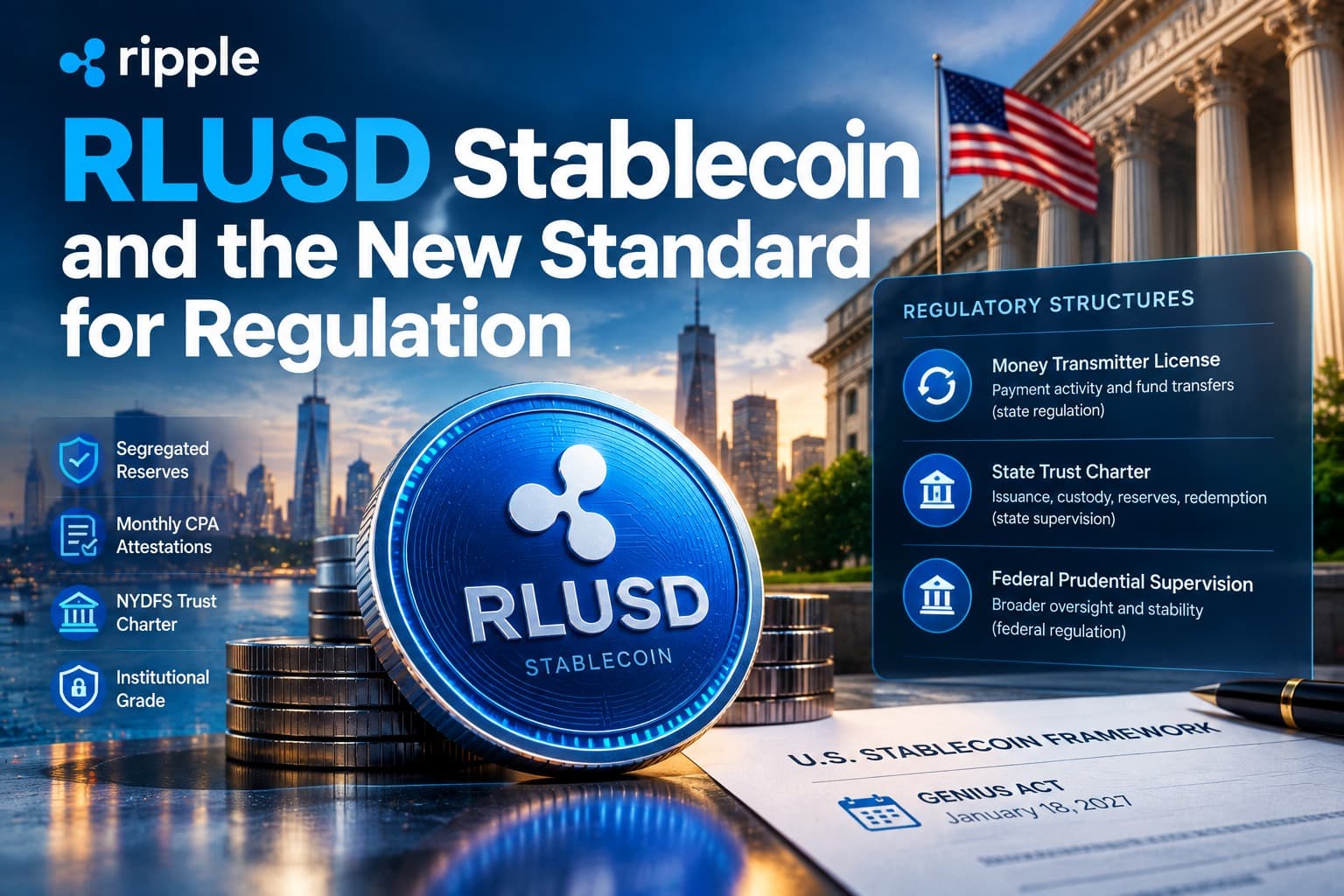
Ripple is challenging the idea that all “regulated” stablecoins operate under the same level of oversight. In a September 2026 statement, the company argued that a money transmitter license, a state trust charter and federal prudential supervision are materially different regulatory structures, with different reserve, verification and failure-resolution requirements. Ripple says its RLUSD stablecoin was designed around the stricter end of that spectrum.
The distinction comes at an important moment for the U.S. stablecoin market.
BINANCE:XRPUSDT
The GENIUS Act has created a federal framework for payment stablecoins, while regulators including the New York State Department of Financial Services (NYDFS) are developing rules for state-regulated issuers. Treasury said in August that the GENIUS Act is expected to take effect on January 18, 2027, with payment stablecoin issuers generally required to obtain an appropriate federal or state license.
Against that backdrop, Ripple’s argument is less about whether a stablecoin is technically “regulated” and more about which regulator supervises the issuer, what assets back the token and what obligations exist if something goes wrong.
 Cross River Brings RLUSD Into Core Banking→
 MoneyGram Joins XDC Network as Institutional Validator→
 Mastercard and BVNK have launched a new global payments platform→
 Fink: Data Center Moratorium Risks Recession→
Regulation is not one-size-fits-all
A money transmitter license primarily regulates the movement of customer funds and payment activity. A limited-purpose trust charter can impose a broader prudential framework covering issuance, reserves, custody and redemption. Federal prudential supervision introduces another layer through a national banking regulator.
Ripple’s own recently published comparison distinguishes these three structures and notes that reserve requirements and verification processes can differ materially.
That distinction matters because the word “regulated” by itself says relatively little about how a stablecoin is structured.
A license may authorize payments without creating the same reserve, governance or supervisory obligations associated with a trust company.
For institutional users, those differences can affect the perceived risk of holding a stablecoin as corporate treasury liquidity, collateral or a settlement asset.
RLUSD stablecoin is issued under a New York trust charter
The existing issuer structure behind RLUSD is Standard Custody & Trust Company, LLC, a Ripple subsidiary chartered by NYDFS as a limited-purpose trust company.
NYDFS lists Standard Custody as a limited-purpose trust charter holder, granted in May 2021.
Ripple’s current documentation states that the stablecoin is issued through Standard Custody and other regulated Ripple subsidiaries, while direct institutional customers are subject to KYC, AML and sanctions-screening requirements.
That framework places the product inside a regulatory regime with specific requirements for reserves, redemption and independent attestations.
NYDFS’s 2022 stablecoin guidance requires regulated U.S. dollar-backed stablecoins to be fully backed by reserve assets with market value at least equal to outstanding tokens. The guidance also calls for clear redemption policies, segregation of reserve assets and monthly independent CPA attestations.
This is the core of Ripple’s argument that not all stablecoins operate under equivalent standards.
What the New York framework requires
NYDFS’s framework is detailed enough to provide a useful benchmark for evaluating stablecoin regulation.
Reserve backing
The regulator requires the reserve to be fully backed and segregated from the issuer’s proprietary assets. Permitted reserve assets include short-dated U.S. Treasury bills, certain fully collateralized reverse repurchase agreements, government money-market funds and qualifying deposit accounts.
Redemption
The guidance requires clear redemption policies giving lawful holders the right to redeem at par, subject to reasonable legal and regulatory conditions. The default standard described by NYDFS is redemption within two full business days after a compliant redemption order.
Independent verification
The reserve must be examined at least monthly by an independent U.S.-licensed CPA using AICPA attestation standards. The regulator also requires an annual attestation relating to internal controls and compliance procedures.
These requirements are particularly important for a stablecoin because a stable price depends on confidence that holders can ultimately exchange tokens for the underlying currency.
The difference between a license and a trust charter
Ripple’s comparison can be summarized as follows:
| Regulatory structure | Primary focus | Reserve framework | Supervision |
|---|---|---|---|
| Money transmitter license | Movement of customer funds and payment activity | Rules vary by jurisdiction and license | State financial regulator |
| Limited-purpose trust charter | Issuance, custody, reserves and redemption | Segregated, specified high-quality liquid assets | State banking/financial regulator |
| Federal trust bank | Trust activities, custody and prudential oversight | Federal framework and supervisory requirements | Office of the Comptroller of the Currency |
*Framework summarized from Ripple’s September 2026 regulatory comparison and applicable U.S. regulatory materials. *
The important point is that these categories are not interchangeable.
A company holding multiple licenses may have broader permissions, but that does not automatically mean a particular stablecoin is issued under every regulatory framework simultaneously.
Federal supervision is a future layer, not the current issuer status
This distinction is especially important in the case of Ripple.
In December 2025, the Office of the Comptroller of the Currency conditionally approved Ripple’s application for the proposed Ripple National Trust Bank. The OCC’s decision document states that the proposed bank would provide services to Standard Custody, including managing the segregated reserve underlying the stablecoin and performing collateral trustee services for RLUSD holders.
However, the approval was conditional.
The OCC decision explicitly states that the proposed bank could not begin banking business until it met the requirements for a bank in organization and received final approval from the OCC.
That distinction remains relevant in September 2026. The OCC’s published list of active national trust banks does not establish that Ripple National Trust Bank is already operating as a fully approved national trust bank.
Therefore, it would be inaccurate to say that RLUSD is currently issued under full federal prudential bank supervision.
A more precise description is that RLUSD stablecoin currently has a New York limited-purpose trust-company issuer structure, while Ripple has a conditionally approved pathway toward an additional federal trust-bank structure.
That nuance is important for institutional reporting.
Why federal oversight could still matter
If the proposed national trust bank receives final approval and begins operations, the additional layer could become strategically important.
The OCC decision specifically contemplates the national trust bank managing RLUSD reserve assets on a directed basis and performing fiduciary collateral-trustee functions for holders.
This could create a more direct connection between the token’s reserve infrastructure and a federally supervised institution.
The development also fits into the broader U.S. transition toward a formal national stablecoin regime.
Treasury’s August 2026 rulemaking states that, beginning January 18, 2027, a person generally may not issue a payment stablecoin in the United States without an appropriate federal or state license.
The regulatory question is therefore moving from “Are stablecoins regulated?” to a much more precise set of questions:
Who regulates the issuer? What reserves are permitted? Who verifies them? How quickly must redemptions occur? What happens if the issuer fails?
Expert opinions: reserve quality may matter more than the label
The most important lesson from the current regulatory debate is that institutional users should look past the word regulated.
A stablecoin’s risk profile depends on the legal structure of its issuer, the quality and segregation of its reserves, the enforceability of redemption rights, the frequency of independent verification and the strength of supervisory controls.
NYDFS explicitly identifies these issues as core elements of its stablecoin oversight. Its guidance says regulators consider not only reserves and redemption but also cybersecurity, operational risks, BSA/AML compliance, consumer protection, safety and soundness and payment-system integrity.
That makes the regulatory structure itself part of the product.
For financial institutions, this can be as important as transaction speed or blockchain performance.
RLUSD stablecoin reserves are designed around segregation and transparency
Ripple says the stablecoin’s reserves are held in segregated accounts at depository institutions and securities custodians and are backed by U.S. dollars and other permitted cash equivalents.
The company identifies BNY as the primary custodian of RLUSD reserves, a relationship announced in July 2025.
Ripple’s transparency page currently reports approximately $2.396 billion of circulating RLUSD against about $2.518 billion of reserve funds as of September 3, 2026, together with monthly independent CPA attestations.
Those figures show why reserve transparency is becoming a competitive element in the stablecoin market.
Issuers are increasingly expected to demonstrate not simply that reserves exist, but how they are structured, where they are held and whether independent verification supports management’s claims.
Regulation could become a competitive advantage
The stablecoin market is moving toward a point where regulatory architecture itself may influence institutional adoption.
Businesses using stablecoins for payments, treasury management or collateral increasingly need predictable legal rights and clear compliance obligations.
A regulated trust-company model can therefore serve as part of the product proposition.
Ripple is explicitly positioning RLUSD stablecoin around institutional use cases such as cross-border payments, settlement and tokenized financial infrastructure. The company’s current documentation says the stablecoin is designed for institutions and operates across the XRP Ledger, Ethereum and additional networks.
CryptoQuorum has previously covered RLUSD’s growth beyond $2 billion and Ripple’s broader institutional strategy across stablecoins, payments and digital-asset infrastructure. That earlier analysis also highlighted the importance of distinguishing issuance announcements from independently dated reserve data.
This is exactly why the regulatory structure matters.
As stablecoins become financial infrastructure rather than simply trading instruments, institutional users need to understand what stands behind the token.
Ripple’s argument comes at a broader inflection point
The timing of Ripple’s statement is significant.
U.S. stablecoin regulation is becoming more formalized, but implementation is still evolving. Treasury, FinCEN, OFAC, the OCC and state regulators are developing rules and supervisory frameworks around payment stablecoins under the GENIUS Act.
At the same time, competing approaches are emerging.
Some issuers emphasize federal banking structures. Others operate through state-level trust charters or money-transmission regimes. The result is likely to be a market in which “regulated stablecoin” becomes an insufficient description.
The more useful question will be regulated by whom, under what charter and with what obligations?
That is the standard institutional buyers are likely to apply as the market matures.
What to watch next
Several developments could determine whether Ripple’s regulatory strategy becomes a competitive advantage.
First, the final status of the Ripple National Trust Bank application will matter. Conditional approval is not the same as an operating federal bank.
Second, implementation of the GENIUS Act will clarify how state-chartered and federally regulated stablecoin issuers coexist.
Third, reserve transparency will remain a major differentiator. Monthly attestations and segregated reserve structures are likely to become increasingly important to corporate users.
Fourth, actual adoption will matter more than regulatory branding. The strongest signal will be whether banks, payment companies, asset managers and enterprises use the stablecoin for settlement, treasury and collateral rather than simply trading.
Bottom line
Ripple’s latest message highlights a fundamental change in how the stablecoin market is being evaluated.
The question is no longer simply whether an issuer can say its stablecoin is “regulated.” Different regulatory structures create different requirements around reserves, redemption, verification, custody and supervision.
RLUSD stablecoin currently benefits from a New York limited-purpose trust-company framework, with NYDFS requirements covering fully backed reserves, segregation, redemption policies and regular independent attestations.
Ripple’s proposed national trust bank represents a potential second layer of federal oversight, but its OCC approval remains conditional and should not be described as an already operational federal bank charter.
For institutions evaluating stablecoins, the key lesson is straightforward: the label “regulated” is only the beginning of due diligence.
The legal structure of the issuer, the quality and segregation of reserves, independent verification and the enforceability of redemption rights provide a much clearer picture of the actual risk framework behind a digital dollar.
That distinction could become increasingly important as the U.S. stablecoin market moves toward a formal regulatory regime in 2027.
Disclaimer
This article is provided for informational and educational purposes only and does not constitute financial, investment, legal, regulatory, tax or other professional advice. References to regulatory frameworks and licenses are intended as factual descriptions of publicly available information and should not be interpreted as an endorsement of any stablecoin or issuer. Digital assets and stablecoins involve counterparty, regulatory, operational and market risks. Readers should conduct independent due diligence and consult qualified professionals before making financial or business decisions.