

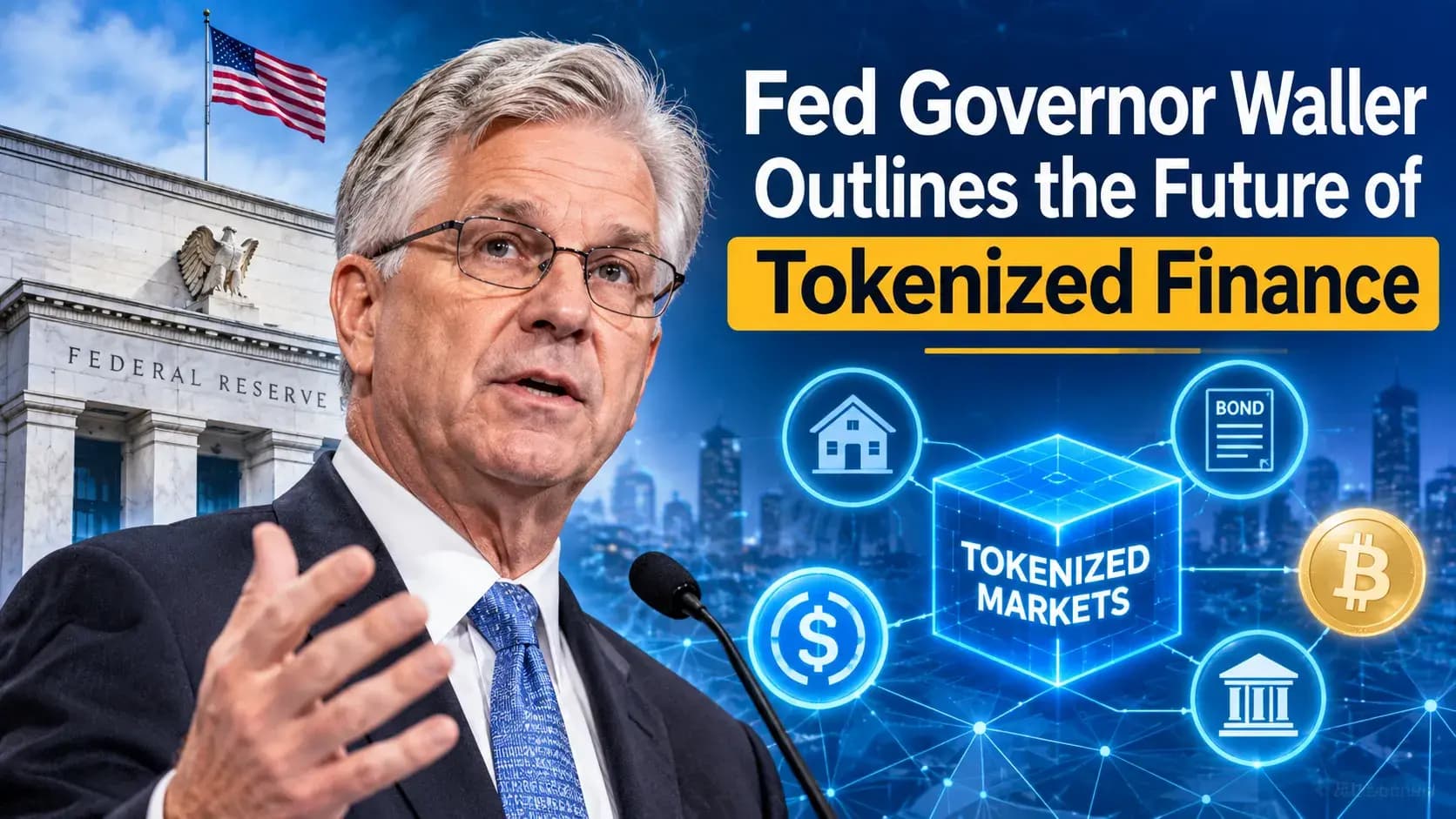
Federal Reserve Governor Christopher Waller has warned that the expansion of blockchain-based financial markets will depend on more than technological innovation. Clear legal frameworks, reliable payment infrastructure and accountability for operational failures will be essential if tokenized assets are to gain broader institutional adoption.
In a speech delivered on November 17 at The Clearing House Annual Conference 2026 in New York, Waller described how tokenization is bringing traditional financial institutions and blockchain-native companies into closer competition. He expects multiple forms of digital money and payment infrastructure to coexist, rather than one technology replacing the existing financial system.
His remarks offer an important perspective on the direction of U.S. financial innovation: the Federal Reserve sees potential in new payment technologies, but the foundations of trust in money and settlement must remain intact.
Blockchain Is Changing Competition in Payments
Waller said the convergence between blockchain technology and established financial markets is already underway. Financial instruments ranging from stocks and bonds to commodities are increasingly being represented as digital tokens and transferred across blockchain networks.
 CFTC Approves Backpack’s Blockchain-Based Derivatives Exchange in the U.S.→
 Binance Blocks MEXC Transfers After FinCEN Order→
 Ondo Plans to Anthropic Tokenized Stock on IPO Day→
 Stock Tokenization: What Are Tokenized Stocks and How Do They Work?→
The attraction is not limited to cryptocurrency trading. Tokenization can introduce programmability into financial transactions, allowing certain actions to be executed automatically when predefined conditions are met.
Waller highlighted the competitive advantages of open blockchain networks, particularly their ability to operate around the clock. Unlike many traditional financial systems, which follow business-day schedules and established operating windows, public blockchains can support transactions 24 hours a day, seven days a week.
This creates opportunities for new companies to compete with established banks and payment providers. New entrants may have stronger technical expertise and greater familiarity with blockchain-based business models. Traditional institutions, however, retain advantages through established customer relationships, market confidence and existing infrastructure.
The governor outlined several approaches emerging in the market. Some financial institutions are developing proprietary blockchain networks, while others are forming industry consortia or partnering with blockchain companies to introduce new products.
Waller does not expect the industry to settle on a single technical model. Instead, he believes different systems will emerge to serve different customers and financial use cases.
Trust and Legal Accountability Remain Major Obstacles
The most significant challenge identified in the speech was not blockchain performance but trust.
As financial assets move onto programmable networks, questions arise over who is responsible when transactions fail or users lose access to their assets. Waller specifically raised the possibility of fraud involving smart contracts, compromised private keys, mistaken transfers and pricing errors.
He also highlighted the problem of assets stranded on failed or abandoned blockchain networks, describing these as “zombie chains.” The Federal Reserve defines the term in this context as networks with very low levels of developer activity and daily use.
Waller referenced recent events involving Binance as an illustration of the risks associated with programmable blockchain systems. His point was broader than any single incident: as financial assets become dependent on digital infrastructure, market participants need to know who is accountable when that infrastructure fails.
For institutional investors, this is a central issue. A token representing a security must preserve the legal and economic rights associated with the underlying asset. Moving a token between networks should not undermine ownership rights, compliance requirements, corporate actions or access to liquidity.
Waller argued that technical safeguards alone will not be enough. Clear governance arrangements, legal rules and common data standards are equally important.
These questions become especially significant when tokenized assets are used in complex transactions involving multiple parties, smart contracts and different blockchain networks. Institutions need clarity about custody, settlement records, insolvency procedures and the treatment of assets if a service provider or network becomes unavailable.
The governor also suggested that systemically important financial transactions may require more conservative blockchain designs. Such systems could prioritize privacy, operational control and stronger safeguards over the unrestricted flexibility available on permissionless networks.
Stablecoins and Tokenized Deposits Could Coexist
Waller expects the payment infrastructure supporting digital assets to become increasingly diverse.
Stablecoins, tokenized bank deposits and tokenized money market funds are all emerging as potential instruments for settling transactions involving digital assets. Each has different characteristics, including its issuer model, regulatory treatment, connection to traditional financial infrastructure and potential use cases.
Stablecoins can facilitate programmable payments and transfers across blockchain networks. Tokenized deposits, meanwhile, represent commercial bank money in digital form and can be used to support transactions within a bank-linked framework.
Waller suggested that businesses may use several types of digital money simultaneously. International payments, corporate treasury operations and high-value securities transactions may require different settlement instruments.
This outlook is consistent with the October 29 report from the Bank for International Settlements’ Committee on Payments and Market Infrastructures (CPMI). The report, The Roles of Central Banks and Central Bank Money in the Evolving Payment System, describes how stablecoins, tokenized deposits and other payment arrangements could improve efficiency and competition while also introducing new operational, liquidity and cyber risks.
The BIS maintains that central bank money remains the safest and most liquid settlement asset for systemically important payment systems. Private-sector payment instruments can expand choice and innovation, but central bank money continues to anchor confidence in the broader system.
Waller made a similar argument. He said central bank money does not need to be used in every transaction or on every platform, but its presence at the foundation of the financial system remains essential.
That position does not amount to opposition to stablecoins or private blockchain infrastructure. Rather, it suggests that the Fed sees private innovation and public settlement infrastructure as complementary parts of the future payment system.
Atomic Settlement Is Not the Only Solution
One of the most frequently discussed benefits of blockchain-based finance is atomic settlement.
In an atomic transaction, multiple steps are completed together or not at all. For example, a tokenized share and its payment could transfer simultaneously, reducing the risk that one party delivers an asset without receiving the corresponding funds.
Waller used the example of an investor purchasing a tokenized stock on a Saturday, when many traditional financial systems are closed. Programmable money could allow the payment and transfer of ownership to take place at the same time, without waiting for conventional operating hours.
However, he cautioned against treating atomic settlement as the only appropriate model.
Net settlement and batch settlement can remain useful, particularly in high-volume financial markets where liquidity efficiency is important. These approaches allow participants to fund net obligations rather than every individual transaction in full.
The distinction matters because faster settlement does not automatically produce a more efficient financial system. Market infrastructure must balance speed, liquidity requirements, risk management and the needs of different participants.
For tokenized securities markets to scale, payment systems will therefore need to support multiple settlement methods and connect reliably with traditional financial rails.
The Federal Reserve Sees a Supporting Role
Waller described the Federal Reserve’s role as supporting responsible innovation rather than directing the market toward one technology.
The central bank can provide core payment and settlement infrastructure, monitor risks to financial stability and engage with private-sector participants. Where market forces cannot resolve a significant issue and the matter falls within the Fed’s mandate, it can also act as a coordinator.
This approach leaves room for private companies to develop new products while preserving the role of established financial infrastructure.
The governor also pointed to a developing connection between tokenization and artificial intelligence. AI agents could eventually participate in payments and commerce, while blockchain-based systems could provide programmable infrastructure for automated transactions.
However, both technologies face similar questions involving trust, governance, common standards and the balance between open and controlled networks.
What Waller’s Speech Means for the Digital Asset Industry
Waller’s remarks do not announce a new Federal Reserve policy or establish a regulatory approval for any particular blockchain, stablecoin or tokenized asset. They instead outline the issues that policymakers and financial institutions must address as digital assets become more closely integrated with traditional markets.
For crypto companies, the message is that technological capability alone will not guarantee institutional adoption. Providers will need credible custody arrangements, reliable operations, clear legal structures and safeguards for customers.
For banks and payment networks, the competitive pressure is increasing. Blockchain-native firms can offer around-the-clock services and programmable transactions, while established institutions can build on their existing relationships and access to regulated financial infrastructure.
The likely outcome, according to Waller, is not the disappearance of traditional payment systems. It is a more interconnected environment in which stablecoins, tokenized deposits, blockchain networks and conventional payment rails serve different purposes.
The next stage of financial innovation will therefore be shaped by how effectively these systems connect—and whether users, institutions and regulators can trust the assets and infrastructure operating between them.