

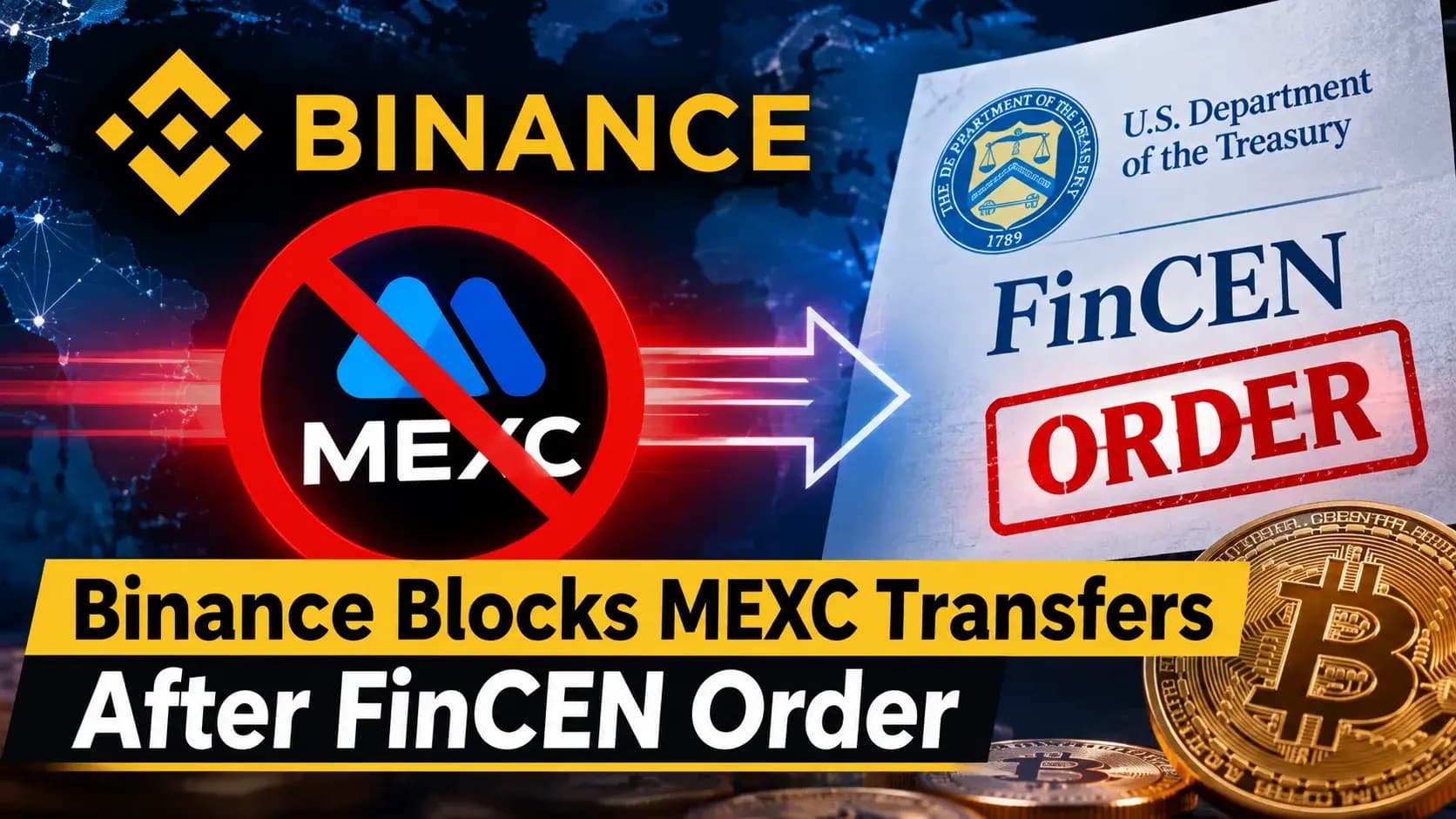
Binance has stopped processing transactions involving cryptocurrency exchange MEXC and its affiliated entities following a U.S. regulatory action that identified MEXC Global as a primary money laundering concern.
In an announcement published on November 10, Binance instructed users not to send funds to, receive funds from, or otherwise conduct transactions through Binance involving MEXC, MEXC Global and related companies. The exchange said transfers from Binance accounts to the listed entities would be rejected, while incoming deposits connected to them could be temporarily withheld for compliance review.
BINANCE:BNBUSDT
The decision follows an order issued by the U.S. Department of the Treasury’s Financial Crimes Enforcement Network (FinCEN) on November 6. The agency alleged that MEXC Global facilitated at least $16 billion in transactions connected to illicit financial activity between May 2021 and May 2026.
The developments introduce new compliance risks for customers who move cryptocurrency between the two platforms. They also demonstrate how regulatory action in the United States can influence the risk controls adopted by major international exchanges.
 SEC examination priorities put tokenization on 2027→
 Crypto.com Brings Prediction Markets to Institutions→
 IMF Sees Global Growth at 3.1% in 2026 as AI Boom Offsets Energy Shock→
 Morgan Stanley Sees $10T Tokenized Asset Market→
What Binance’s New Restrictions Mean
Binance’s November 10 announcement covers MEXC Global and a list of associated companies, including MEXC Global Limited, MEXC Estonia OÜ, GIDA Technology AG, MEXC Singapore Pte Ltd and other entities.
The restrictions have two main components.
First, Binance will reject requests to transfer funds from Binance accounts to the listed entities. Customers should therefore not expect transfers to MEXC addresses or affiliated platforms to be processed normally.
Second, deposits received from the identified entities will be temporarily withheld while Binance conducts compliance checks. The exchange warned that affected accounts could face additional restrictions under its Terms of Use, potentially including termination of services.
Binance also cautioned users against indirect transactions involving the named companies. This means that customers should not assume that routing funds through another wallet or intermediary will avoid the restrictions.
The exchange has not provided a universal timetable for completing individual reviews or releasing deposits that are temporarily withheld. The outcome may depend on the origin of the funds, the entities involved and the results of Binance’s compliance assessment.
The announcement is available in Binance’s official notice, Important: Transactions with Certain Crypto Platforms.
Why FinCEN Targeted MEXC Global
The restrictions follow a significant regulatory action against MEXC Global.
On November 6, FinCEN announced that it had issued an order under Section 9714(a) of the Combating Russian Money Laundering Act. The measure identifies MEXC Global as a foreign financial institution of primary money laundering concern in connection with Russian illicit finance.
According to the U.S. Treasury, MEXC facilitated at least $16 billion in transactions associated with illicit activity between May 2021 and May 2026. The agency identified several categories of alleged activity, including sanctions evasion, cybercrime and transactions involving actors connected to Russia, Iran and North Korea.
The Treasury also highlighted nearly $1.5 billion in transactions linked to Russian sanctions evasion, including direct transactions involving entities subject to U.S., European Union and United Kingdom sanctions.
FinCEN further alleged that MEXC processed transactions involving Iranian cryptocurrency exchanges and financial networks connected to sanctioned actors.
These figures represent the U.S. government’s findings and allegations in its regulatory order. They should not be interpreted as a claim that every transaction conducted through MEXC was illicit.
The full regulatory announcement is available on the FinCEN website.
The FinCEN Order and Binance Restrictions Have Different Timelines
One important distinction is the timing and legal scope of the two measures.
FinCEN’s order was published in the Federal Register on November 10, 2026. Under the document, the prohibition on covered financial institutions transmitting funds to or from MEXC Global becomes effective 30 days after publication.
That places the effective date on December 10, 2026.
The federal measure applies to covered financial institutions and prohibits specified fund transfers involving MEXC Global. The order includes convertible virtual currency within its definition of funds.
Binance, however, announced its own restrictions on November 10, with immediate effect. Its decision therefore preceded the effective date of the federal prohibition.
This distinction matters because Binance’s announcement is a platform-level compliance measure, while FinCEN’s order establishes a federal regulatory prohibition for institutions covered by the law.
The two measures are related, but they are not identical. Binance’s restrictions are governed by its own compliance policies and Terms of Use, and the exchange’s notice identifies a list of entities and affiliates relevant to its platform.
The Federal Register document can be reviewed here.
MEXC Says It Is Operating Normally
MEXC responded to FinCEN’s action on November 7, saying it was reviewing the order with its legal and compliance teams.
In its official statement, the exchange said its platform was operating normally and that customer assets remained secure. It also said it intended to engage constructively with FinCEN and other relevant authorities.
MEXC added that it had begun an independent review of its anti-money laundering and sanctions controls.
The company’s response is important for understanding the situation from the platform’s perspective. However, it does not resolve the regulatory findings or change the restrictions announced by Binance.
MEXC’s statement can be read on its official announcements page.
For customers, the practical distinction is that MEXC’s statement about normal platform operations does not guarantee that transfers involving Binance will be accepted.
What This Means for Crypto Users
The immediate impact is most relevant to customers who use both exchanges and regularly transfer assets between them.
Users should consider several points before initiating transactions:
- Transfers to MEXC: Binance says requests involving the listed entities will be rejected.
- Deposits from MEXC: Incoming funds may be withheld for compliance review.
- Account restrictions: Binance says affected accounts may face temporary restrictions or further action under its Terms of Use.
- Indirect transfers: Binance explicitly warns against transactions conducted indirectly through its platform involving the named entities.
- Transfer timing: Users should not assume that a transaction will be processed or released within a standard withdrawal timeframe.
Customers should review Binance’s official announcement and contact its support team if they have a pending transaction or believe their account has been affected.
They should also avoid attempting to bypass compliance controls by splitting transactions, using intermediaries or misrepresenting the source of funds. Such actions could create additional compliance concerns.
Importantly, the Binance announcement does not state that every MEXC customer automatically loses access to their assets. Nor does it establish a general prohibition on all cryptocurrency transfers outside Binance.
The restrictions concern transactions involving the identified entities through Binance, while FinCEN’s separate order applies to covered financial institutions under U.S. law.
Expert Perspective: Compliance Risk Extends Beyond U.S. Institutions
The case illustrates how a regulatory action against one cryptocurrency platform can affect relationships across the wider digital asset industry.
FinCEN’s order is directed at covered financial institutions, but other exchanges and service providers may independently reassess their exposure to the entities named in the regulatory action.
Compliance specialists at ComplyFactor, in their November 10 analysis of the Section 9714 order, highlighted the importance of understanding which financial institutions and money transmitters fall within the measure’s scope. They also noted that questions involving transfers routed through intermediaries may require legal interpretation.
This is a significant point for the cryptocurrency industry: regulatory exposure is not determined solely by whether a company is based in the United States. International platforms that interact with covered institutions may face additional scrutiny from banking partners, payment providers and other exchanges.
Legal analysis from Steptoe’s November 9 sanctions update similarly describes the order as a measure under Section 9714 of the Combating Russian Money Laundering Act, rather than a conventional asset-freezing action under an OFAC sanctions designation.
The distinction matters. The order creates a specific restriction on covered fund transfers; it should not be inaccurately described as a blanket freeze of every MEXC user’s cryptocurrency.
For exchanges, the broader lesson is that AML controls, sanctions screening and transaction monitoring can influence access to financial infrastructure even before a regulatory measure reaches its effective date.
What Happens Next?
The next important date is December 10, when FinCEN’s order is scheduled to take effect.
Before then, exchanges, financial institutions and other service providers will need to assess their obligations and determine how to identify transactions involving the entities covered by the measure.
Binance’s restrictions are already in place, and customers should follow the platform’s official guidance rather than assume that the federal effective date provides an additional window for transfers.
MEXC, meanwhile, says it is reviewing the regulatory findings and its compliance controls. Further information from the exchange or U.S. authorities could clarify how the situation develops.
The case may also influence how other cryptocurrency platforms approach transfers involving exchanges facing regulatory scrutiny.
Conclusion
Binance’s decision to block transactions involving MEXC and its affiliates marks a significant development in the regulatory response to FinCEN’s November 6 order.
The immediate consequences are practical: transfers to the listed entities will be rejected, incoming deposits may be held for review, and affected customers could face account restrictions.
The broader issue is the growing importance of regulatory compliance in determining how cryptocurrency platforms interact with one another and with traditional financial institutions.
For users, the safest approach is to verify the status of transfers through official exchange channels, understand the source of their funds and avoid attempting to circumvent compliance restrictions.
BINANCE:BTCUSDT
Disclaimer: This article is for informational purposes only and does not constitute legal or financial advice. Regulatory measures and platform policies may change. Users should consult official announcements and qualified advisers regarding their individual circumstances.