

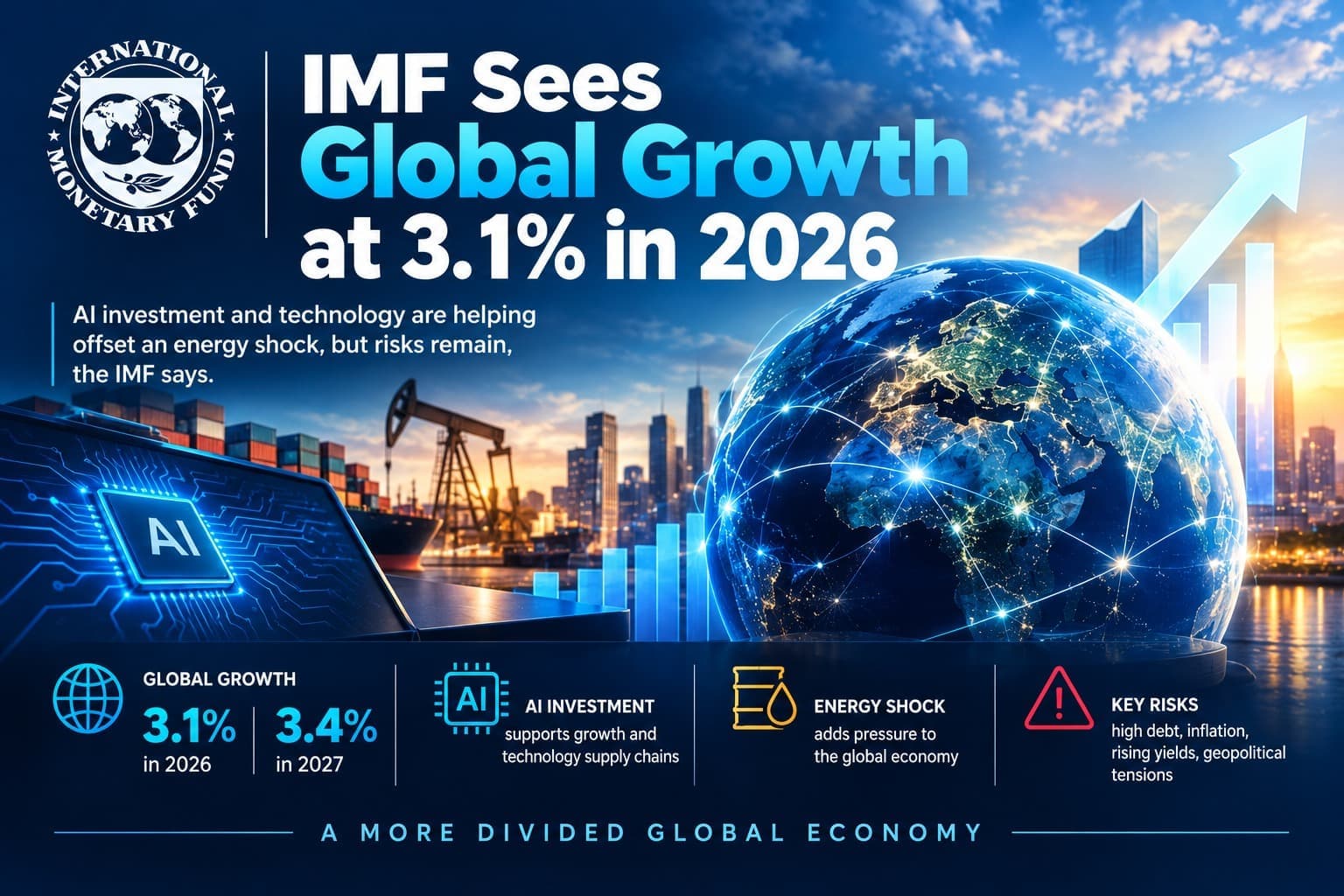
The International Monetary Fund expects the world economy to expand by 3.1% in 2026, with a powerful artificial intelligence investment cycle helping offset the economic impact of higher energy prices and geopolitical disruption.
The IMF’s October 2026 World Economic Outlook slightly raises its 2026 forecast from the 3.0% projected in July. Growth is then expected to accelerate to 3.4% in 2027, unchanged from the IMF’s July estimate.
But the headline numbers conceal an increasingly divided world economy.
Countries benefiting from AI infrastructure investment and technology supply chains are outperforming many energy-importing and lower-income economies. At the same time, elevated public debt, higher bond yields, persistent inflation and the Middle East conflict leave policymakers with less room to respond to another major shock.
 Morgan Stanley Sees $10T Tokenized Asset Market→
 SEC Proposes Expanding Cross-Trading for Funds→
 XRP Asia Officially Launches in Seoul to Accelerate XRP Ledger Adoption Across the Asia-Pacific Region→
 SEC Proposes New Crypto Custody Rules→
“The global economy has been resilient, but that resilience is reaching its limits,” IMF Chief Economist Silvana Tenreyro said as the report was released.
The message from the IMF is therefore not simply that the economy has avoided a severe downturn. It is that much of the resilience now depends on a narrow collection of economic engines — particularly AI investment.
AI investment is supporting the world economy
One of the most striking conclusions of the October outlook is the growing influence of artificial intelligence on economic activity.
Massive spending on data centers, semiconductors, computing infrastructure and related technologies is supporting investment in the United States while generating demand across technology supply chains in Asia and other regions.
The effect is large enough to influence the IMF’s macroeconomic forecasts.
The Fund estimates that world trade expanded 8.3% between 2023 and 2025, while AI-related trade grew about 29%. Without the AI component, overall trade growth would have been significantly weaker.
The benefits are also geographically concentrated.
South Korea, Malaysia, Mexico and Thailand are among economies benefiting from demand for AI-related hardware and infrastructure, while the United States continues to receive a major investment boost from the build-out of AI capacity.
The IMF now estimates that only 32 countries account for 95% of world economic growth, compared with 54 countries in its April assessment.
That concentration creates both opportunity and vulnerability.
If AI generates substantial productivity improvements, the investment cycle could support economic activity for years. If expectations outrun actual productivity gains, however, a correction could affect investment, equity valuations and broader financial conditions.
What happens if the AI boom reverses?
The IMF does not treat continued AI expansion as guaranteed.
Its downside analysis examines what could happen if anticipated productivity gains fail to materialize and companies sharply reduce investment.
Under that scenario, U.S. GDP could initially fall about 0.8%, with additional spillovers affecting Asian technology exporters.
A simultaneous correction in asset prices and tightening of financial conditions could amplify the impact. The IMF estimates the combined shock could reduce world output by approximately 1.1% by 2028, including a 1.8% reduction in U.S. output relative to the baseline.
IMF Managing Director Kristalina Georgieva summarized the concentration risk with a stark analogy, saying the economy is increasingly standing on an “AI leg.”
The concern is particularly relevant for financial markets because AI-related companies have become important drivers of equity valuations, corporate investment and capital expenditure.
A reassessment of expected returns could therefore spread beyond the technology sector.
For investors following the institutional technology cycle, CryptoQuorum recently examined how Nasdaq CEO Adena Friedman sees tokenization and digital financial infrastructure as another potential source of capital efficiency. Both trends demonstrate how technology investment is increasingly intersecting with broader macroeconomic and financial-market conditions.
United States holds at 2.3%
The IMF expects the U.S. economy to grow 2.3% in both 2026 and 2027.
Private consumption, tax policy and AI investment are providing support, although part of the AI investment boost leaks abroad through imports of hardware and components.
The euro area is expected to grow more slowly.
The IMF raised its 2026 euro-area projection to 1.1% from 0.9% in July, citing stronger investment, participation in AI supply chains and higher defense spending.
The United Kingdom’s forecast was also upgraded, to 1.3% for 2026.
China, meanwhile, is expected to expand 4.5% in 2026 before slowing to 4.0% in 2027. Higher energy costs and weak domestic demand remain constraints despite strong exports.
India stands out among the world’s largest economies. The IMF projects growth of 7.0% in both 2026 and 2027, supported by domestic demand, services activity and investment.
Inflation remains a problem
Economic resilience has not eliminated inflationary pressure.
The IMF expects global headline consumer price inflation to reach 4.7% in 2026 before easing to 4.1% in 2027.
Energy remains a central source of uncertainty.
The October forecast assumes an average oil price of approximately $96 per barrel in 2026 and $87 in 2027. It also assumes that the Strait of Hormuz will reopen in March 2027, followed by a broader normalization of shipping conditions by October.
Those assumptions are critical.
A prolonged disruption that pushes oil to $130 per barrel through the first quarter of 2027 would cut approximately 0.5 percentage point from 2027 world economic growth, according to the IMF’s adverse scenario.
Inflation in 2027 could simultaneously rise another 1.1 percentage points, reaching about 5.2%.
That combination — weaker output and higher inflation — would create a particularly difficult environment for central banks.
High government debt reduces room for another crisis
The IMF’s second major warning concerns public finances.
Governments accumulated substantial debt through the pandemic and subsequent economic shocks. Higher interest rates now make that debt considerably more expensive to service.
Rising sovereign bond yields can compound the problem by increasing refinancing costs.
The Fund argues that governments should rebuild fiscal buffers rather than assuming they will always be able to borrow cheaply during the next downturn.
Tenreyro called for countries to restore fiscal space and rebuild supply-side resilience.
This is particularly important because many of the mechanisms used to absorb previous shocks are becoming less effective.
Energy reserves have been drawn down. Government balance sheets are under greater pressure. Interest rates remain relatively high in many economies.
The ability to respond to another large geopolitical, financial or climate shock may therefore be weaker than the headline 3.1% growth number suggests.
Growth is becoming increasingly uneven
Perhaps the most important structural message from the October WEO is divergence.
The AI investment boom is benefiting economies positioned inside technology supply chains, while the Middle East energy shock disproportionately affects countries dependent on imported energy or directly exposed to the conflict.
The IMF has downgraded almost half of the economies covered by its forecasts compared with April.
Several Gulf economies face especially severe contractions because of the regional conflict and disruption to energy production and trade.
Latin America and the Caribbean are also receiving relatively little benefit from the AI investment boom. The IMF projects regional growth of 2.3% in 2026 and 2.5% in 2027.
This uneven distribution matters because an apparently stable world economy can still contain significant regional recessions and financial stress.
What the IMF outlook means for crypto markets
The IMF report is not a cryptocurrency forecast, but its conclusions have important implications for digital assets.
Crypto markets increasingly trade within the same global liquidity environment as equities and other risk assets.
Persistent inflation can keep central banks cautious about reducing interest rates. Higher sovereign bond yields can increase the attractiveness of lower-risk fixed-income assets relative to speculative investments. An AI-driven equity correction could also trigger broader deleveraging and risk reduction.
Conversely, resilient economic activity combined with declining inflation could support financial conditions and investor appetite for risk.
Bitcoin and other digital assets therefore remain exposed to many of the macroeconomic forces highlighted by the IMF: inflation expectations, interest rates, government bond yields, energy prices, geopolitical shocks and global liquidity.
The relationship is not mechanical. A change in GDP growth does not automatically determine Bitcoin’s price. But the financial conditions surrounding growth can materially influence capital flows across risk assets.
AI presents upside as well as downside
The IMF is not uniformly pessimistic about artificial intelligence.
Its alternative upside scenario shows how faster adoption and stronger productivity gains could lift world GDP by an additional 0.6% by 2029.
The United States and China would capture a substantial share of those benefits.
The difference between the positive and negative scenarios depends largely on whether enormous investment in AI infrastructure translates into durable productivity improvements.
That makes the next several years unusually consequential.
Markets are already pricing significant expectations into AI-related companies and infrastructure spending. If productivity follows, the current investment cycle could strengthen economic capacity. If returns disappoint, the same concentration of capital could amplify a financial correction.
The global economy remains resilient — but vulnerable
The October World Economic Outlook presents an unusual macroeconomic picture.
AI investment is providing a powerful positive shock at the same time that geopolitical conflict and high energy prices are creating a negative supply shock.
For now, the positive forces are strong enough to keep global growth above 3%.
But the IMF’s warning is that resilience should not be confused with immunity.
High public debt, reduced fiscal buffers, elevated energy prices, concentrated AI investment and geopolitical uncertainty leave the world economy vulnerable to additional shocks.
The 3.1% headline forecast therefore tells only part of the story.
The more important question is whether governments and financial markets can use the current period of resilience to rebuild buffers before the next disruption arrives.
Disclaimer: This article is for informational purposes only and does not constitute investment, financial or economic advice. IMF projections are forecasts based on assumptions that can change as economic, geopolitical and financial conditions evolve.