

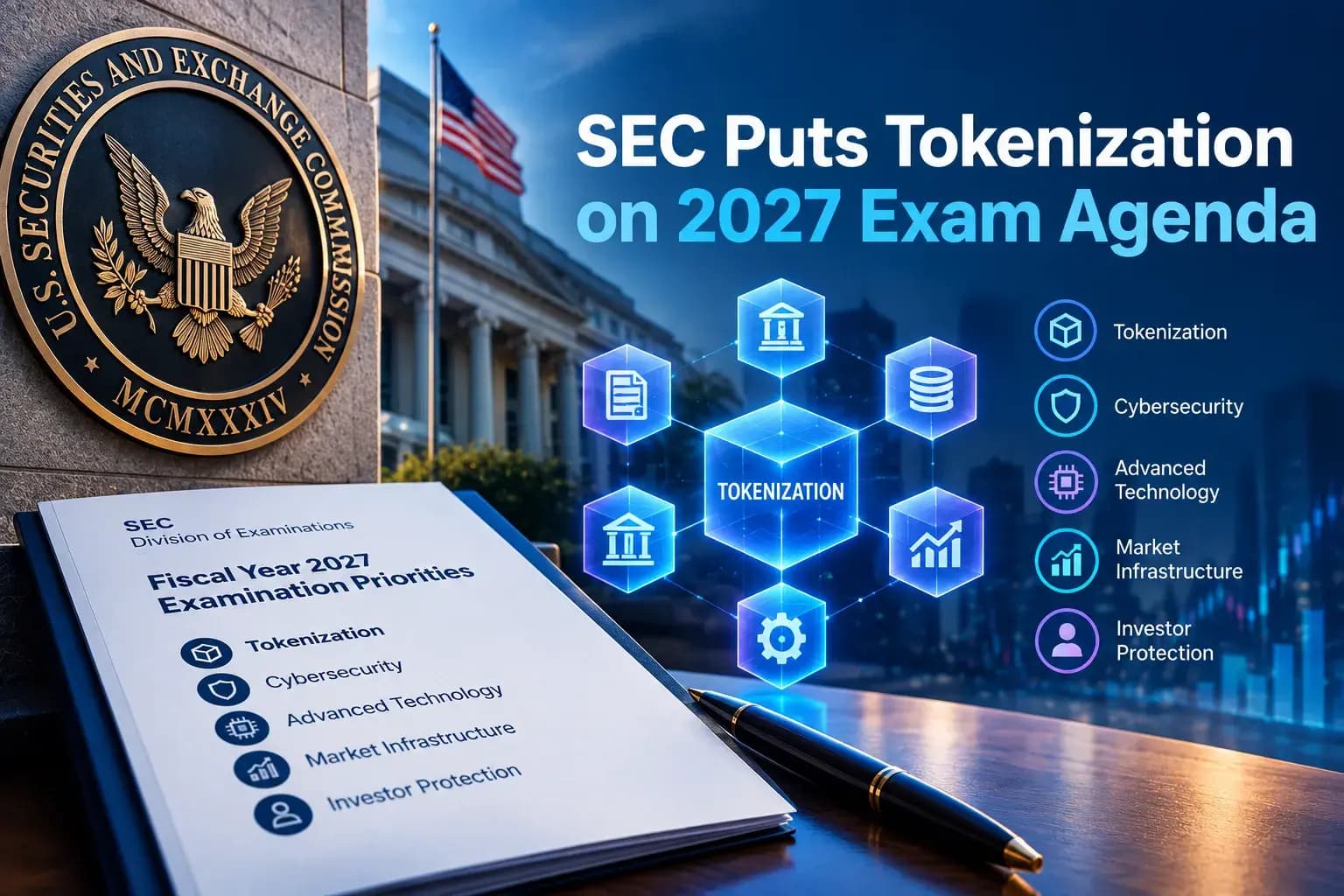
The U.S. Securities and Exchange Commission has identified tokenization, advanced technology, cybersecurity and changes to financial-market infrastructure among the areas that will receive heightened attention from examiners in fiscal 2027.
The SEC‘s Division of Examinations published its Fiscal Year 2027 examination priorities on October 23, outlining the risks and market developments that will guide its oversight of more than 34,000 registrants.
For the digital-asset industry, one line is particularly significant: the SEC explicitly identifies tokenization among the developments reshaping market infrastructure that examiners will monitor.
The inclusion comes as the agency simultaneously moves toward allowing controlled experimentation with tokenized securities, making supervision increasingly relevant as blockchain infrastructure moves closer to regulated U.S. capital markets.
 Tokenized U.S. Treasuries: How They Work→
 JPMorgan Brings Tokenized Money Market Funds to Solana→
 What Is Asset Tokenization and How Does It Work?→
 Crypto.com Brings Prediction Markets to Institutions→
SEC Adds Tokenization to Its 2027 Priorities
The official SEC FY2027 announcement identifies eight broad areas of heightened attention.
They include investment advisers’ fiduciary duties and conflicts of interest; retail investor protection; private funds and private credit; broker-dealer supervision and anti-money laundering compliance; cybersecurity; advanced technologies; evolving market infrastructure; and oversight of critical market participants.
Tokenization appears within the market-infrastructure category alongside reforms to U.S. Treasury clearing.
That placement is important.
Rather than treating blockchain-based assets solely as a separate “crypto” category, the SEC is examining tokenization in the context of changes to the infrastructure supporting conventional financial markets.
This distinction reflects how tokenization is evolving.
Tokenized Treasury products, investment funds and equities increasingly connect blockchain technology with assets that already fall within established securities and financial-market frameworks.
Why Tokenization Matters to the SEC
Tokenization can change how securities are issued, recorded, transferred, traded and settled.
A tokenized security can represent rights associated with an underlying traditional asset while using distributed-ledger technology for parts of the ownership or transaction process.
That creates potential efficiencies, but it also introduces questions involving custody, recordkeeping, smart contracts, cybersecurity, investor rights, operational resilience and market structure.
Those issues are increasingly relevant in the United States.
In September, the SEC issued temporary conditional relief allowing qualifying Tokenized Securities Venues to experiment with trading certain tokenized NMS stocks through permissioned automated market makers and liquidity pools.
CryptoQuorum examined that framework in SEC Allows Limited Tokenized NMS Stock Trading.
The juxtaposition is notable: the SEC is creating room for regulated tokenization experiments while simultaneously signaling that the technology will be part of its risk-based examination program.
That is not necessarily contradictory.
Innovation and supervision can develop at the same time, particularly when new infrastructure begins interacting with regulated securities markets.
Tokenization Is Not a New Enforcement Category
The SEC examination priorities should not be interpreted as a new regulatory crackdown on tokenized assets.
The Division explicitly states that its annual priorities are not an exhaustive list of everything examiners may review. Instead, they identify areas that currently warrant heightened attention based on the agency’s risk assessments.
The priorities also do not establish new legal obligations.
A firm’s obligations continue to depend on applicable federal securities laws, regulations and its specific activities.
This distinction is particularly important for crypto and RWA markets, where references to tokenization in regulatory documents can easily be interpreted as either approval or prohibition.
The FY2027 document represents neither.
It indicates that the SEC considers tokenization sufficiently relevant to modern financial infrastructure to warrant examination attention.
Expert View: SEC Says Examinations Must Evolve With Markets
SEC Chairman Paul S. Atkins described examinations as one of the Commission’s most important tools for promoting compliance and protecting investors.
According to Atkins, examinations also provide regulators with insight into emerging risks, changing business practices and market developments.
Keith Cassidy, Director of the Division of Examinations, emphasized the need for supervision to evolve alongside markets.
“The markets we oversee continue to evolve rapidly, and the examination program must evolve with them,” Cassidy said in the SEC announcement.
His comments provide useful context for the inclusion of tokenization.
The SEC is not examining blockchain technology in isolation. It is considering how technological and structural changes could affect investors, registered firms and market integrity.
The Division also says it can adjust its focus throughout FY2027 in response to market events, new products, emerging technologies and changing investor concerns.
Advanced Technology Moves Higher on the Agenda
Tokenization is only one technology-related component of the new priorities.
The SEC also highlights emerging technologies, including what the agency calls “super intelligence” and other advanced technologies that may influence market operations, compliance, fraud prevention and investor protection.
The full FY2027 Examination Priorities report also discusses the Division’s own adoption of advanced technology.
According to the report, the Division is working to integrate such tools into examinations and risk assessment while keeping human examiner judgment central to the process.
This creates two sides to the technology issue.
Regulators must examine how financial firms use increasingly sophisticated systems while also modernizing their own surveillance and analytical capabilities.
For financial institutions deploying blockchain, automated trading or advanced AI systems, technological innovation therefore increasingly intersects with traditional compliance requirements.
Cybersecurity and Customer Data Remain Critical
Operational resilience and cybersecurity remain prominent in the FY2027 agenda.
This has direct relevance to digital assets.
Blockchain networks can provide transparent and tamper-resistant transaction records, but firms interacting with them still rely on wallets, private keys, APIs, smart contracts, custody systems and conventional IT infrastructure.
A blockchain transaction may be secure at the protocol level while vulnerabilities exist elsewhere in the operational chain.
That is one reason custody remains an important regulatory issue.
CryptoQuorum recently covered the SEC’s proposed crypto custody rules for advisers and funds, which seek to modernize requirements affecting how regulated investment firms hold digital assets.
Taken together, custody, cybersecurity and tokenization illustrate the broader challenge regulators face: integrating new financial technology without weakening established investor protections.
Private Funds and Complex Investments Also Face Scrutiny
The FY2027 priorities extend well beyond digital assets.
The Division will focus on private funds, private credit and other complex investment strategies, while investment advisers will continue to face examinations covering fiduciary duties, conflicts of interest, recommendations and compliance programs.
Retail investors are another major focus.
The SEC specifically highlights complex, higher-risk and illiquid investment products.
For broker-dealers, examiners will look at financial responsibility, trading practices, supervision and anti-money laundering compliance.
These priorities matter to the digital-asset sector because institutional crypto and tokenization increasingly overlap with conventional investment structures.
Tokenized funds, securities and other RWA products do not necessarily sit outside traditional regulatory frameworks simply because blockchain technology is involved.
What This Means for the RWA Market
The inclusion of tokenization in the SEC examination priorities is another indication that real-world asset tokenization is moving from experimentation toward regulated financial infrastructure.
The market has already expanded beyond tokenized representations of simple assets.
Asset managers are bringing money market funds and Treasury strategies onchain. Financial institutions are exploring tokenized deposits. Infrastructure providers are developing systems for tokenized equities, collateral and settlement.
The SEC itself has now created a limited framework for experimenting with tokenized NMS stocks.
As these markets expand, regulatory questions increasingly concern not whether tokenization exists, but how it interacts with custody, shareholder rights, settlement, disclosures, cybersecurity and market integrity.
That is a more mature regulatory question.
It also suggests that the next phase of RWA development will increasingly depend on compliance infrastructure alongside blockchain infrastructure.
A More Transparent Examination Approach
The FY2027 announcement also contains an important message for regulated firms.
The Division says it is working to make the examination process more accessible, including improving how registrants receive examination observations and interact with staff.
The agency is also strengthening coordination between the examination staff, SEC policymaking divisions and other regulators.
This continues a theme seen under Chairman Atkins.
When the SEC released its FY2026 priorities, Atkins said examinations should not operate as a “gotcha” exercise.
The regulatory implication is that examination priorities are intended partly to tell firms where supervisors see emerging risks before an examination occurs.
For companies developing tokenization infrastructure, that provides a useful compliance signal.
Cybersecurity, customer protection, operational resilience and the legal structure surrounding tokenized securities should be considered during product design rather than after deployment.
What Market Participants Should Watch in 2027
Several developments could determine how important tokenization becomes within the SEC’s examination program.
The first is adoption.
If regulated broker-dealers, investment advisers, funds and market infrastructure providers accelerate their use of tokenized assets, examination activity is likely to generate more practical information about how existing securities rules apply.
The second is market structure.
The SEC’s September Innovation Exemption creates an opportunity to observe limited tokenized NMS stock trading under defined conditions. Real trading activity could expose operational or regulatory issues that theoretical discussions do not reveal.
The third is custody.
Institutional tokenization requires legally robust systems for controlling digital assets and private keys while protecting client assets.
Finally, interoperability will matter.
As securities and investment products appear across multiple blockchain networks, regulators and financial institutions will need to address fragmented liquidity, ownership records, settlement and cross-chain operational risks.
Bottom Line
The SEC’s FY2027 priorities provide another signal that tokenization is entering the mainstream regulatory conversation.
The agency is not announcing a new tokenization rule or declaring tokenized assets inherently problematic. Instead, it is identifying the technology as one of the developments changing financial-market infrastructure and therefore deserving greater supervisory attention.
That distinction matters.
In September, the SEC created a limited framework for experimentation with tokenized U.S. stocks. In October, it proposed changes affecting crypto custody by advisers and funds. Now tokenization itself appears within the Division of Examinations’ risk agenda.
Together, these developments suggest that U.S. regulation is moving beyond the basic question of whether blockchain belongs in securities markets.
The emerging question is how blockchain-based financial infrastructure can operate within those markets while preserving custody standards, investor rights, cybersecurity and market integrity.
For the RWA sector, that transition could be significant.
Tokenization is increasingly being treated not simply as a crypto innovation, but as an evolving component of regulated capital-market infrastructure.
Disclaimer: This article is for informational purposes only and does not constitute investment, legal or financial advice. SEC examination priorities do not establish new legal requirements, and regulatory policies may change.