

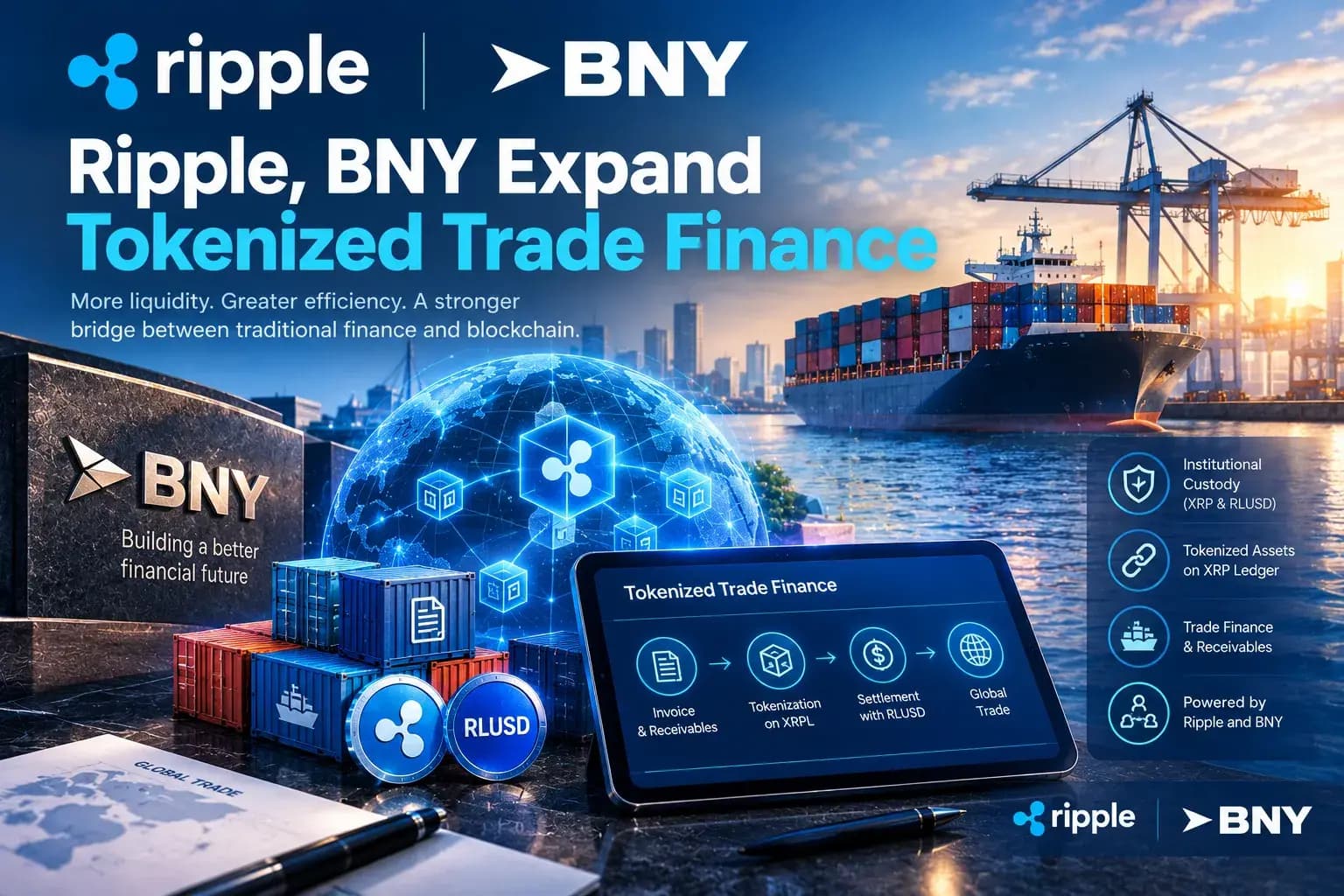
Ripple and BNY are expanding their digital asset partnership across institutional custody and tokenized trade finance, bringing XRP and RLUSD deeper into the infrastructure of one of the world’s largest financial services companies.
Announced on October 27, the expanded collaboration adds XRP and Ripple’s dollar-backed stablecoin RLUSD to BNY’s Digital Asset Custody platform for eligible institutional clients.
BINANCE:XRPUSDT
The companies also intend to expand support for tokenized assets and investment products issued on the XRP Ledger, or XRPL, and work toward enabling BNY clients to mint and redeem RLUSD directly through the bank.
But the partnership goes beyond custody.
 Ripple National Trust Bank wins OCC approval→
 SEC examination priorities put tokenization on 2027→
 Tokenized U.S. Treasuries: How They Work→
 JPMorgan Brings Tokenized Money Market Funds to Solana→
Ripple and BNY are also exploring blockchain-based trade finance with working-capital platform C2FO, focusing on assets such as approved accounts receivable that could be represented on XRPL and made accessible to a broader range of investors.
The announcement comes just one day after Ripple received final approval from the Office of the Comptroller of the Currency to establish Ripple National Trust Bank, adding another regulated component to the company’s institutional digital-asset strategy.
BNY Adds Institutional Custody for XRP and RLUSD
The most immediate development is BNY’s addition of XRP and RLUSD to its Digital Asset Custody platform.
According to the official Ripple and BNY announcement, eligible institutional clients can use the platform to safeguard, hold and transfer the assets within BNY’s existing governance and control framework.
This extends a relationship that was already significant.
BNY serves as the primary reserve custodian for RLUSD and also maintains a custody relationship with Ripple Prime, Ripple’s institutional prime brokerage business.
The expansion therefore connects several layers of Ripple’s institutional infrastructure: stablecoin reserves, digital asset custody, prime brokerage and blockchain settlement.
For institutions, that integration may be more important than simply adding another cryptocurrency to a custody platform.
Banks, asset managers and corporations generally require defined custody arrangements, operational controls, risk management and regulated counterparties before digital assets can be incorporated into existing financial workflows.
BNY provides that traditional institutional layer.
RLUSD Could Become More Closely Integrated With BNY
The next phase could deepen the relationship further.
BNY intends to work with Ripple toward allowing its clients to mint and redeem RLUSD directly through the bank.
That capability is not described as fully available today. It is an intended development and should therefore be distinguished from BNY’s already-live custody support.
If implemented, direct minting and redemption could reduce friction for institutional users moving between conventional dollar infrastructure and blockchain-based settlement.
RLUSD is already central to the relationship.
BNY holds reserves supporting the stablecoin, while Ripple says RLUSD has grown to approximately $2.5 billion in market capitalization and is being used across payments, trading and tokenized finance.
The stablecoin also gained an additional regulatory layer this week after final OCC approval for Ripple National Trust Bank, which will manage segregated RLUSD reserves and act as collateral trustee for holders.
That development is covered separately in CryptoQuorum’s analysis of Ripple’s OCC approval for a national trust bank.
Ripple and BNY Target Tokenized Assets on XRPL
BNY also intends to broaden support for tokenized assets and investment products issued on XRP Ledger as institutional activity develops.
That could be strategically important for XRPL.
A blockchain can support tokenized financial products technically, but institutional adoption requires more than issuance infrastructure. Investors need custody, settlement, liquidity, compliance systems and mechanisms for moving between digital and traditional financial assets.
BNY could provide part of that bridge.
The bank reported $63.4 trillion in assets under custody and/or administration and $2.2 trillion in assets under management as of September 30, 2026.
Connecting infrastructure of that scale with a public blockchain does not guarantee institutional adoption, but it reduces one of the practical barriers facing tokenized assets: access to established financial servicing infrastructure.
Expert View: Tokenization Must Move Beyond Issuance
Ripple President Monica Long framed the collaboration as a transition from issuing assets onchain to making those assets useful within financial markets.
Her argument is important for understanding the next stage of tokenization.
Putting a Treasury security, fund share or receivable on a blockchain is only the first layer. For tokenization to change financial markets meaningfully, those assets must be usable for payments, settlement, financing and collateral.
BNY’s Carolyn Weinberg, Chief Innovation and Market Transformation Officer, offered a similar institutional perspective.
She said future market infrastructure will require connectivity across payments, liquidity, collateral and securities, supported by bridges between established financial systems and always-on blockchain technology.
Both executives represent companies participating directly in the initiative, so their comments should be understood as strategic views rather than independent assessments.
Still, they identify a genuine challenge facing the RWA market: tokenized assets need financial infrastructure around them, not simply blockchain representation.
Trade Finance Moves Onto XRP Ledger
The most interesting RWA component of the announcement involves trade finance.
Ripple and BNY intend to advance tokenized trade finance on XRPL, subject to client requirements.
Trade finance is a large but operationally complex market built around invoices, receivables, payment obligations and financing arrangements between suppliers, buyers, banks and capital providers.
The companies are exploring a supply-chain finance initiative with C2FO, a working-capital platform, aimed at improving investor access to this asset class.
One potential target is approved accounts receivable.
A receivable represents money a company is entitled to receive from a customer. Businesses often finance those receivables to access cash before an invoice reaches its payment date.
Representing those claims digitally could potentially make financing and distribution more efficient.
Importantly, tokenization does not change the underlying economic asset. The value still depends on a real-world payment obligation and the creditworthiness and contractual relationships behind it.
Blockchain changes the infrastructure used to represent, transfer and potentially settle that asset.
C2FO Takes the Idea Further With Instant Pay
Ripple separately announced a more specific initiative with C2FO on October 27.
The companies plan to bring financing and settlement activity supporting C2FO Instant Pay onto XRP Ledger, using RLUSD for settlement.
C2FO says businesses using supply-chain finance can currently wait days for funds to move through conventional banking infrastructure even after an invoice has been approved for early payment.
Under the proposed model, participating capital providers would fund early payments while XRPL and RLUSD handle settlement.
C2FO says its existing Early Pay programs have facilitated more than $250 billion in working capital through accelerated payment of approved invoices.
That existing commercial activity distinguishes the project from purely experimental tokenization concepts.
Instead of inventing a new asset specifically for blockchain, the companies are attempting to apply blockchain settlement to an established financing market.
Why Receivables Are Important for RWA Tokenization
Receivables are particularly interesting from an RWA perspective because they represent a vast category of short-duration financial claims generated by ordinary business activity.
A supplier delivers goods.
The buyer approves an invoice.
The supplier may then wait 30, 60 or 90 days to receive payment.
Working-capital platforms and financial institutions can provide financing against that future payment.
Tokenization could potentially create a digital representation of the financing claim and make ownership, settlement and distribution more programmable.
That could broaden investor access, although regulatory, credit, legal and operational risks remain.
Investors still need to understand who owes the money, whether the receivable is legally enforceable, how defaults are handled and what rights a token actually represents.
Those questions cannot be solved merely by placing the asset on a blockchain.
For background, CryptoQuorum’s guide to real-world asset tokenization explains how traditional financial claims can be represented using blockchain infrastructure.
XRP and RLUSD Have Different Roles
The BNY announcement also makes an important distinction between XRP and RLUSD.
Both assets are now supported by BNY’s custody platform, but they serve different purposes.
XRP is the native digital asset of XRP Ledger.
RLUSD is a dollar-backed stablecoin designed to maintain a stable value and support payments, trading and tokenized finance.
For the C2FO initiative, Ripple specifically identifies RLUSD as the settlement asset.
That distinction matters because headlines suggesting that XRP itself will be used to finance or settle all tokenized receivables would go beyond what the companies announced.
XRP could benefit indirectly from broader XRPL adoption, but the trade-finance initiative does not establish a direct investment thesis or guarantee additional demand for XRP.
OCC Approval Strengthens Ripple’s Institutional Strategy
The BNY announcement arrived only one day after another major development for Ripple.
On October 26, the OCC gave final approval for Ripple National Trust Bank.
The federally supervised institution is authorized to manage segregated reserves supporting RLUSD, serve as collateral trustee for those reserves and provide fiduciary digital asset custody.
Taken together, the two announcements show how Ripple is assembling different parts of an institutional financial stack.
Ripple National Trust Bank provides federally supervised reserve and custody infrastructure.
BNY provides institutional custody and traditional financial servicing.
RLUSD provides a dollar-denominated settlement asset.
XRPL provides blockchain infrastructure.
C2FO brings established working-capital activity and corporate receivables.
The important story is therefore larger than a new XRP custody listing.
From Holding Digital Assets to Using Them
Institutional digital-asset adoption has historically focused heavily on custody.
That made sense. Before institutions could use blockchain-based assets, they needed secure ways to hold them.
The Ripple-BNY collaboration points toward a different phase.
Custody remains essential, but the focus is expanding toward utility: using digital assets for collateral, payments, settlement, investment products and trade finance.
This mirrors a broader shift across the RWA market.
Asset managers are tokenizing money market funds and Treasury products. Banks are experimenting with tokenized deposits. Financial institutions are exploring blockchain-based collateral and settlement.
Trade finance could become another major category because it connects blockchain technology directly with corporate cash flow and working capital.
What Comes Next
Several elements of the partnership remain prospective.
BNY’s custody support for XRP and RLUSD is already available to eligible institutional clients, but direct RLUSD minting and redemption through BNY is an intended future capability.
Support for additional XRPL-based tokenized assets is also expected to expand over time.
The broader trade-finance initiative remains subject to client requirements, while the C2FO project will provide an important test of whether blockchain settlement can produce measurable operational advantages in a real working-capital market.
The metrics to watch will be practical ones: financing volume, settlement time, institutional participation, liquidity, operating costs and whether investors gain meaningful access to assets that were previously difficult to distribute.
Bottom Line
Ripple’s expanded BNY relationship represents another step in the institutionalization of XRP Ledger.
The immediate development is straightforward: BNY now supports institutional custody of XRP and RLUSD.
But the larger strategy is more ambitious.
Ripple and BNY want to connect custody with stablecoin issuance and redemption, tokenized investment products, payments, collateral and tokenized trade finance.
The C2FO initiative gives that strategy a real-world testing ground in corporate receivables and working capital.
Combined with Ripple’s newly approved national trust bank, the developments suggest the company is building infrastructure designed to connect public blockchain rails with regulated financial institutions rather than operating as a parallel system outside them.
Whether that infrastructure achieves meaningful scale will depend on institutional demand and execution.
But the direction is increasingly clear: the next stage of tokenization is moving beyond putting assets onchain.
The challenge now is making those assets useful inside real financial markets.
Disclaimer: This article is for informational purposes only and does not constitute investment, legal or financial advice. Digital assets and tokenized financial products involve risk and may not be suitable for all investors.