

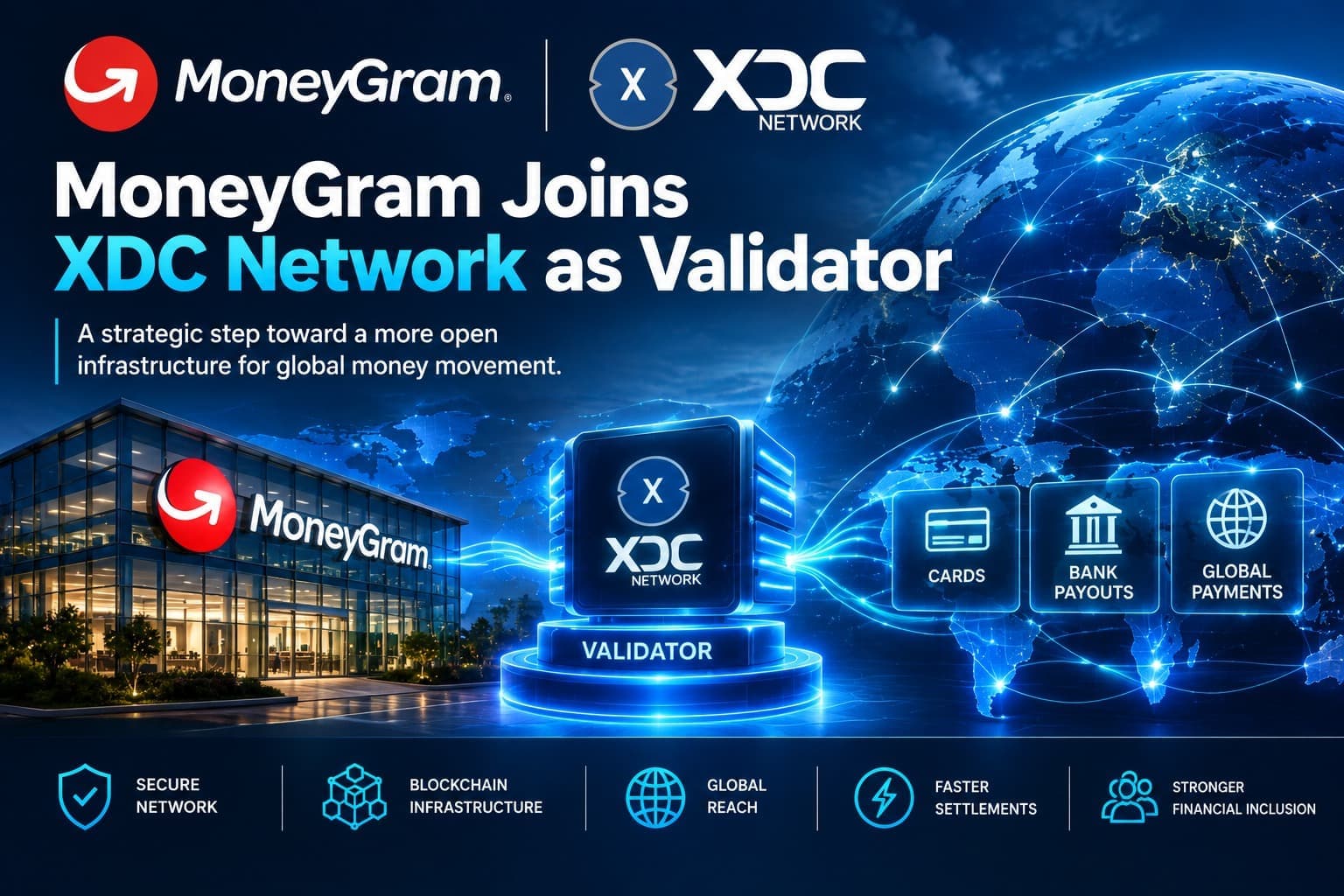
MoneyGram is expanding its blockchain infrastructure strategy by joining XDC Network as an institutional validator, giving the global payments company a direct role in securing another public blockchain.
The company announced the move on October 15 through its official X account, saying it would participate in network security as part of its broader effort to build more open infrastructure for global money movement.
“MoneyGram is joining @XDCNetwork as an institutional validator, taking an active role in securing the network,” the company said.
The announcement is concise, but it adds another important piece to MoneyGram’s rapidly expanding blockchain strategy.
 Mastercard and BVNK have launched a new global payments platform→
 Fink: Data Center Moratorium Risks Recession→
 Ripple, Meritz Bring Tokenization to Korea→
 SEC Sets Compliance Seminar for Nov. 19→
Rather than relying on a single blockchain, MoneyGram is increasingly participating directly in the infrastructure of multiple networks. The company already operates as a validator on Solana, serves as an anchor remittance validator for Tempo and has built stablecoin services around Stellar.
The XDC announcement, however, should not be interpreted as confirmation that MoneyGram will move customer remittances or its MGUSD stablecoin onto XDC. Neither company has announced such an integration.
What MoneyGram’s Validator Role Means
Validators perform infrastructure-level functions on blockchain networks.
Depending on the consensus mechanism, validators participate in confirming transactions, producing or signing blocks and maintaining the integrity of the distributed ledger.
XDC uses its XDPoS consensus architecture. According to the network’s technical documentation, masternodes help validate transactions and secure the blockchain.
Operating a masternode requires Know Your Customer verification and a minimum stake of 10 million XDC.
The network distinguishes between validator and standby masternodes. Validators participate directly in transaction validation and block creation, while standby nodes are structurally similar but do not actively produce blocks.
XDC’s official masternode documentation provides the technical requirements for operating this infrastructure.
MoneyGram has not disclosed how many nodes it plans to operate, the address of its validator, how its required stake will be structured or when the node will become active.
Those details matter because announcing an intention to become a validator is different from confirming an identifiable validator operating onchain.
Why XDC Is Relevant to MoneyGram
XDC is an enterprise-focused Layer 1 blockchain designed around financial applications including trade finance, tokenization and payments.
The network is EVM-compatible, allowing developers familiar with Ethereum tooling to build smart-contract applications while using XDC’s own consensus infrastructure.
Its institutional focus is particularly relevant to MoneyGram.
XDC describes trade finance and real-world asset tokenization as core areas of development. The network also supports native USDC and Cross-Chain Transfer Protocol functionality, giving applications access to dollar-denominated blockchain liquidity.
According to the XDC Foundation, its ecosystem is increasingly targeting the intersection of stablecoins, payments, tokenized assets and enterprise financial infrastructure.
That does not mean MoneyGram has committed to using those capabilities.
For now, the confirmed relationship is narrower: MoneyGram is joining as an institutional validator and helping secure the blockchain.
MoneyGram Is Becoming a Multichain Infrastructure Participant
The broader context makes the announcement more significant.
MoneyGram is no longer simply experimenting with blockchain as an alternative payment channel. During 2026, the company has increasingly moved into the infrastructure layer itself.
In May, MoneyGram announced a partnership with Tempo, a Layer 1 blockchain designed for high-volume payments. MoneyGram became Tempo’s anchor remittance validator and said the relationship would also extend to stablecoin settlement.
The company described that strategy as building an open and interoperable global payments network capable of operating “across chains” and across borders.
Then, in June, MoneyGram joined Solana as a validator, contributing directly to the network’s security and performance.
The XDC relationship now adds a third blockchain-infrastructure component.
That pattern suggests MoneyGram is deliberately avoiding dependence on one network.
Instead, it is positioning itself to connect traditional payment infrastructure with multiple blockchain ecosystems.
MGUSD Adds Another Layer to the Strategy
MoneyGram’s blockchain expansion also includes its own stablecoin.
In June, the company launched MGUSD, a U.S. dollar stablecoin designed to support financial services across the MoneyGram network.
MGUSD was launched with native issuance on Stellar and infrastructure involving Bridge, M0 and Fireblocks.
MoneyGram described the stablecoin as a foundation for services designed to connect digital dollars with its international payment network.
That is consistent with the company’s longer relationship with Stellar.
MoneyGram has used Stellar-based infrastructure to provide stablecoin cash-in and cash-out services, connecting digital wallets with physical fiat access.
CryptoQuorum recently covered how Zebec and MoneyGram are expanding stablecoin payroll through Stellar, allowing eligible users to move from blockchain-based compensation toward local-currency access through MoneyGram’s network.
The important point is that these initiatives currently have distinct roles.
Stellar supports existing stablecoin services and MGUSD infrastructure. Solana and Tempo have announced validator relationships. XDC now adds another validator role.
MoneyGram has not said that those architectures will be consolidated onto one blockchain.
Expert View: Open Infrastructure Rather Than One Chain
MoneyGram’s own previous statements provide useful context for understanding the strategy.
When announcing its Solana validator role in June, MoneyGram CEO Anthony Soohoo argued that the future of money would depend on open networks rather than isolated systems.
“Open, interoperable networks are the future of money,” Soohoo said in that announcement.
The XDC move is consistent with that view.
Running infrastructure on multiple networks potentially gives MoneyGram technical experience across different blockchain architectures while reducing reliance on any single ecosystem.
That could become valuable if stablecoin payments evolve into a genuinely multichain market in which consumers and businesses use different networks while payment providers handle interoperability in the background.
The approach resembles what is increasingly happening across the broader payments industry.
Mastercard, for example, is pursuing a “multi-money” strategy that aims to make fiat currencies, stablecoins and eventually tokenized deposits interoperable through existing financial infrastructure.
The common theme is abstraction: customers may eventually care less about which blockchain processes a transaction than whether value moves reliably, quickly and compliantly.
Institutional Validators Can Strengthen Network Credibility
For XDC, adding a global payments company as a validator has strategic value beyond raw computing capacity.
Institutional blockchain adoption depends partly on whether regulated companies are willing to operate infrastructure rather than simply experiment with applications.
XDC has been adding recognizable institutional participants to its validator ecosystem.
Republic announced a validator role earlier in 2026, while digital-asset custodian Hex Trust subsequently joined as an institutional masternode validator.
The XDC Foundation has framed these additions as part of an effort to strengthen network security, decentralization and institutional infrastructure.
MoneyGram extends that trend into global payments.
Still, institutional participation should not automatically be interpreted as decentralization. The quality of a validator set also depends on factors including operator independence, geographic distribution, stake concentration and governance.
A recognizable corporate name is therefore one indicator of institutional engagement—not a complete measure of network security.
Why XDC Focuses on Trade Finance and Tokenization
The partnership also connects two different areas of global money movement.
MoneyGram is best known for remittances and cross-border consumer payments.
XDC has focused heavily on trade finance and real-world asset infrastructure.
Trade finance remains operationally complex because international transactions can involve banks, exporters, importers, insurers, logistics companies and large volumes of documentation.
Blockchain advocates argue that tokenization and shared ledgers can reduce reconciliation and improve transparency across some of these processes.
XDC has developed its network specifically around those enterprise use cases.
Its ecosystem includes projects involving tokenized receivables, financial instruments and supply-chain documentation.
CryptoQuorum’s guide to real-world asset tokenization explains how traditional claims and financial instruments can be represented using blockchain infrastructure.
Whether MoneyGram eventually connects its payments business with XDC’s trade-finance ecosystem remains unknown.
The current announcement does not establish such a product.
What the Announcement Does Not Mean
Several distinctions are especially important for investors.
First, MoneyGram has not announced that it will process remittances through XDC.
Second, there is no announcement that MGUSD will be issued on the network.
Third, MoneyGram has not disclosed the amount of XDC it will hold or how the stake required for its validator infrastructure will be managed.
Finally, becoming a validator does not establish a direct relationship between the announcement and the market price of XDC.
Validator participation can strengthen infrastructure and demonstrate institutional interest, but cryptocurrency prices are influenced by liquidity, market conditions, adoption, regulation and broader investor sentiment.
Treating a validator announcement as a guaranteed price catalyst would therefore go beyond the available evidence.
A Broader Shift in Global Payments
The larger story is MoneyGram’s transformation from a conventional remittance provider into a company increasingly involved in blockchain infrastructure.
Its strategy now includes stablecoin issuance, digital-to-cash conversion, blockchain payroll connectivity and direct validator participation.
MoneyGram’s partnership with Kraken also enables eligible customers to convert crypto holdings into cash through the company’s physical distribution network in more than 100 countries.
These initiatives connect several financial layers that historically operated separately: cash, bank money, stablecoins, crypto assets and blockchain settlement.
The validator strategy takes MoneyGram one layer deeper.
Instead of merely using blockchain networks, the company is participating in their operation.
That distinction is what makes the XDC announcement noteworthy.
What Comes Next
The next evidence to watch will be technical and commercial.
MoneyGram or XDC could publish the validator address, activation date and additional details about how the node is operated.
A much more significant development would be an announcement that MoneyGram intends to use the blockchain for customer payments, settlement, MGUSD or another commercial service.
None of those integrations has been confirmed.
For now, the most defensible conclusion is narrower but still meaningful: one of the world’s established money-transfer companies is expanding its direct participation in public blockchain infrastructure.
MoneyGram is not choosing a single blockchain winner.
It is building across networks.
Disclaimer: This article is for informational purposes only and does not constitute investment, financial or legal advice. Digital assets involve market, technology, regulatory and liquidity risks. Validator participation by an institution does not guarantee adoption of a blockchain for commercial payments or future appreciation of its native token.