

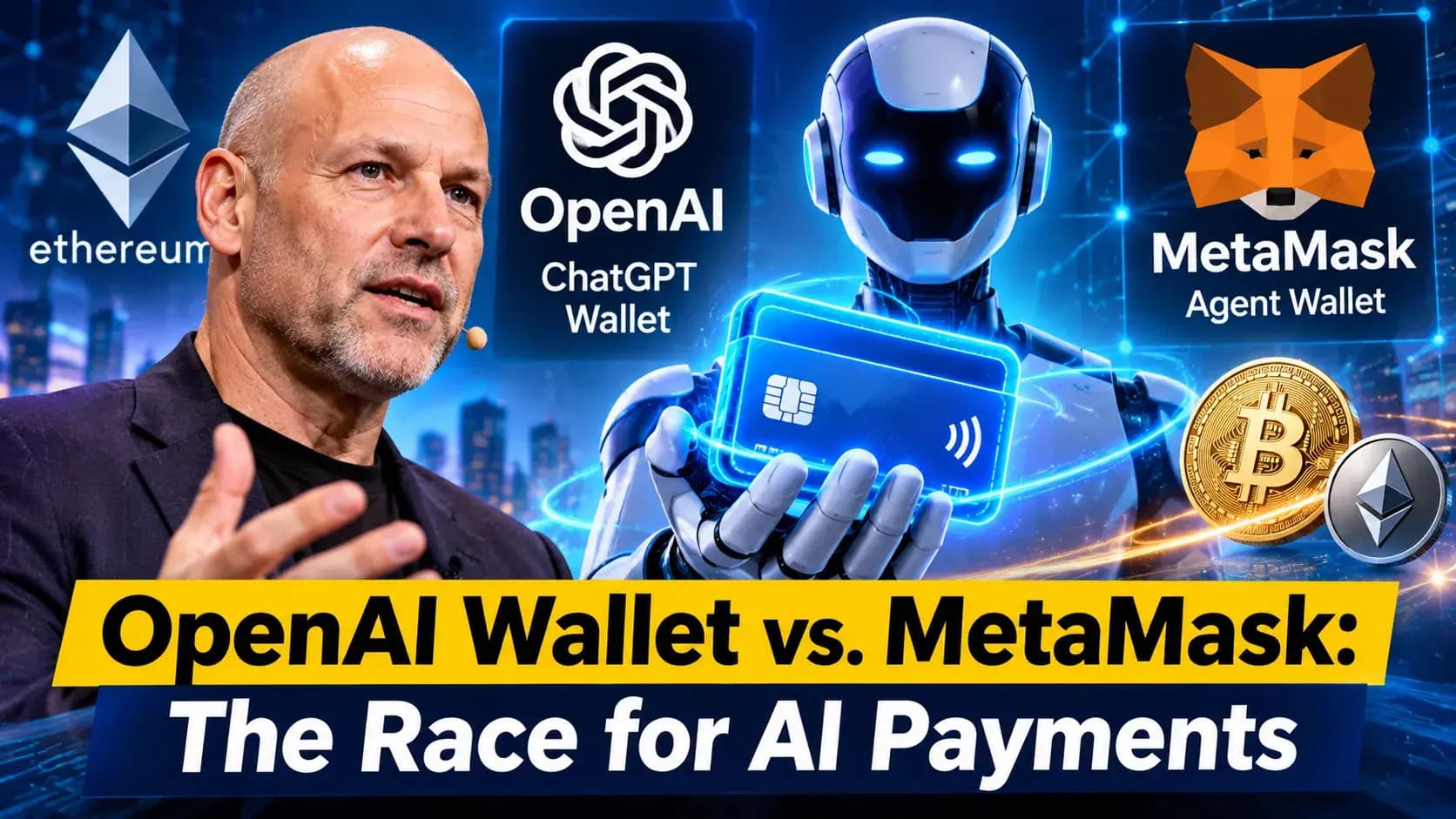
Artificial intelligence agents are moving beyond answering questions and recommending products. They are beginning to perform tasks that involve real payments, financial transactions and the movement of digital assets. That shift is creating a new competition between traditional payment infrastructure and cryptocurrency wallets designed for autonomous software.
The debate was highlighted at CNBC’s Digital Finance Forum in New York on November 17, when CNBC correspondent MacKenzie Sigalos interviewed Ethereum co-founder and MetaMask CEO Joe Lubin about OpenAI’s recently introduced ChatGPT Wallet and the role of crypto-native wallets in an emerging machine-driven economy.
Lubin argued that the central question is not whether an AI agent would prefer MetaMask over a wallet developed by an AI company. It is whether users can remain empowered and protected when software acts on their behalf.
His comments point to a broader challenge for the industry: as AI agents gain the ability to spend money, users need reliable ways to control permissions, limit losses and verify transactions.
 Coinbase CEO Calls for Crypto Industry Unity After Binance Hack→
 Ondo Plans to Anthropic Tokenized Stock on IPO Day→
 Banks Block AI Agents From Customer Accounts→
 Fink: Data Center Moratorium Risks Recession→
OpenAI Brings Payments Into the ChatGPT Ecosystem
OpenAI announced ChatGPT Wallet on November 13, introducing a payment feature that allows its Dots AI agents to complete purchases on behalf of users.
The system is designed to work with existing card networks rather than requiring customers to convert funds into cryptocurrency or use a blockchain-based payment system.
Users add an eligible payment card to their wallet. When an agent finds a product and prepares to complete a purchase, the user reviews the items, total amount and selected card before approving the transaction.
Each purchase requires a security check, such as Face ID or fingerprint verification. After approval, the payment network generates a payment token that substitutes for the user’s actual card details. This token allows the transaction to be processed without exposing the original card information to the agent or merchant.
OpenAI developed the product in partnership with American Express, Chase, Mastercard and Visa. Eligible users retain their existing card rewards and protections for qualifying disputes with merchants.
The initial rollout is limited to ChatGPT Pro subscribers aged 18 or older in the United States with eligible U.S.-issued cards. The feature is available through Dots rather than ordinary ChatGPT conversations.
OpenAI has also outlined a longer-term vision in which users could delegate purchases under predefined conditions, including spending limits, product categories and time periods. Such capabilities would allow agents to complete more tasks without requiring approval for every individual purchase, although the company says additional safeguards will be necessary. <Cite refs={[“turn450857news7″,”turn450857search1”]}/>
The distinction is important: the initial version still requires the user to approve each purchase. Fully delegated spending is a future direction, not the current default functionality.
Why Joe Lubin Thinks Crypto Wallets Matter
During the CNBC interview, Sigalos asked Lubin why AI agents would choose a crypto-native wallet such as MetaMask instead of a payment product developed specifically for AI applications.
Lubin shifted the focus from the agent to the person who owns the funds.
He said the issue is how users are empowered and protected. AI agents maintain memory, receive instructions and act according to those instructions, but their behavior can sometimes diverge from what users intended.
Lubin warned that agents can sometimes ignore instructions. This creates a financial risk when an autonomous system has permission to execute transactions.
MetaMask’s approach is to give agents access to cryptocurrency functionality while establishing safeguards around their authority. Lubin said the company has built a system that is financially backed by a policy designed to reimburse users if an agent acts improperly.
His statement reflects MetaMask’s broader argument that autonomous financial activity needs more than a wallet address and access to funds. It requires a framework that defines what an agent can do and provides protection when something goes wrong.
The reimbursement statement should be understood as Lubin’s description of MetaMask’s protection arrangements, not as an unlimited guarantee covering every possible loss. Users need to examine the applicable terms, eligibility requirements and exclusions before relying on any protection policy.
MetaMask Agent Wallet Uses a Different Financial Model
MetaMask has been developing wallet infrastructure specifically for AI agents.
Unlike ChatGPT Wallet, which connects agent purchases to conventional card networks, MetaMask Agent Wallet is designed for cryptocurrency transactions and blockchain-based applications.
MetaMask’s approach includes user-defined spending limits and rules governing which protocols an agent can interact with. The objective is to let software perform transactions without giving it unrestricted control over a user’s assets.
The company has also described transaction simulations and security screening as part of its protection model. These mechanisms are intended to identify suspicious or potentially harmful activity before transactions are finalized.
MetaMask’s broader vision is closely connected to the Ethereum ecosystem and decentralized finance. AI agents could potentially use wallets to execute swaps, interact with smart contracts, manage positions or pay for blockchain-based services.
In July 2026, MetaMask published an explanation of why agents that execute actions need wallets. The company argued that an agent capable of paying for computing resources, purchasing data or managing digital assets needs a way to hold value and authorize transactions.
This is a different use case from an assistant that simply recommends a product. Once software can execute financial decisions, the wallet becomes part of the infrastructure that turns instructions into economic activity. <Cite refs={[“turn739778search3″,”turn739778search5”]}/>
ChatGPT Wallet and MetaMask Are Not Direct Substitutes
Although both products address agent-driven transactions, they serve different financial environments.
ChatGPT Wallet is built around existing payment cards and merchant checkout systems. Its purpose is to let an AI agent help users shop while preserving familiar payment protections and card relationships.
MetaMask is designed for users and applications operating in cryptocurrency ecosystems. Its wallet infrastructure can support blockchain transactions, smart-contract interactions and decentralized financial services.
The differences can be summarized as follows:
| Feature | ChatGPT Wallet | MetaMask Agent Wallet |
|---|---|---|
| Main payment model | Traditional card payments | Cryptocurrency and on-chain transactions |
| Agent integration | OpenAI Dots | AI-agent frameworks |
| User authorization | Approval and security check for each purchase | Programmable wallet permissions and transaction safeguards |
| Asset access | Eligible payment cards | Digital assets and blockchain networks |
| Primary use cases | Shopping and merchant payments | On-chain activity, trading and decentralized applications |
| Main infrastructure | Banks and card networks | Blockchain networks and wallet infrastructure |
The two models could eventually coexist. A user might rely on a conventional card-based wallet for online shopping while using a crypto-native wallet for blockchain transactions and automated financial operations.
The more important competitive question is which infrastructure will become the default interface between people, AI agents and money.
AI Agents Could Create a Machine-to-Machine Economy
The long-term opportunity extends beyond automated shopping.
AI agents may increasingly need to purchase computing power, access paid data, subscribe to digital services and interact with other software systems. These activities could happen automatically and repeatedly, without a person initiating every individual payment.
In that environment, payment systems must support transactions between software services as well as purchases made by human customers.
Blockchain networks could offer advantages for certain applications because smart contracts allow transactions to be executed according to predefined rules. Digital assets can also move between compatible applications without relying exclusively on conventional bank operating hours.
However, blockchain infrastructure is not automatically the best solution for every payment. Card networks already provide established merchant acceptance, dispute procedures and consumer protections. For mainstream retail purchases, those advantages remain significant.
The future may therefore involve several payment models rather than a single winner.
OpenAI’s approach shows how AI agents can work within existing commercial infrastructure. MetaMask’s strategy demonstrates how crypto-native wallets could support autonomous activity in decentralized financial systems.
For a wider explanation of how digital assets can be represented and transferred through blockchain networks, see CryptoQuorum’s guide to asset tokenization and how it works.
Security and User Control Will Determine Adoption
The most difficult problem facing agent-driven payments is not simply making transactions faster. It is ensuring that an AI system cannot spend money in ways the user did not authorize.
Several risks need to be addressed:
- Incorrect instructions: An agent may misunderstand a request or select an unsuitable product or service.
- Compromised systems: Malicious websites, software vulnerabilities or manipulated information could influence an agent’s decisions.
- Excessive permissions: An agent with unrestricted access to funds could create significant losses.
- Unclear responsibility: Users need to know who is accountable when a transaction is unauthorized or an automated system fails.
- Merchant compatibility: Websites and payment providers must recognize legitimate agent activity without weakening fraud prevention.
OpenAI’s requirement for purchase-by-purchase approval addresses some of these concerns, while MetaMask emphasizes programmable transaction rules and financial protection.
Neither approach removes every risk. Security checks can reduce unauthorized activity, but they cannot guarantee that an agent will always make the right purchasing decision.
The challenge will become more complex as companies introduce systems that allow users to preauthorize spending across multiple transactions.
What Comes Next for AI and Crypto Payments?
The CNBC discussion between Sigalos and Lubin highlights an emerging competition over the financial infrastructure of autonomous software.
OpenAI is bringing AI-assisted commerce into the existing payments ecosystem, working with major banks and card networks. MetaMask is developing infrastructure that allows agents to operate with digital assets and interact with blockchain applications.
Both approaches address the same fundamental transition: AI systems are moving from providing information to carrying out actions with economic consequences.
For the cryptocurrency industry, the opportunity is not limited to speculation or token prices. Autonomous agents could become users of blockchain networks, creating demand for wallets, programmable payments, smart contracts and decentralized services.
But adoption will depend on whether people trust these systems with real money. Clear spending limits, transparent authorization, reliable security and meaningful user control will be essential.
Lubin’s central point is therefore relevant beyond MetaMask: the future of agentic finance will be determined not only by what AI agents can do, but also by how effectively the people behind them remain in control.