

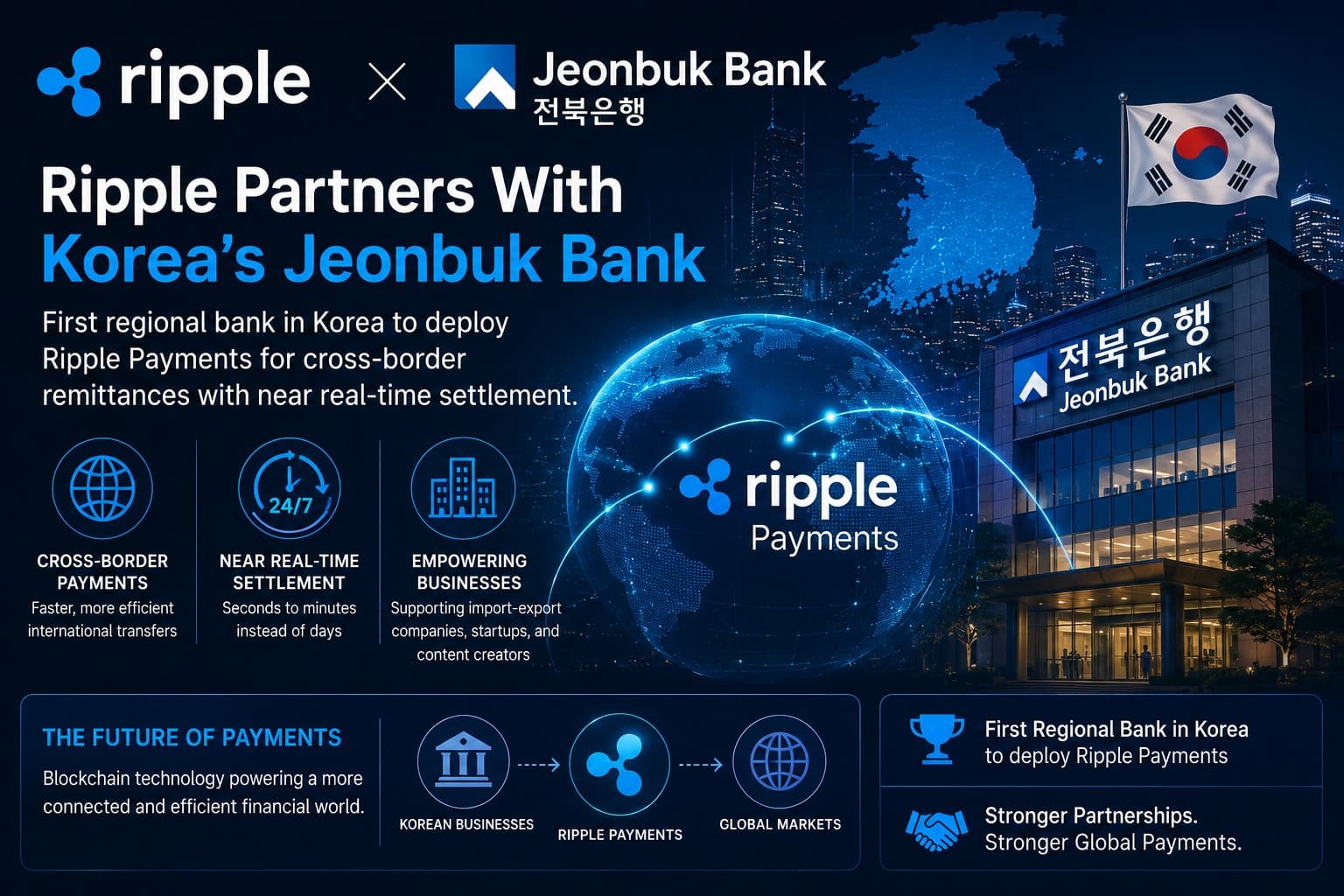
Ripple has partnered with South Korea’s Jeonbuk Bank to deploy Ripple Payments for cross-border remittances, making the lender the first regional bank in Korea to adopt the payments platform.
Announced on August 18, 2026, the partnership is designed to give Jeonbuk Bank’s business customers access to near real-time international settlement. Ripple says transfers can be completed in seconds to minutes and operate around the clock, compared with the days that traditional international transfers can require when they move through intermediary banks.
BINANCE:XRPUSDT
The deal represents another step in the expansion of blockchain-based financial infrastructure into South Korea’s regulated banking sector.
Jeonbuk Bank Becomes Korea’s First Regional Ripple Payments Bank
Jeonbuk Bank, headquartered in Jeonju and part of JB Financial Group, has a significant regional presence in South Korea. The bank says its 2026 strategy includes strengthening digital and AI capabilities while developing new growth engines.
 Cross River Brings RLUSD Into Core Banking→
 MoneyGram Joins XDC Network as Institutional Validator→
 Mastercard and BVNK have launched a new global payments platform→
 Fink: Data Center Moratorium Risks Recession→
Its partnership with Ripple adds cross-border payments to that digital-finance strategy.
Under the arrangement, Jeonbuk Bank will use Ripple Payments to provide international remittance services to business customers. Ripple specifically identifies import-export companies, technology startups and online content creators among the potential users.
For businesses that regularly receive or send money internationally, settlement speed can affect working capital, supplier payments and cash-flow management. Moving from a process dependent on multiple correspondent institutions toward a continuously operating digital payment infrastructure could reduce some of those delays.
Ripple says its platform can complete settlement in seconds to minutes rather than the days that may be required through conventional intermediary-bank routes.
How the New Payment Model Differs From Traditional Transfers
Cross-border banking traditionally involves multiple institutions and payment instructions that may pass through correspondent banking relationships before reaching the recipient.
The underlying payment message and the actual movement of funds can therefore involve several steps. Differences in operating hours, compliance reviews, foreign-exchange processing and local banking infrastructure can add additional time.
Ripple’s model is designed around a single institutional connection that coordinates payment routing and settlement.
The result is intended to provide three major improvements:
| Feature | Traditional Cross-Border Transfer | Ripple Payments |
|---|---|---|
| Operating availability | Dependent on banking infrastructure and hours | 24/7 |
| Typical settlement target | Can take days | Seconds to minutes |
| Intermediaries | Often multiple correspondent banks | Streamlined digital payment infrastructure |
| Target users | Consumers and businesses | Jeonbuk business customers |
| Transparency | Can vary across intermediaries | Designed for greater payment visibility |
Note: Actual settlement times can vary depending on destination markets, compliance procedures and local financial infrastructure.
Ripple’s own documentation for the Korea-KRW corridor also shows that compliance and beneficiary verification remain part of the payment process. Certain Korean payouts can require identity verification before funds are released.
That means “near real-time” should not be interpreted as an unconditional guarantee that every transaction will arrive instantly.
Ripple and Korea’s Institutional Digital-Asset Push
The Jeonbuk Bank agreement is significant because it is not an isolated technology experiment.
Ripple has already established relationships with other Korean financial institutions in 2026.
In April, Ripple announced a partnership with Kbank, South Korea’s first internet-only bank, to deploy institutional digital-asset wallet infrastructure through Ripple Custody. The system is designed to provide regulated financial institutions with scalable wallet infrastructure for managing digital assets across multiple blockchain networks.
Ripple also announced a partnership with Kyobo Life Insurance to explore on-chain government bond settlement.
Together, the relationships cover different parts of financial infrastructure:
| Korean Institution | Ripple Solution | Primary Focus |
|---|---|---|
| Jeonbuk Bank | Ripple Payments | Cross-border remittances |
| Kbank | Ripple Custody | Institutional wallet infrastructure |
| Kyobo Life Insurance | Ripple infrastructure | On-chain government bond settlement |
This broader approach is important. Rather than positioning blockchain solely as a cryptocurrency trading technology, Ripple is increasingly presenting it as infrastructure for payments, custody, tokenization and institutional treasury operations.
Expert Opinion: Regional Banks Matter
Fiona Murray, Ripple’s Managing Director for Asia Pacific, said the Jeonbuk partnership reflects growing momentum among Korean financial institutions building digital-asset capabilities and looking for long-term infrastructure partners.
Murray also emphasized the role regional banks play in the real economy. According to Ripple, the Jeonbuk deployment extends near real-time cross-border settlement directly to the businesses served by the regional lender.
Park Choon-won, President of JB Jeonbuk Bank, described the partnership as part of the bank’s effort to move beyond its traditional regional role and develop into a digital-finance leader.
His comments point to a broader competitive dynamic in Asian banking: regional institutions are increasingly looking for technology that allows them to provide sophisticated international services without having to build every component of the infrastructure themselves.
XRP Is Not Confirmed as the Settlement Asset
The distinction between Ripple’s infrastructure and XRP is particularly important for investors.
Ripple is closely associated with XRP, and the company says XRP and its RLUSD stablecoin underpin parts of its broader digital-finance offering. However, the Jeonbuk Bank announcement does not identify XRP as the settlement asset for this specific implementation.
Independent reporting also noted that the companies did not disclose whether the service would use XRP, RLUSD, another digital asset or fiat-based settlement rails. Payment corridors, supported currencies, fees and expected transaction volumes were also not disclosed.
That means investors should avoid treating the partnership announcement as confirmation of new XRP transaction demand.
The commercial significance of the deal can be assessed independently of the XRP question: a regulated Korean bank is deploying Ripple’s payment infrastructure for cross-border business transfers.
That is the more defensible takeaway from the available information.
Why South Korea Is an Important Market
South Korea has a highly active digital-asset market, but institutional adoption is evolving along a different path from retail cryptocurrency trading.
Banks and financial institutions are increasingly exploring regulated applications for blockchain technology, including custody, stablecoin-based payments, tokenized securities and on-chain settlement.
Ripple’s Korean expansion reflects that transition.
Kbank’s wallet infrastructure initiative and Jeonbuk Bank’s payments deployment demonstrate two complementary use cases. One addresses the secure management of digital assets, while the other focuses on moving value across borders.
CryptoQuorum recently covered Ripple’s broader expansion of digital-asset custody in Asia Pacific, where the company is combining custody and tokenization infrastructure for financial institutions. This development provides additional context for Ripple’s strategy of building an institutional financial-services stack.
The company’s approach is therefore broader than a single remittance product.
Potential Benefits for Korean Businesses
For Jeonbuk Bank’s customers, the most immediate potential advantage is operational rather than speculative.
Importers and exporters often have to coordinate payments with suppliers, customers and financial institutions in different jurisdictions. Faster settlement could improve cash-flow visibility and reduce the time capital remains in transit.
Technology startups and online content businesses can face similar challenges when revenue and expenses are distributed across multiple countries.
A continuously available payment system could also reduce the impact of time-zone differences.
However, the ultimate benefit will depend on the corridors Jeonbuk Bank supports, the fees charged to customers, foreign-exchange rates and how quickly transactions pass local compliance requirements.
None of those commercial details has been publicly disclosed.
The Bigger Shift: Payments Are Becoming Programmable Infrastructure
The Jeonbuk Bank partnership illustrates a broader transformation in financial infrastructure.
Traditional cross-border payments were designed around relationships between banks and messaging networks. Blockchain-based systems introduce a different architecture in which settlement, asset movement and transaction records can be coordinated digitally.
That does not mean banks will immediately replace existing systems.
Instead, the likely transition is more incremental. Financial institutions can integrate blockchain-based infrastructure where it offers measurable advantages while retaining conventional banking systems for other transactions.
This hybrid approach may be particularly important in regulated markets such as South Korea.
For Ripple, the strategy creates an opportunity to become infrastructure behind financial institutions rather than simply another provider competing for end-user cryptocurrency transactions.
What to Watch Next
Several developments will determine how important the Jeonbuk Bank partnership becomes.
First, launch details. The parties have not publicly disclosed the exact payment corridors or transaction volumes.
Second, settlement assets. Whether the service ultimately uses fiat, stablecoins, XRP or another settlement mechanism could affect how the market interprets the partnership.
Third, customer adoption. The number and type of businesses using the service will provide a better indication of commercial traction than the partnership announcement itself.
Fourth, Korean regulation. The country’s evolving framework for digital assets and stablecoins will influence how banks can expand blockchain-based payment services.
Finally, Ripple’s institutional pipeline. The Jeonbuk deal follows partnerships with Kbank and Kyobo Life Insurance, suggesting that Ripple is attempting to build a broader presence across Korea’s financial sector.
The Bottom Line
Jeonbuk Bank’s deployment of Ripple Payments is a significant development for South Korea’s regional banking sector and another example of blockchain infrastructure moving into regulated financial services.
The bank becomes the first regional lender in Korea to deploy the platform for cross-border remittances, with Ripple targeting settlement in seconds to minutes and 24/7 availability.
The partnership also reinforces Ripple’s expanding institutional footprint in Korea, following its work with Kbank and Kyobo Life Insurance.
But the announcement should be interpreted carefully. It confirms the deployment of Ripple Payments; it does not confirm that XRP or RLUSD will be used for Jeonbuk Bank’s transactions.
For now, the most important development is the infrastructure itself: a Korean regional bank is adopting a blockchain-based payment system to modernize international business transfers. If customer adoption follows, the partnership could provide another example of how blockchain technology is becoming embedded in conventional banking without requiring banks to abandon their existing financial systems.
Disclaimer: This article is for informational and educational purposes only and does not constitute financial, investment, legal or tax advice. XRP, cryptocurrencies and digital assets are highly volatile and may result in partial or total loss of capital. The partnership described above does not confirm future XRP demand, price performance or transaction volumes. Readers should conduct their own research and consult qualified financial professionals before making investment decisions.