
What Is a Spot Bitcoin ETF and How Does It Work? The Wall Street “Suit” for Digital Gold
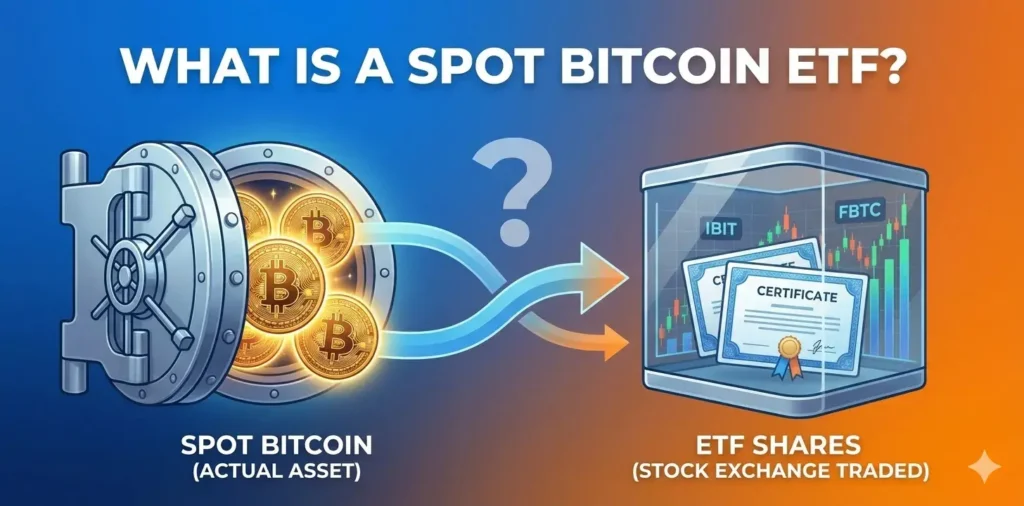
A comprehensive guide explaining the mechanics, benefits, and market impact of Spot Bitcoin ETFs. This article breaks down how Wall Street’s entry into crypto changes the game for retail and institutional investors alike.
For years, the phrase “Bitcoin ETF” was the “Waiting for Godot” of the financial world—everyone was talking about it, but it never seemed to arrive. That changed in early 2024 when the SEC finally greenlit a wave of applications, effectively bridging the gap between decentralized finance and the traditional stock market.
But what exactly is a spot bitcoin etf, and why did its approval send shockwaves through the industry? Whether you are a seasoned “HODLer” or a traditional investor looking to dip your toes into digital waters, this crypto etf guide will break down the mechanics, the players, and the implications of this landmark financial product.
What Is a Spot Bitcoin ETF?
An ETF, or Exchange-Traded Fund, is a type of investment fund that is traded on stock exchanges, much like individual stocks. A spot bitcoin etf specifically tracks the current, or “spot,” price of Bitcoin.
When you buy shares in a spot ETF, the fund provider actually purchases the underlying Bitcoin and holds it in a secure digital vault. This is the fundamental piece of the bitcoin etf explained: the share price is directly tied to the real-time value of the Bitcoin held by the fund.
The Core Difference: Spot vs. Futures ETFs
Before spot ETFs were approved, investors only had access to “Futures ETFs.” It is crucial to understand the distinction:
- Futures ETFs: These don’t hold actual Bitcoin. Instead, they trade derivative contracts that speculate on the future price of the asset. This can lead to “tracking errors” where the ETF price doesn’t perfectly match Bitcoin’s price.
- Spot ETFs: These hold the physical (or rather, digital) asset. If the price of Bitcoin goes up by 5%, your ETF shares should, in theory, reflect that same gain (minus small management fees).
| Feature | Spot Bitcoin ETF | Futures Bitcoin ETF |
| Underlying Asset | Actual Bitcoin (Physical) | Derivative Contracts |
| Price Accuracy | High (Tracks Spot Price) | Variable (Subject to Contango) |
| Regulation | Regulated by SEC | Regulated by SEC/CFTC |
| Suited For | Long-term investors | Short-term speculators |
How Does a Spot Bitcoin ETF Work?
The “magic” of a spot bitcoin etf happens behind the scenes through a process known as creation and redemption. This ensures that the share price stays as close to the actual price of Bitcoin as possible.
The Key Players
- The Sponsor (Issuer): Companies like BlackRock, Fidelity, or Grayscale that create and manage the fund.
- The Custodian: A highly secure entity (often Coinbase Custody or Gemini) responsible for storing the actual Bitcoin.
- Authorized Participants (APs): Large financial institutions (like Jane Street or JPMorgan) that have the power to create or redeem ETF shares.
The Creation and Redemption Mechanism
When demand for the ETF rises and the share price begins to trade at a “premium” (higher than the actual value of the Bitcoin it represents), the Authorized Participants step in. They buy Bitcoin on the open market and deliver it to the ETF sponsor. In exchange, the sponsor creates new ETF shares for the AP, who then sells them on the stock exchange.
Conversely, if the ETF is trading at a “discount,” the APs buy the cheap ETF shares, exchange them with the sponsor for actual Bitcoin, and sell that Bitcoin for a profit. This arbitrage loop is what keeps a spot bitcoin etf accurately pegged to the market.
Why Is Everyone Talking About It? The Benefits
The introduction of a spot bitcoin etf solves several major pain points for the average investor.
1. Ease of Access
Historically, buying Bitcoin required setting up a digital wallet, registering on a crypto exchange, and memorizing a “seed phrase” (a 12-to-24-word password). If you lose that phrase, your money is gone forever. With an ETF, you can buy Bitcoin through your existing brokerage account (like Charles Schwab or Vanguard) just as easily as buying Apple stock.
2. Regulatory Oversight
Crypto exchanges have historically operated in a “gray area.” By contrast, a spot bitcoin etf is a highly regulated financial product. Issuers must provide regular audits, transparent fee structures, and adhere to strict consumer protection laws.
3. Institutional Inflows
Many pension funds, 401(k) providers, and massive institutional desks are prohibited from buying crypto directly. An ETF gives them a “compliant” way to allocate capital to Bitcoin. This influx of “big money” is a primary reason why many analysts see the spot bitcoin etf as a long-term catalyst for price appreciation.
The Potential Drawbacks and Risks
While the ETF is a massive step forward, it isn’t perfect. As with any investment, there are trade-offs to consider.
- Management Fees: Every ETF has an “expense ratio.” While competition has driven these fees very low (often between 0.20% and 1.5%), they are still a recurring cost that you wouldn’t pay if you held the Bitcoin yourself.
- “Not Your Keys, Not Your Coins”: This is a famous mantra in the crypto world. When you use a spot bitcoin etf, you don’t actually own the Bitcoin; you own a claim on the fund’s Bitcoin. You cannot use those shares to buy a coffee or send money to a friend.
- Market Hours: Bitcoin trades 24/7, 365 days a year. The stock market does not. If a major crash happens on a Sunday morning, you won’t be able to sell your ETF shares until the market opens on Monday.
The Impact on the Crypto Market
The arrival of the spot bitcoin etf has fundamentally changed the “DNA” of the market.
“We are seeing the ‘financialization’ of Bitcoin. It is moving from a niche internet experiment to a staple of the 60/40 portfolio.” — Market Analyst Insight
Reduced Volatility?
Over time, the deep liquidity provided by institutional players may help dampen Bitcoin’s legendary volatility. Large buy and sell orders that used to move the needle significantly on smaller exchanges are now absorbed by the massive liquidity pools of Wall Street.
Price Discovery
Because the spot bitcoin etf requires the actual purchase of the asset, it creates direct “buy pressure.” Every dollar that flows into BlackRock’s IBIT or Fidelity’s FBTC represents Bitcoin being taken off the open market and placed into cold storage.
How to Choose the Right ETF
If you’ve decided that a spot bitcoin etf is right for your portfolio, you’ll notice there are several options. When comparing them, look for:
- Expense Ratio: Lower is generally better, but check if there is a “fee waiver” that might expire soon.
- Liquidity (Trading Volume): Higher volume means it’s easier to buy and sell without affecting the price.
- The Custodian: Most use Coinbase, but some investors prefer funds that use a different custodian for the sake of diversification.
Stay informed, read the latest crypto news in real time!
Conclusion: A New Era for Bitcoin
The spot bitcoin etf is more than just a new way to trade; it is a validation of the technology. It proves that the world’s largest financial institutions view Bitcoin as a legitimate, permanent asset class. While it removes some of the “cypherpunk” spirit of self-sovereignty, it opens the door for millions of people to participate in the potential upside of the digital economy with the safety nets of traditional finance.
As we look toward the future, the success of these funds will likely pave the way for an Ethereum ETF and perhaps even “basket” ETFs that hold multiple different cryptocurrencies.