

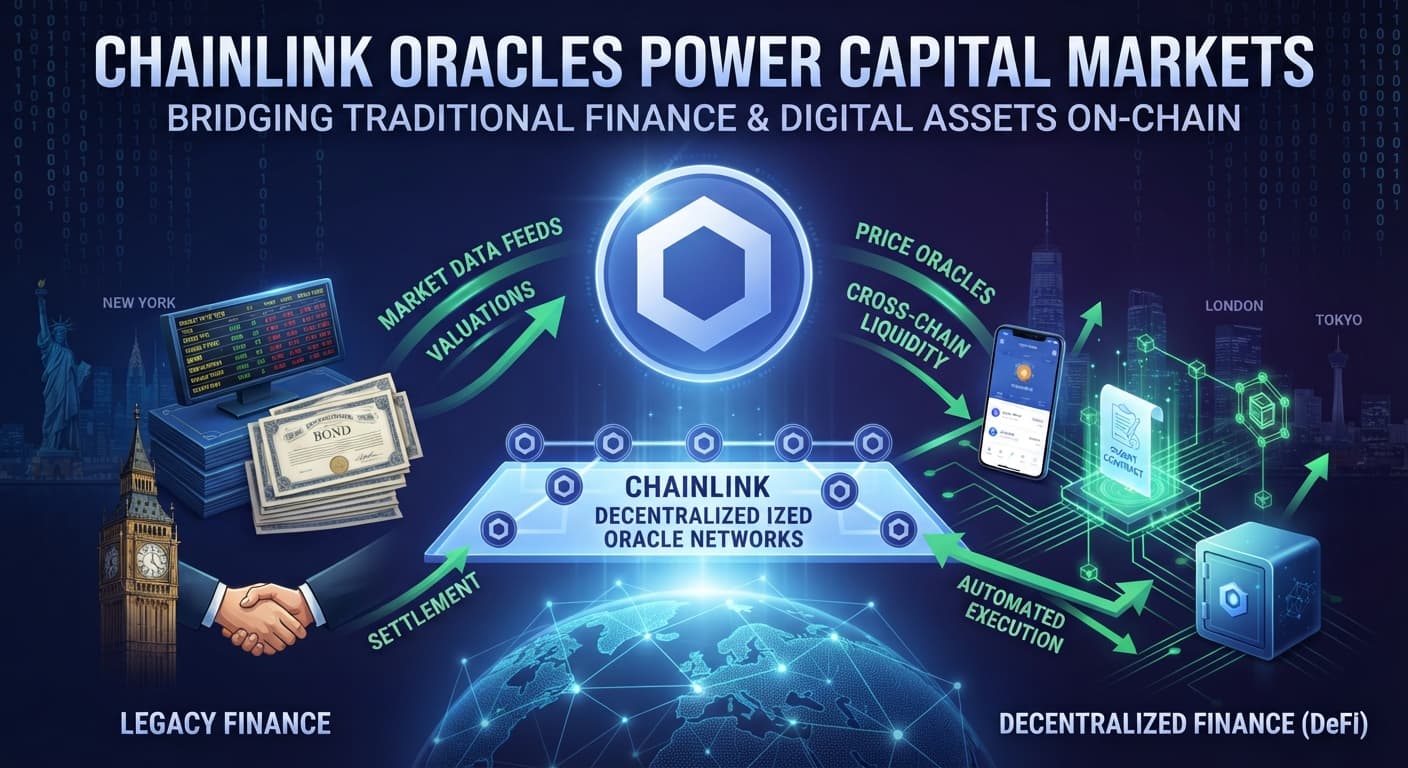
The financial technology sector is experiencing a structural revolution as traditional capital markets converge with decentralized finance (DeFi). At the core of this transition lies the need for reliable, tamper-proof, and real-time data feeds that can seamlessly connect off-chain financial systems with on-chain smart contracts. As the industry-standard decentralized oracle platform, Chainlink continues to play a pivotal role in bringing global assets, institutional liquidity, and advanced financial products onto blockchains.
By utilizing decentralized node operators and cryptographically secure validation mechanisms, Chainlink eliminates single points of failure. This technological architecture ensures that high-value financial applications—ranging from automated lending markets to tokenized real-world assets—operate with absolute precision and trust.
BINANCE:LINKUSDT
| Oracle Feature | Technical Implementation | Value to Ecosystem |
| Decentralized Validation | Multiple independent oracle nodes | Eliminates single points of failure and data manipulation |
| Cross-Chain Interoperability | CCIP (Cross-Chain Interoperability Protocol) | Enables secure data and token transfers across disparate ledgers |
| Real-World Data Feeds | Aggregated off-chain price and market metrics | Powers accurate liquidations, valuations, and settlements |
The Mechanics of Decentralized Oracle Networks
Smart contracts are inherently isolated environments; they cannot natively access external data sources such as bank feeds, price tickers, or enterprise databases. This limitation, commonly known as the oracle problem, historically restricted blockchain utility to closed ecosystems. Chainlink resolves this challenge by acting as a secure middleware layer that retrieves, verifies, and delivers external data to on-chain protocols.
Through a combination of decentralized data aggregation, reputation scoring, and cryptographic proofs, the network ensures that the information fed into smart contracts is accurate and tamper-resistant. Node operators are incentivized via staking mechanisms, where they lock native tokens as collateral to encourage honest behavior and penalize inaccurate reporting.
 How CFOs Are Transforming Corporate Treasury With Digital Assets, XRP, and RLUSD→
 XRP Ledger Foundation Advances Ecosystem Resilience with Strategic Infrastructure Upgrades→
 Zebec and MoneyGram Expand Stablecoin Payroll Through Stellar→
 TRON Ecosystem Expands in Q2 2026 Across AI, Payments and Tokenization→
“Chainlink serves as the foundational data layer for the modern multi-chain economy, bridging legacy financial plumbing with decentralized execution.” — Financial Systems Analyst
Expanding Utility Across Global Financial Institutions
Major global financial institutions and asset managers are increasingly adopting decentralized infrastructure to streamline settlement times and lower operational overhead. By integrating decentralized data feeds, institutions can launch tokenized financial instruments—such as real-world asset funds, tokenized equities, and regulated stablecoins—with full confidence in their on-chain price accuracy.
Market experts emphasize that institutional adoption relies heavily on robust compliance and data integrity standards. As regulatory frameworks evolve, networks that provide transparent, verifiable audit trails are uniquely positioned to capture long-term enterprise market share.
| Network Metric | Operational Status | Strategic Impact |
| Node Network | Decentralized global operator set | High fault tolerance and censorship resistance |
| Asset Integration | Multi-chain and cross-chain support | Unified liquidity across Ethereum, Layer 2s, and alternative L1s |
| Enterprise Readiness | Secure cryptographic proofs | Compliance-friendly verification for institutional participants |
Expert Perspectives on Future Market Integration
Financial strategists and blockchain researchers frequently highlight that the future of banking lies in hybrid architectures—systems where legacy rails communicate securely with public execution layers. Industry commentary underscores that oracle security is just as important as consensus security; a smart contract is only as reliable as the data it consumes.
Include expert opinions: Analysts point out that as tokenization scales into trillions of dollars of traditional equities, commodities, and debt instruments, standardized oracle protocols will form the unshakeable foundation of global liquidity settlement.
Conclusion
The ongoing integration of traditional financial markets with decentralized applications marks a paradigm shift in how global capital moves. By providing secure data feeds, cross-chain communication, and robust verification standards, Chainlink remains at the forefront of this financial evolution. As institutional participation accelerates, the demand for secure, decentralized infrastructure will continue to shape the next era of digital finance.
Disclaimer
Disclaimer: The information provided in this article is for educational and informational purposes only and does not constitute financial, investment, or legal advice. Digital asset markets and decentralized finance protocols carry inherent risks. Always conduct your own research and consult with a licensed financial professional before engaging with blockchain applications.