

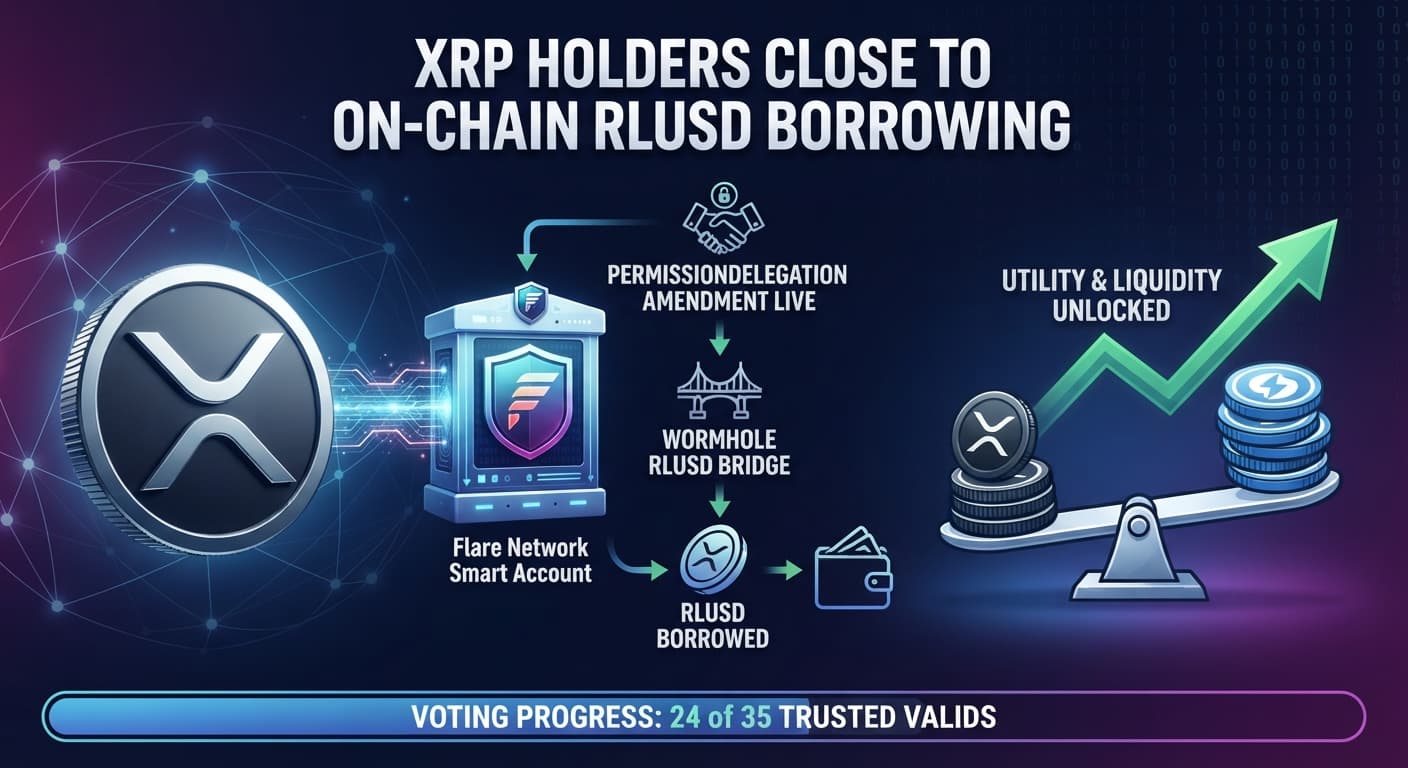
The intersection of decentralized finance and cross-chain interoperability is poised for a major leap forward. Flare Networks co-founder Hugo Philion has proposed an innovative framework enabling XRP holders to borrow RLUSD directly against their digital assets on-chain. By leveraging Flare Smart Accounts alongside the Wormhole bridging protocol, this development aims to bridge isolated network liquidity without forcing long-term holders to liquidate their core asset holdings.
However, bringing this capability to life hinges on a crucial governance milestone on the XRP Ledger (XRPL). Validator support for the necessary network upgrade has climbed steadily, putting the community just a few votes away from activating the required protocol changes.
BINANCE:XRPUSDT
| Governance Metric | Current Status / Target | Operational Significance |
| Trusted Validators | 24 of 35 secured (29 needed) | Represents the 80% threshold required for activation |
| Voting Timeline | Opened August 12 | Follows a refined iteration after a 2025 patch |
| Core Dependency | PermissionDelegationV1_1 amendment | Permits secure, non-custodial transaction authorization |
The Mechanics of the Flare and Wormhole Integration
Under Hugo Philion’s proposed structure, users will not need to manually maneuver tokens across disparate wallets or surrender private keys to third-party custodians. Instead, the architecture utilizes Flare Smart Accounts to act as an extended operational arm for the XRP Ledger.
Users can lock or represent their XRP on Flare as wrapped tokens (FXRP), which subsequently serve as collateral within decentralized lending markets like Morpho to borrow RLUSD. The borrowed stablecoins are then routed directly back to the user’s native XRPL wallet address. This seamless loop relies heavily on the Wormhole bridge infrastructure to transfer data and asset states safely between networks.
 How CFOs Are Transforming Corporate Treasury With Digital Assets, XRP, and RLUSD→
 RLUSD stablecoin and the New Standard for Regulation→
 Zebec and MoneyGram Expand Stablecoin Payroll Through Stellar→
 Altcoin Perpetual Futures Open Interest Surpasses Bitcoin for the First Time Since December 2024→
“Five more votes and XRP holders can borrow onchain. Flare Networks co-founder Hugo Philion wants XRP holders to borrow RLUSD against their XRP on-chain using FLR smart accounts. That needs the Wormhole RLUSD bridge, which needs the ‘PermissionDelegation’ amendment to be live.” — BSCNews
Why the PermissionDelegation Amendment Matters
The linchpin for this cross-chain capability is the PermissionDelegationV1_1 amendment. This protocol upgrade allows an XRPL account to authorize another account or smart contract system to execute specific transactions on its behalf via a DelegateSet transaction, all without transferring master private keys.
An earlier version of this functionality was introduced and subsequently pulled back in 2025 after diagnostic reviews revealed a fee-charging flaw during failed transaction attempts. The refined proposal now sitting before validators fixes these vulnerabilities, ensuring secure execution for institutional and retail participants alike.
| Integration Layer | Technology Stack | Function in Lending Flow |
| Collateral Layer | XRP Ledger & Flare Smart Accounts | Secures native assets without leaving original custody model |
| Interoperability | Wormhole Bridge | Translates state and liquidity across blockchain boundaries |
| Lending Markets | Morpho Protocol on Flare | Facilitates over-collateralized stablecoin borrowing |
Expert Perspectives on Cross-Chain Utility
Fintech researchers and network analysts note that unlocking native decentralized finance capabilities for major legacy assets drastically enhances capital velocity. Rather than remaining dormant in cold storage, tokenized holdings can generate utility, liquidity, and yield without incurring taxable disposition events associated with outright sales.
Prominent community commentators have emphasized that establishing trust-minimized bridges between the XRP Ledger and EVM-compatible networks like Flare expands the total addressable market for stablecoins such as RLUSD. As decentralized lending protocols integrate deeper compliance and robust collateral standards, institutional confidence across the broader digital asset economy continues to strengthen.
Conclusion
With validator voting sitting just five votes away from the required threshold, the proposal by Flare Networks marks a critical juncture for XRP utility. By combining non-custodial permission delegation, Wormhole interoperability, and deep stablecoin liquidity via RLUSD, holders are closer than ever to unlocking decentralized financial services directly from their native ledger. As the remaining validators cast their ballots, the ecosystem prepares for a new era of multichain efficiency.
Disclaimer
Disclaimer: The information provided in this article is for informational and educational purposes only and does not constitute financial, investment, or legal advice. Cross-chain lending, smart contracts, and digital asset protocols involve high levels of risk. Always conduct independent research and consult with qualified professionals before engaging with decentralized finance applications.