

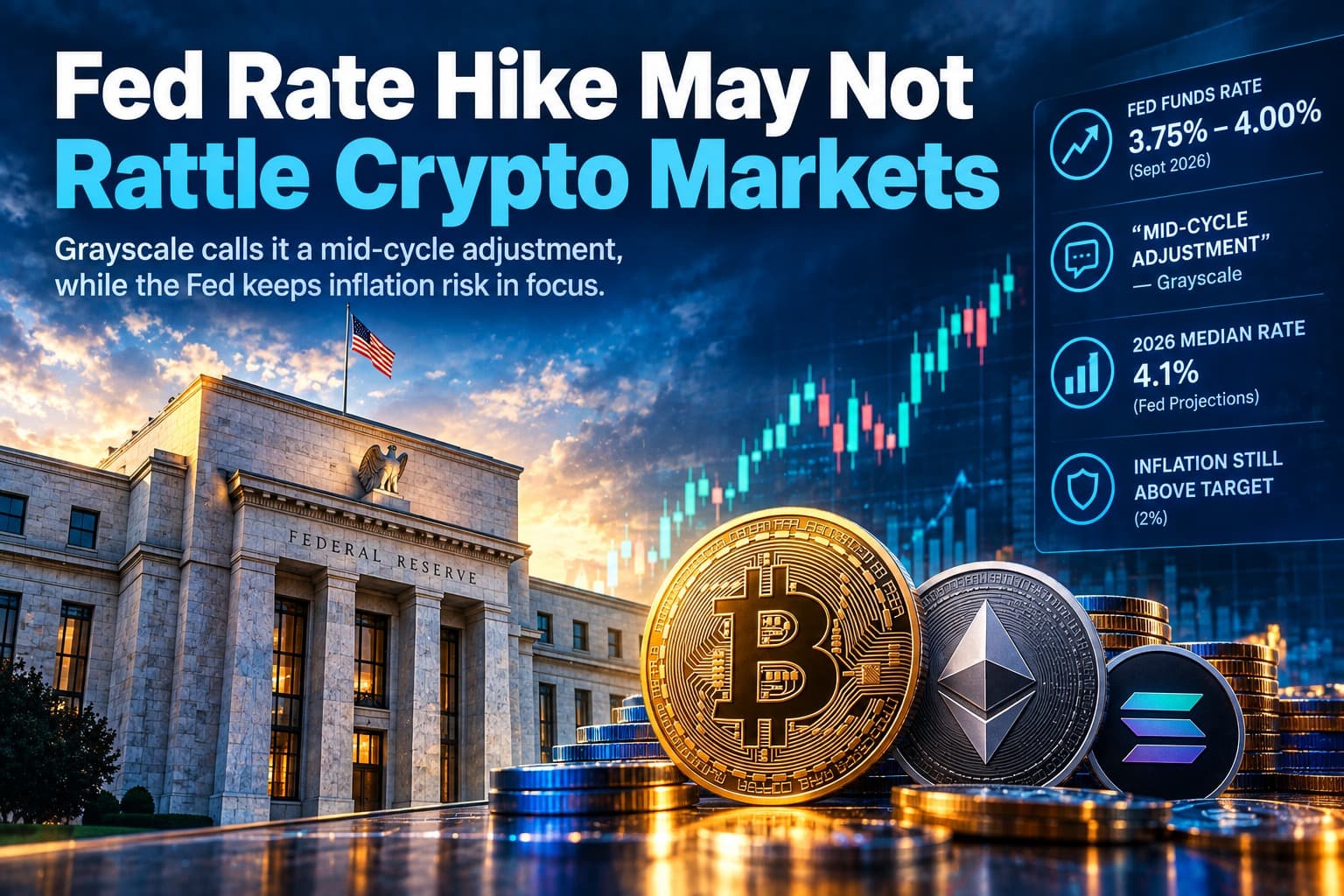
The Federal Reserve’s latest interest-rate increase may have a more limited impact on cryptocurrency markets than the tightening cycle of 2022–2023, according to Grayscale Research. The asset manager’s head of research, Zach Pandl, describes the September move as a “mid-cycle adjustment” rather than a new structural tightening cycle, while Federal Reserve projections point to at least one further increase in 2026.
The Federal Open Market Committee voted unanimously on September 16 to raise the federal funds target range by 25 basis points to 3.75%–4.00%. The Fed said economic activity was expanding at a solid pace, while inflation remained elevated.
BINANCE:BTCUSDT
The decision was the first U.S. rate increase since July 2023. Bitcoin showed relatively limited immediate reaction, trading around the mid-$76,000 area as markets absorbed the decision.
For crypto investors, the bigger question is not simply what happened on September 16, but whether the move marks the beginning of another prolonged period of restrictive monetary policy.
 Deutsche Bank Announces Institutional Bitcoin Custody for Corporate and Hedge Fund Clients→
 Solana Tokenized Equity Supply Surges to Record $684M Amid Multi-Platform Expansion→
 Michael Saylor Releases Comprehensive Bitcoin Investor Guide Highlighting Absolute Scarcity and Reserve Asset Status→
 XRP Ledger Foundation Advances Ecosystem Resilience with Strategic Infrastructure Upgrades→
Grayscale’s answer is currently more restrained.
The Fed has started tightening again
The September decision marks a change from the easier monetary conditions that prevailed during the Fed’s previous easing phase.
The FOMC raised rates by a quarter percentage point, taking the target range to 3.75%–4.00%. The decision was unanimous at 12–0. The central bank said inflation remains elevated and that the latest policy action should support a more timely return toward its 2% objective.
The economic backdrop is notably different from the beginning of the 2022 tightening cycle.
In September 2026, the Fed described domestic spending as resilient, productivity growth as strong and capital investment as robust. The median projection for real GDP growth was raised to 2.3% for 2026, compared with 2.2% in the June projections. The median unemployment-rate forecast was reduced to 4.1% from 4.3%.
At the same time, inflation remains above target.
The Fed’s median projection for headline PCE inflation is 3.7% for 2026, falling to 2.3% in 2027, 2.1% in 2028 and 2.0% in 2029. Core PCE inflation is projected at 3.4% in 2026.
That combination — resilient growth and persistent inflation — explains why the central bank is willing to maintain a restrictive rate environment.
Why Grayscale sees a different cycle
Grayscale’s argument rests on the difference between a large policy regime shift and a smaller adjustment inside an established cycle.
Zach Pandl, Grayscale’s head of research, argues that the latest move should not be compared directly with the rapid tightening that began in 2022. Grayscale says that earlier cycle materially increased the opportunity cost of holding non-interest-bearing assets such as Bitcoin.
Pandl instead points to March 1997, when the Federal Reserve made a one-off 25-basis-point increase and the Nasdaq continued its broader advance afterward. The historical comparison is intended to show that a single rate increase does not necessarily change the long-term trajectory of risk assets.
Grayscale therefore argues that one or two additional increases in 2026 would not necessarily produce the same shift in crypto capital allocation seen during the previous tightening regime.
This remains a market view rather than a conclusion established by the Fed.
The Fed’s projections still point higher
There is an important counterweight to Grayscale’s interpretation.
The Federal Reserve’s September Summary of Economic Projections puts the median year-end policy rate at 4.1% for 2026, compared with 3.8% in the June projections. The current target midpoint is 3.875%, meaning the median projection is consistent with another quarter-point increase by year-end.
The distribution is even more revealing.
Of the 18 officials submitting 2026 rate projections, 12 placed the year-end midpoint at 4.125%, four at 4.375% and two at 3.875%. That means 16 officials projected a level above the current midpoint.
The projections do not constitute a commitment to future policy. The Fed explicitly emphasizes that appropriate monetary policy depends on how economic conditions evolve.
Nevertheless, the distribution demonstrates that another increase is already incorporated into most policymakers’ individual projections.
How higher rates can affect Bitcoin
The traditional argument against high interest rates for Bitcoin is straightforward.
Bitcoin does not pay a conventional yield. When Treasury bills, money-market funds and other short-term instruments offer increasingly attractive returns, the opportunity cost of holding a non-yielding asset can rise.
That dynamic was particularly visible during the 2022–2023 tightening cycle.
But the current crypto market has changed since then.
Institutional exposure is broader, regulated Bitcoin investment products are more established, stablecoin liquidity has expanded and tokenized financial products are becoming a larger part of the digital-asset ecosystem.
CryptoQuorum’s recent Bitcoin market-structure analysis using Glassnode data highlighted that institutional flows and derivatives positioning can now influence market structure alongside direct spot demand.
That does not make Bitcoin immune to monetary policy.
It means the transmission mechanism may be more complicated than simply “rates up, Bitcoin down.”
Expert opinions: crypto is no longer one trade
One of the most important elements in Pandl’s analysis is that different crypto sectors can react differently to higher rates.
Grayscale says stablecoin issuers such as Circle and Tether can generate additional revenue when short-term cash rates are higher because their reserves can earn interest. At the same time, tokenized bonds and money-market products may become more attractive to investors looking for on-chain exposure to yield-bearing assets.
That creates a very different dynamic from Bitcoin.
A higher-rate environment can theoretically place pressure on Bitcoin while simultaneously improving the economics of certain stablecoin businesses and increasing demand for tokenized Treasury products.
The crypto market is therefore becoming more similar to traditional finance, where different assets respond differently to the same monetary-policy change.
Pandl summarized this distinction by noting that crypto is diverse and that higher rates can affect different assets in different ways.
Stablecoins may have a different rate relationship
Stablecoins provide an especially useful example.
A dollar-backed stablecoin does not normally seek to appreciate against the dollar. Its primary function is to maintain a relatively stable value and facilitate settlement.
The issuer, however, may invest reserve assets in cash and short-duration government securities.
When short-term interest rates rise, the income earned on those reserves can increase, subject to the issuer’s reserve structure, operating costs and other factors.
This is one reason Grayscale identifies stablecoin issuers as potential beneficiaries of higher cash rates.
It also helps explain the growing importance of tokenized financial products.
If investors can hold a blockchain-based representation of a Treasury or money-market strategy while receiving a yield, the blockchain becomes a distribution and settlement layer for traditional fixed-income exposure.
CryptoQuorum’s recent coverage of institutional crypto adoption has examined the same convergence between stablecoins, tokenized assets and traditional finance.
Tokenization could benefit from a higher-rate environment
Grayscale’s argument creates an interesting contradiction.
Higher yields can make Bitcoin less attractive at the margin because safer interest-bearing assets offer more income.
Yet the same higher yields can make tokenized Treasury products more attractive.
That distinction is becoming increasingly relevant because major financial institutions are building blockchain infrastructure for traditional securities.
DTCC, for example, is preparing its Tokenization Service for October 2026 after completing production tests involving DTC-custodied securities. CryptoQuorum recently covered that development in its analysis of DTCC’s tokenization initiative.
The emergence of tokenized Treasuries and money-market instruments means crypto investors increasingly have access to assets that combine blockchain settlement with conventional financial yield.
In this environment, “crypto” no longer describes a single macro trade.
Market reaction matters, but expectations matter more
One reason the September decision did not immediately disrupt Bitcoin is that financial markets can react more strongly to surprises than to anticipated policy moves.
The September increase was widely expected before the meeting. Bitcoin traded around $76,000 after the decision and showed relatively limited immediate reaction.
That does not mean markets have ignored the Fed.
The important variables are now the future path of rates, inflation and liquidity.
If inflation falls faster than expected, the projected policy path could change.
If inflation remains persistent or accelerates, the Fed could maintain or increase restrictive policy for longer.
For Bitcoin, the difference between those scenarios may ultimately matter more than the 25-basis-point increase itself.
The 2022 comparison has limitations
It is reasonable to compare today’s market with 2022, but the comparison has important limitations.
The 2022–2023 cycle involved a much larger cumulative shift in rates. The federal funds target moved from near zero to 5.25%–5.50% across that tightening period.
Today, the starting point is already considerably higher, and the current move is a quarter-point increase within an established rate environment.
The investor base is also different.
U.S. spot Bitcoin ETFs, larger institutional trading infrastructure and broader corporate participation provide market channels that were much less developed in 2022.
CryptoQuorum’s institutional-adoption research documents this broader transition, with digital assets increasingly integrated into traditional investment and settlement infrastructure.
That does not guarantee lower volatility.
It changes the composition of demand.
What could challenge Grayscale’s thesis?
Grayscale’s interpretation faces several tests.
A sustained sequence of rate increases would look increasingly different from a one-off adjustment.
Persistent inflation could prevent the Fed from easing policy as quickly as investors might expect.
Higher Treasury yields could increase the opportunity cost of holding non-yielding assets.
Weakening liquidity could affect speculative assets even if Bitcoin’s institutional investor base continues growing.
A stronger dollar could create additional headwinds for dollar-priced commodities and digital assets.
On the other hand, continued ETF inflows, institutional adoption and expanding on-chain financial products could provide sources of demand that did not exist at the same scale during the previous tightening period.
What traders should monitor
The most useful indicators over the next several weeks are likely to be:
Inflation data
The Fed remains focused on returning inflation toward its 2% objective. Further inflation surprises could influence the expected rate path.
Treasury yields
Higher short-term yields increase the opportunity cost of holding assets without conventional income.
ETF flows
Persistent Bitcoin ETF inflows would provide evidence of continuing institutional demand.
Stablecoin supply
Growth in stablecoin liquidity can provide another indication of capital entering the digital-asset ecosystem.
Tokenized Treasury demand
An increase in tokenized fixed-income products would demonstrate that higher yields can attract capital into blockchain-based financial products even during restrictive monetary conditions.
Bitcoin’s correlation structure
A changing relationship between Bitcoin, equities, Treasury yields and the dollar could reveal whether the asset’s market drivers are becoming more independent.
What comes next?
The next major test will be whether the Fed actually needs to implement the additional increase implied by its September projections.
The October 28–29 meeting is scheduled as the next FOMC meeting, while the December 8–9 meeting is another decision point for 2026.
The September projections provide the market with a useful baseline, but they are not a promise.
Fed policymakers themselves emphasize that their forecasts are subject to substantial uncertainty and can change as economic conditions evolve.
That means the most important signal for crypto may be the direction of the policy path, rather than the existence of one additional 25-basis-point move.
Bottom line
The latest Fed rate hike does not automatically recreate the monetary environment that accompanied the 2022–2023 crypto bear market.
The Federal Reserve raised rates by 25 basis points to 3.75%–4.00%, while its September projections put the median year-end 2026 policy rate at 4.1%. Sixteen of 18 policymakers projected a year-end rate above the current midpoint.
Grayscale Research, meanwhile, views the latest move as a mid-cycle adjustment and argues that one or two additional increases would not necessarily generate the same capital-allocation changes seen during the previous tightening cycle.
That assessment remains an investment view rather than a certainty.
The more interesting development is that the crypto market itself has changed. Bitcoin now shares the digital-asset ecosystem with regulated investment products, stablecoins, tokenized Treasuries and institutional settlement infrastructure.
Higher rates can create headwinds for non-yielding assets such as Bitcoin while simultaneously improving the economics of some stablecoin models and increasing the attractiveness of tokenized fixed-income products.
For crypto investors, the central issue is therefore not whether higher rates are “good” or “bad” for crypto.
It is which parts of the digital-asset market benefit from the new rate environment, which face pressure, and whether the Fed’s current projections actually translate into a prolonged tightening cycle.
The next major evidence will come from inflation, Treasury yields, ETF flows, stablecoin liquidity and the Fed’s subsequent policy decisions.
Disclaimer
This article is provided for informational and educational purposes only and does not constitute financial, investment, trading, tax, legal or other professional advice. Cryptocurrency markets are highly volatile and may result in substantial losses. Statements attributed to Grayscale or other market participants represent their views and should not be interpreted as guarantees of future market performance. Federal Reserve projections are subject to change as economic conditions evolve. Readers should conduct independent research and consider their own financial circumstances and risk tolerance before making investment decisions.