

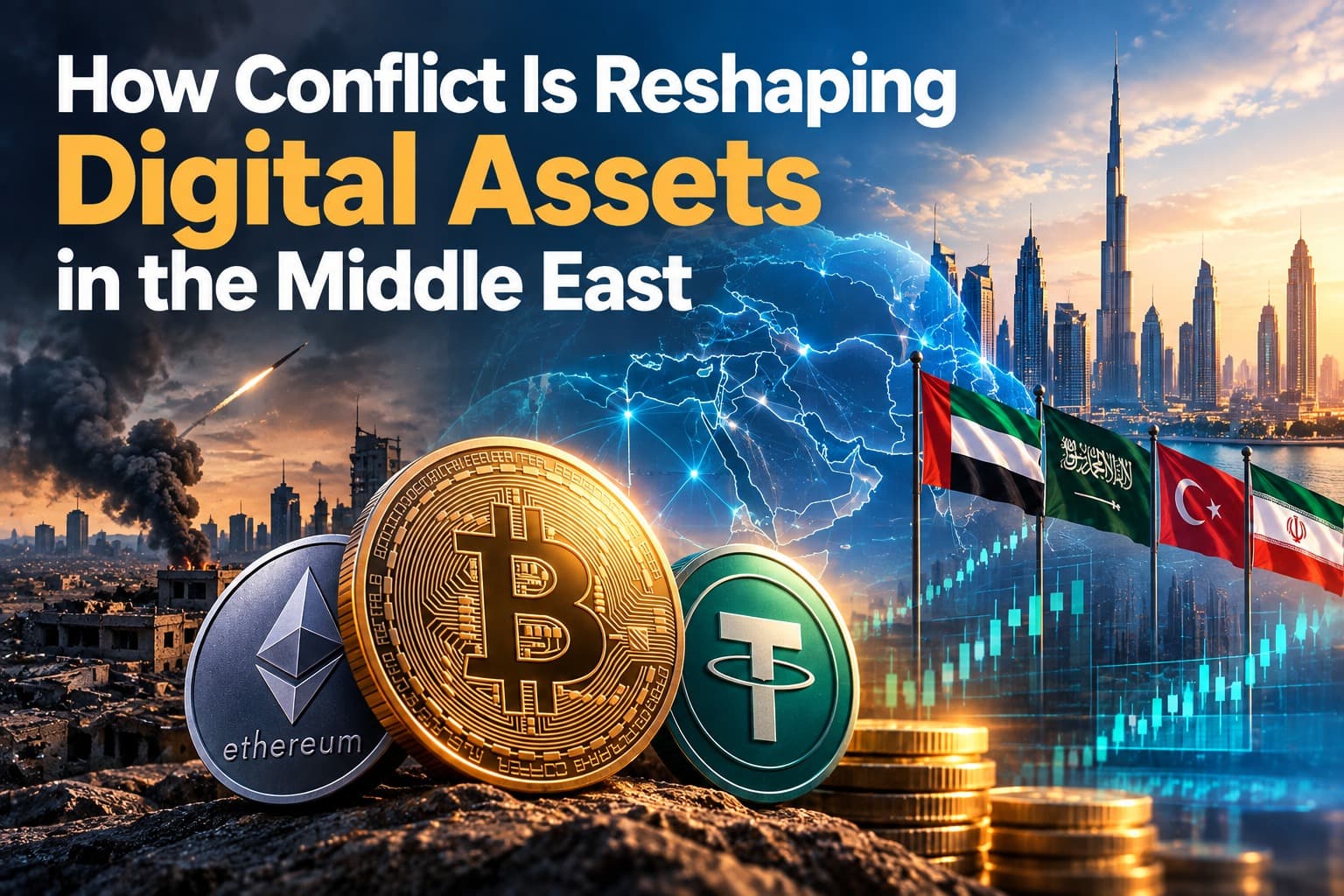
Conflict, currency instability and financial fragmentation are changing how digital assets are used across the Middle East and North Africa (MENA), according to a September 4 analysis from the Bitcoin Policy Institute (BPI). The report argues that the region is developing two distinct crypto models: defensive adoption in economies facing monetary and geopolitical stress, and regulated institutional growth in the Gulf.
The distinction is important. It challenges the idea that cryptocurrency adoption has a single cause across the region.
BINANCE:BTCUSDT
In countries such as Egypt, Lebanon and Iran, Bitcoin and dollar-backed stablecoins can provide an alternative route for preserving value or transferring funds when traditional financial systems become more constrained. In the Gulf, meanwhile, governments are building regulated markets designed to attract institutions, fintech companies and blockchain investment.
BPI estimates that annual on-chain transaction volume across MENA has grown from roughly $100 billion in 2022 to about $350 billion by 2025–2026.
 Cathie Wood Remains Bullish on Bitcoin as BTC-Gold Ratio Signals a Potential Shift→
 TRON Ecosystem Expands in Q2 2026 Across AI, Payments and Tokenization→
 Solana Leads August App Revenue at $143M→
 Grayscale Warns of Rising Equity Concentration→
The report’s author, Zaid M. Belbagi, frames the trend through the effects of the Israel-Iran conflict and the region’s broader economic transformation. Because BPI is a Bitcoin-focused research and advocacy nonprofit, its interpretation should be read alongside independent datasets such as Chainalysis rather than treated as a neutral market consensus.
Conflict created a real-world stress test for Bitcoin
The most revealing part of the analysis concerns the market reaction to the Israel-Iran escalation in June 2025.
Bitcoin did not immediately behave like a traditional safe-haven asset.
Following the initial Israeli strikes on Iran, BPI said the overall cryptocurrency market capitalization fell by around 3.7%, while Bitcoin declined approximately 2.3% and Ethereum fell about 7.5%. That initial reaction resembled a conventional risk-off move in which investors reduced exposure to volatile assets.
But the market response subsequently changed.
Rather than abandoning crypto completely, investors shifted some capital away from higher-risk altcoins toward Bitcoin. BPI reported that Bitcoin dominance rose to 64.8%, while BTC stabilized in the roughly $104,000–$106,000 range despite continuing military tensions.
This sequence provides a more nuanced picture of Bitcoin’s role.
The cryptocurrency can initially trade like a risk asset when geopolitical uncertainty hits global markets. At the same time, once investors begin differentiating between crypto assets, Bitcoin can attract capital relative to smaller and more speculative tokens.
That is not the same thing as proving Bitcoin is a safe haven. Instead, it suggests that its role can change depending on the stage of a crisis and the alternatives available to investors.
Crypto markets keep operating when traditional markets close
The conflict also highlighted one structural feature of digital assets that is difficult to replicate in traditional finance: 24/7 market availability.
BPI cited Stephen Coltman, vice president and head of macro at 21Shares, who pointed to the contrast between conventional markets and crypto during the regional crisis. According to Coltman’s observation in the report, stock exchanges closed during periods of missile attacks in the UAE while crypto exchanges continued operating.
This matters because continuous trading provides investors with an always-open venue for adjusting exposure.
It does not eliminate liquidity risk, volatility or counterparty risk. Nor does it guarantee that cryptocurrency prices will rise during a crisis. But it does mean that digital assets can continue to provide transfer and trading functionality even when local financial infrastructure is disrupted.
That operational resilience is one reason the role of digital assets in the Middle East increasingly extends beyond speculation.
Currency instability is another major adoption driver
Geopolitical conflict is only part of the story.
BPI identifies currency depreciation as another major reason for growing cryptocurrency usage in parts of MENA. The report specifically highlights Egypt, Turkey, Lebanon and Iran, where local economic pressures have encouraged some users to seek alternatives to domestic currencies.
In Egypt, BPI reports that peer-to-peer Bitcoin trading volumes increased by more than 300% following successive devaluations of the Egyptian pound.
The underlying mechanism is straightforward.
When a local currency loses purchasing power rapidly, households and businesses may look for assets denominated in currencies they perceive as more stable. Dollar-backed stablecoins can become particularly attractive because they combine a digital settlement mechanism with exposure to a widely recognized unit of account.
Bitcoin serves a different purpose. It carries substantially more price volatility, but it can provide a globally transferable asset that does not depend directly on the domestic banking system.
Independent research from Chainalysis supports the broader picture of strong and divergent crypto adoption across MENA. Its 2025 regional analysis identified the Middle East as a major cryptocurrency market, while also emphasizing that adoption patterns vary significantly from country to country.
The Gulf is building a different crypto model
The strongest contrast in the BPI analysis is between economically constrained markets and the Gulf.
The United Arab Emirates, Bahrain, Saudi Arabia and Qatar are increasingly approaching digital assets as part of financial-market development and economic diversification rather than simply as an alternative savings vehicle.
BPI estimates that the UAE processed approximately $150 billion in cryptocurrency transactions during 2025, while Saudi Arabia recorded 154% year-over-year growth and Qatar grew by 120%. Turkey remained the region’s largest market by raw transaction value, at nearly $200 billion annually, according to the report.
Recent independent coverage of the BPI report has repeated those estimates, including Saudi Arabia’s 154% growth and the UAE’s roughly $150 billion in activity.
The Gulf story is therefore different from the crisis-driven adoption model.
Governments are creating legal frameworks, licensing businesses and investing in digital financial infrastructure with the goal of attracting institutional capital.
A snapshot of the regional split
| Market | Reported trend | Main adoption driver |
|---|---|---|
| UAE | ~$150B crypto transactions in 2025 | Institutional adoption and regulated infrastructure |
| Saudi Arabia | 154% year-over-year growth | Economic diversification, fintech and blockchain investment |
| Qatar | 120% year-over-year growth | Regulatory development and digital finance |
| Turkey | Nearly $200B annual activity | Large user base and currency pressures |
| Egypt | P2P Bitcoin volume reported up 300%+ | Currency depreciation and value preservation |
*Source: Bitcoin Policy Institute; figures are estimates cited in its September 4, 2026 analysis. *
Regulation is becoming a competitive advantage
The Gulf’s strategy increasingly depends on regulation.
Dubai’s Virtual Assets Regulatory Authority (VARA) maintains a dedicated framework covering virtual-asset issuance and a range of licensed activities, including custody, exchange and transfer and settlement services. VARA’s current rulebooks also contain specific requirements for fiat-referenced and asset-referenced virtual assets.
Dubai’s regulatory development also extends into tokenization. In February 2026, VARA said the first phase of its real-estate tokenization pilot had been completed and that the project had entered a controlled testing and evaluation phase.
Bahrain has followed a similar institutional approach.
The Central Bank of Bahrain introduced its Stablecoin Issuance and Offering Module in July 2025, establishing a licensing and regulatory framework for stablecoin issuers and permitting licensed issuers to offer single-currency stablecoins backed by currencies approved by the central bank.
These policies illustrate an important shift. Regulation is no longer necessarily being viewed only as a restriction on crypto. In some Gulf markets, it is becoming part of the strategy for attracting companies and institutional investors.
Expert opinions: Bitcoin’s role is more complicated than a safe haven
The most useful interpretation of the BPI analysis may be that Bitcoin’s role during conflict is conditional rather than binary.
A conventional safe-haven asset is expected to preserve or increase value during periods of market stress. Bitcoin has not consistently behaved that way.
Its decline during the initial phase of the June 2025 Israel-Iran escalation demonstrates that it can still trade as a risk asset when investors are reducing exposure across financial markets.
However, its subsequent outperformance relative to altcoins indicates that investors may increasingly distinguish Bitcoin from more speculative digital assets during periods of uncertainty.
That distinction is supported by the market’s internal structure: capital does not have to leave crypto entirely for defensive positioning to emerge. Investors can rotate within the asset class.
The operational perspective from 21Shares’ Stephen Coltman adds another dimension. Continuous crypto-market access can have practical value during disruptions even when prices remain volatile.
For that reason, calling Bitcoin simply a “safe haven” misses part of the story. Its potential value in the region may lie equally in portability, continuous settlement and independence from individual market hours.
Stablecoins may be even more important than Bitcoin
While Bitcoin dominates much of the investment narrative, stablecoins could be the more practical financial tool in countries facing currency pressure.
Their main advantage is lower price volatility relative to assets such as BTC.
For someone trying to move dollar-denominated value, pay a supplier or preserve purchasing power, a dollar-backed stablecoin can be more directly useful than Bitcoin.
This helps explain the growing importance of stablecoins across MENA’s digital financial infrastructure.
It also connects the Middle East story with a broader global trend covered by CryptoQuorum in its analysis of institutional crypto adoption, where stablecoins, tokenized assets and blockchain settlement are increasingly becoming part of institutional financial infrastructure.
At the same time, stablecoins introduce their own risks. Users depend on the issuer, reserves, redemption mechanisms, the underlying blockchain and applicable regulation.
Why the regional divergence matters globally
The MENA experience offers a useful case study for the future of digital finance.
In one part of the region, crypto is being adopted because traditional financial systems may be under pressure. In another, governments are deliberately integrating digital assets into regulated financial markets.
Those two models can coexist.
A person in an inflation-affected economy may see stablecoins as a practical savings and payments instrument, while a financial institution in Dubai may use regulated digital assets for custody, tokenization or investment.
The result is a market developing from both the bottom up and the top down.
That is significant for global crypto companies because the Gulf is increasingly competing not only for retail users but also for exchanges, custodians, fintech firms, asset managers and blockchain developers.
What to watch next
The next stage of MENA’s crypto development will likely depend on several factors.
First, geopolitical stability. Renewed conflict could increase demand for portable digital assets while simultaneously triggering broad risk-off selling.
Second, currency conditions. Further depreciation in local currencies could strengthen demand for dollar-backed stablecoins and Bitcoin.
Third, regulation. Clear licensing frameworks could continue attracting institutional firms to Gulf jurisdictions.
Fourth, tokenization. Real-world asset projects could shift the region’s digital-asset market further toward traditional finance.
Fifth, institutional liquidity. Greater participation from professional investors could make local markets deeper, but also more closely connected to global financial cycles.
Bottom line
The latest Bitcoin Policy Institute analysis suggests that conflict is not simply increasing or decreasing cryptocurrency adoption in the Middle East. It is changing the reasons people and institutions use digital assets.
In economies affected by sanctions, conflict or currency depreciation, Bitcoin and stablecoins can serve as alternative mechanisms for transferring or preserving value. In Gulf economies, meanwhile, governments are building regulated frameworks designed to attract institutional capital and position the region as a global digital-asset hub.
The experience of the June 2025 Israel-Iran conflict also demonstrates that Bitcoin should not automatically be classified as a safe-haven asset. It initially sold off alongside other risk assets before investors rotated toward BTC from more speculative cryptocurrencies.
For the broader industry, the more important story may be the emergence of two complementary forms of adoption: crypto as financial resilience in stressed economies and crypto as regulated infrastructure in growth-oriented financial centers.
That divergence could make the Middle East one of the most important regions to watch as digital assets become more closely integrated with global finance.
Disclaimer
This article is provided for informational and educational purposes only and does not constitute financial, investment, trading, legal or other professional advice. Cryptocurrency markets are highly volatile and can involve substantial losses. References to Bitcoin, stablecoins or digital-asset adoption do not constitute recommendations to buy, sell or hold any asset. Readers should conduct their own research and consult qualified professionals before making financial decisions.