

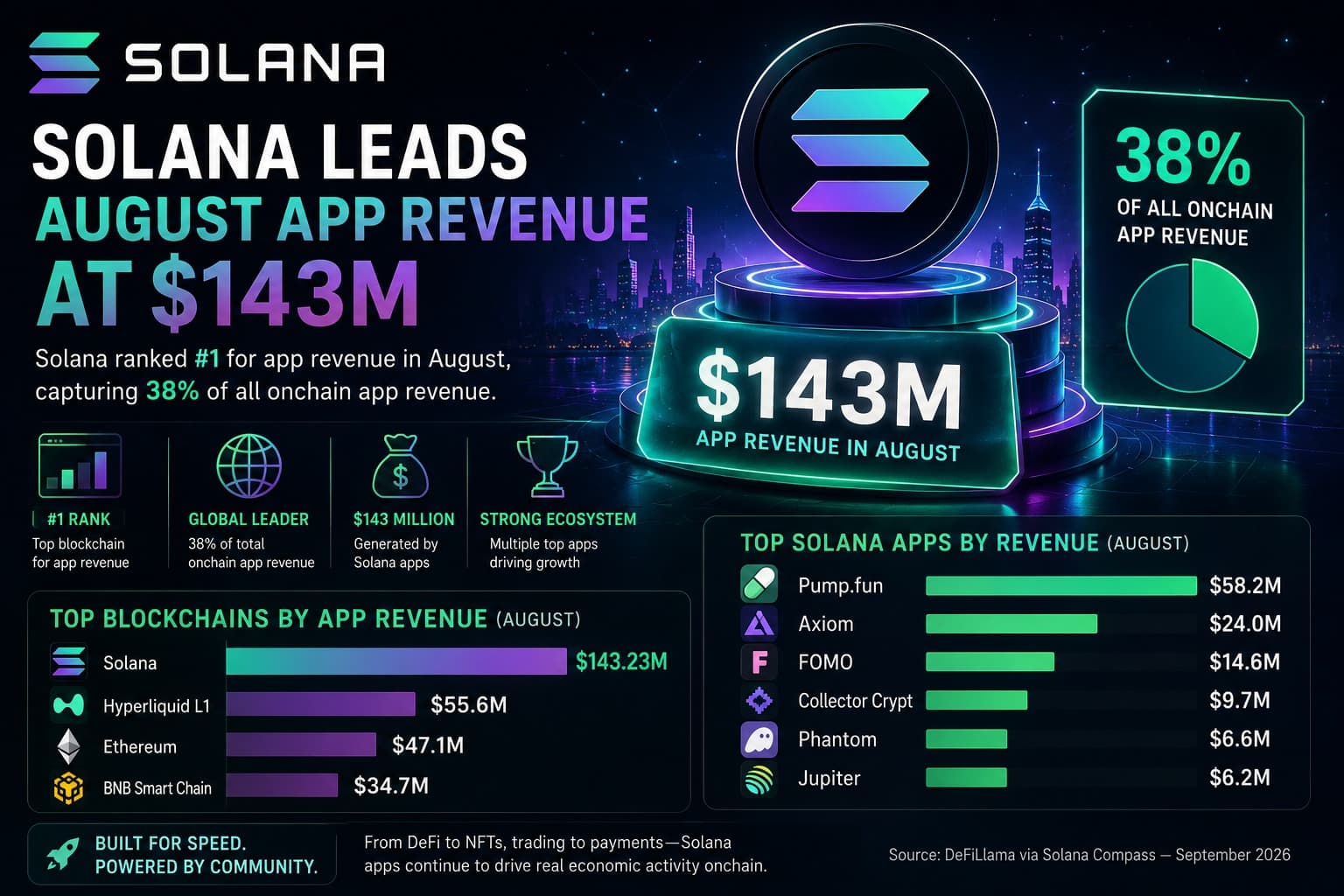
Solana ranked first among blockchain networks for application revenue in August, with its apps generating approximately $143 million and accounting for 38% of total onchain app revenue, according to data cited by Solana and attributed to DeFiLlama.
The Solana network posted the figure on Sept. 3, saying it ranked No. 1 for app revenue during August. More detailed DeFiLlama data reviewed by Solana Compass put the monthly total at $143.23 million, or about 38.1% of the $375.53 million generated by applications across all chains.
BINANCE:SOLUSDT
The result puts Solana well ahead of several major competitors and highlights the economic activity being generated at the application layer, even as the broader cryptocurrency market remains volatile.
Solana Takes the Lead in August
The scale of Solana’s August result becomes clearer when compared with other major networks.
 Grayscale Warns of Rising Equity Concentration→
 Strategy Challenges MSCI Over Bitcoin Index Plan→
 TRON Adds $903.4M in Stablecoin Market Cap in One Week→
 Cronos Network Halts After Tectonic Exploit Estimated at $75M→
| Blockchain | August App Revenue |
|---|---|
| Solana | $143.23M |
| Hyperliquid L1 | $55.6M |
| Ethereum | $47.1M |
| BNB Smart Chain | $34.7M |
Source: DeFiLlama data cited by Solana Compass; figures are approximate except for Solana’s reported $143.23M.
Solana’s total was more than twice Hyperliquid’s figure and roughly three times Ethereum’s. It also exceeded the combined revenue of Hyperliquid L1, Ethereum and BNB Smart Chain by approximately $6 million.
That makes the August result significant not simply because Solana crossed the $100 million threshold, but because the network captured a substantial portion of application-layer economic activity across the entire blockchain sector.
What the $143 Million Actually Measures
One of the most important qualifications is what DeFiLlama means by application or protocol revenue.
The $143.23 million does not represent all fees generated by the Solana blockchain. It does not include every transaction fee paid to validators, priority fees, or other forms of network-level revenue.
Instead, the metric focuses on revenue retained by applications and protocols. This can include fees collected by trading platforms, token launchpads, wallets, decentralized exchanges and other applications.
That distinction matters when comparing Solana’s performance with other blockchain metrics.
For example, a blockchain can have enormous transaction activity without producing the same amount of application revenue. Conversely, an ecosystem with fewer transactions can generate significant economic value through applications that charge relatively high fees.
Therefore, the August ranking should be interpreted as a measurement of application-layer monetization, rather than a comprehensive ranking of blockchain economics.
Six Solana Apps Generated More Than $6 Million Each
Another important feature of the August data is the distribution of revenue across different types of applications.
According to Solana Compass’s analysis of DeFiLlama data, six Solana applications individually exceeded $6 million in August:
- Pump.fun: approximately $58.2 million
- Axiom: approximately $24 million
- FOMO: approximately $14.6 million
- Collector Crypt: approximately $9.7 million
- Phantom: approximately $6.6 million
- Jupiter: approximately $6.2 million
Together, those six applications generated roughly $119 million, or more than four-fifths of Solana’s August total.
The composition is also notable. Revenue came from several different categories, including a memecoin launchpad, trading terminals, social trading, an NFT marketplace, a wallet and a decentralized-exchange aggregator.
That provides a more nuanced picture than simply saying Solana’s revenue was driven by one application.
Trading Activity Becomes a Major Revenue Engine
Trading applications were particularly important during August.
Axiom generated roughly $24 million, while social trading application FOMO generated approximately $14.6 million. Combined, the two platforms produced about $38.6 million in retained application revenue.
Solana Compass also reported that Solana decentralized-exchange volume increased during the month, rising from approximately $32.6 billion in the second week of August to $50.7 billion in the final week.
That increase provides context for the revenue figures. When more assets are traded and more users interact with decentralized applications, protocols with fee-based business models have greater opportunities to monetize that activity.
The trend is consistent with Solana’s broader positioning as a high-throughput environment for trading and consumer-facing applications. The official Solana platform continues to emphasize payments, capital markets and crypto applications as major use cases for the network.
From Memecoins to Financial Infrastructure
Pump.fun remained the largest individual contributor, with approximately $58.2 million in August revenue according to the DeFiLlama data cited by Solana Compass.
Its contribution demonstrates the continuing economic importance of token-launch activity within the Solana ecosystem.
But the wider data suggest that Solana’s application economy extends beyond memecoins.
Trading terminals, wallets, NFT infrastructure and decentralized exchanges all contributed meaningful amounts. This diversification is relevant because a network whose application revenue comes from several categories may have a broader economic base than one dependent on a single use case.
The development also fits with Solana’s expanding role in tokenized assets. In July, the Solana ecosystem highlighted the growth of tokenized equities and the arrival of issuer-backed shares, while financial institutions have continued exploring tokenization on the network.
CryptoQuorum previously examined this trend in its coverage of Chainlink’s expansion into tokenized equities, an area where blockchain infrastructure is increasingly being connected to traditional capital markets.
Expert View: Revenue Is More Useful When the Contributor Base Is Broad
The August figures should not be viewed only as a leaderboard.
Solana Compass’s analysis points to the importance of having multiple applications generating meaningful revenue. Its assessment is that the result becomes structurally more interesting when a launchpad, trading platforms, a wallet, an NFT marketplace and a DEX aggregator all contribute independently.
That is an important distinction for analysts evaluating blockchain ecosystems.
A temporary revenue spike generated by one application can disappear quickly if user incentives change or activity migrates elsewhere. A broader application base potentially provides greater resilience, although it does not guarantee that revenue will remain at current levels.
This is particularly relevant for Solana because its ecosystem has historically experienced sharp cycles in trading activity and speculative demand.
Network Capacity Is Also Expanding
The August revenue performance arrived alongside continued technical development.
Solana reduced its mainnet target slot time from 400 milliseconds to 350 milliseconds in August, with further reductions planned. The network also activated a higher block compute limit, increasing the amount of computation that can be processed within a block.
Solana’s official August 27 changelog said a feature gate reducing slot times to 300 milliseconds had reached mainnet, while work continued toward the network’s longer-term performance targets.
These upgrades matter because application growth ultimately depends on infrastructure that can support increasing demand.
If trading, payments, tokenization and consumer applications continue to grow, capacity and latency become increasingly important competitive factors.
August Continues a Stronger Revenue Trend
The $143 million August result also represents a sharp increase from July.
Solana application revenue was approximately $82.9 million in July, according to DeFiLlama data cited by Solana Compass. August therefore represented an increase of more than $60 million month over month.
Earlier in August, Solana applications had already recorded a weekly revenue figure of approximately $35 million, the highest weekly level in 29 weeks at that time.
The sequence suggests that August’s result was not simply the product of a single unusually strong day.
At the same time, monthly cryptocurrency activity remains cyclical. Revenue can change rapidly with trading volumes, token launches, market prices and user incentives. The August number should therefore be treated as a snapshot of current economic activity rather than a guaranteed forward-looking run rate.
Why the Ranking Matters for Solana
Application revenue is becoming an increasingly important metric for evaluating blockchain ecosystems.
Market capitalization measures the value investors assign to a token. Transaction counts measure network activity. Total value locked measures capital deployed in protocols.
Application revenue adds another dimension: how much economic value applications are actually capturing from users.
Solana’s August performance therefore provides a useful indicator of the commercial activity taking place across its ecosystem.
The result also reinforces the network’s competition with Ethereum and newer high-activity chains such as Hyperliquid. Ethereum remains one of the largest blockchain ecosystems by developer activity, liquidity and infrastructure, while Solana is increasingly competing on execution speed, consumer applications and trading activity.
CryptoQuorum’s previous coverage of Solana’s broader institutional adoption and the expansion of blockchain-based financial infrastructure provides additional context for this transition.
What to Watch Next
The key question after August’s record application revenue is whether Solana can maintain a high level of economic activity without relying excessively on speculative trading.
Several indicators will be worth monitoring:
- Application revenue: whether September remains close to August’s elevated level.
- Revenue diversification: whether more applications outside trading and token launches begin contributing significant amounts.
- DEX volume: whether the late-August increase continues.
- Stablecoin and payment activity: whether Solana captures more non-speculative transactions.
- Tokenized assets: whether institutional use cases develop alongside consumer applications.
- Network capacity: whether infrastructure improvements support higher activity without compromising reliability.
These factors will help determine whether August was a temporary peak or part of a broader expansion of Solana’s application economy.
The Bottom Line
Solana’s $143.23 million in August application revenue represents one of the strongest monthly performances among blockchain ecosystems in 2026.
With approximately 38% of global onchain app revenue, Solana ranked ahead of Hyperliquid, Ethereum and BNB Smart Chain on this specific metric.
More importantly, the revenue came from several application categories rather than a single source. Trading platforms, token launches, wallets, NFTs and decentralized exchanges all contributed to the network’s economic activity.
The result does not guarantee continued growth for Solana or an increase in the value of SOL. Application revenue can fluctuate substantially with market conditions.
But as a measure of actual economic activity at the application layer, August’s numbers strengthen the case that Solana has become one of the most commercially active blockchain ecosystems in the market.
BINANCE:ETHUSDT
Disclaimer: This article is for informational and educational purposes only and does not constitute financial, investment, legal or tax advice. Cryptocurrency and blockchain investments involve substantial risk and may result in partial or total loss of capital. Historical revenue, transaction activity and ecosystem growth do not guarantee future results. Readers should conduct their own research and consult a qualified financial professional before making investment decisions.