

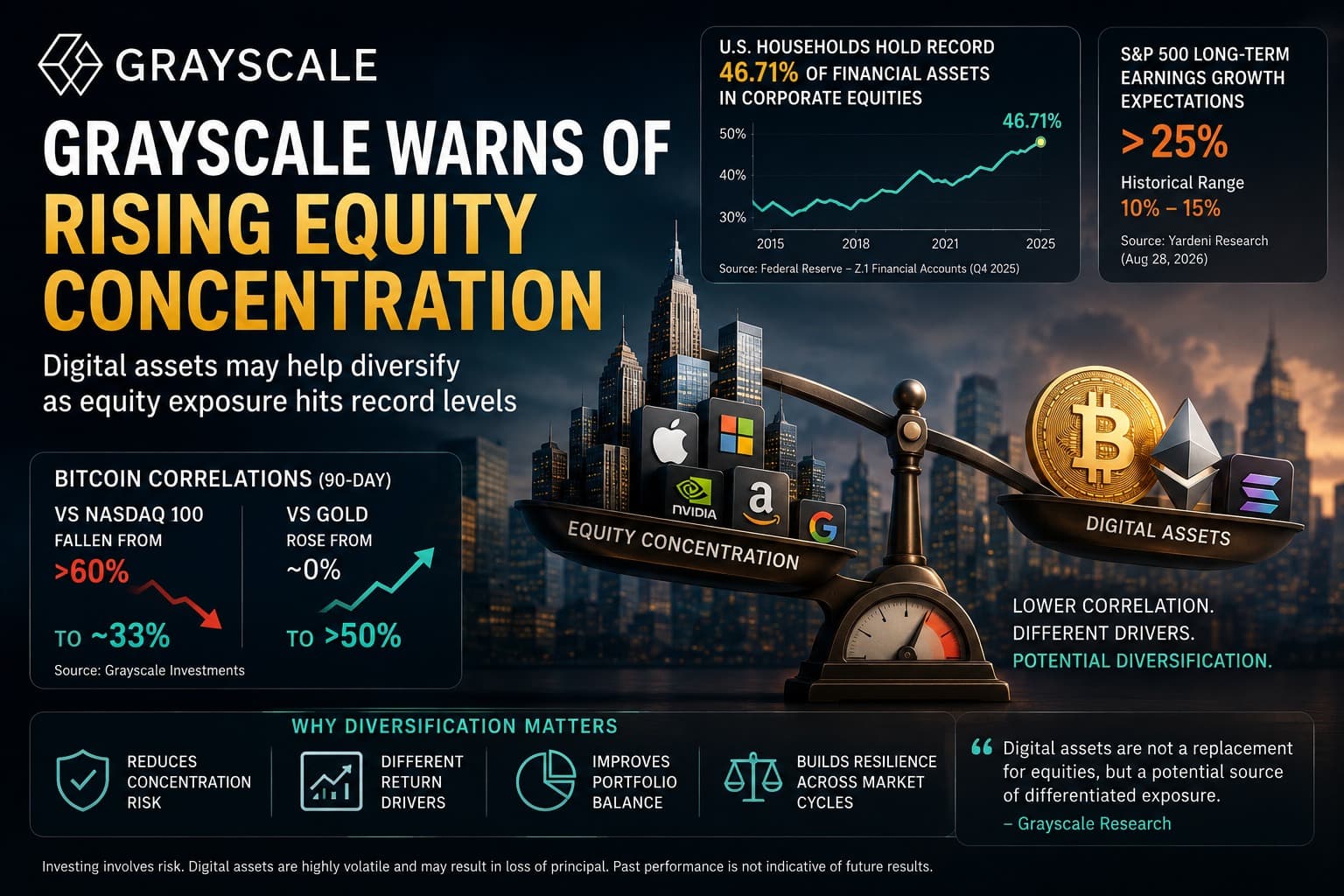
U.S. household portfolios are becoming increasingly dependent on corporate equities, while stock valuations are pricing in unusually strong future earnings growth. In a new analysis published Sept. 1, Grayscale argues that this backdrop could strengthen the case for adding digital assets as a diversifying component rather than treating crypto as a replacement for stocks.
The argument comes as Bitcoin’s relationship with traditional markets is changing. Grayscale says Bitcoin’s 90-day correlation with the Nasdaq 100 has fallen from above 60% to about 33%, while its correlation with gold has climbed from near zero to above 50%. Those figures do not make Bitcoin a safe-haven asset, but they show that its short-term behavior is not currently identical to that of major technology equities.
BINANCE:BTCUSDT
Record Equity Exposure Changes the Diversification Debate
The starting point for Grayscale’s thesis is portfolio concentration.
Data from the Federal Reserve show that U.S. households held $66.6 trillion in corporate equities at the end of 2025. The category includes directly and indirectly held securities in household financial accounts.
 Solana Leads August App Revenue at $143M→
 Strategy Challenges MSCI Over Bitcoin Index Plan→
 TRON Adds $903.4M in Stablecoin Market Cap in One Week→
 Cronos Network Halts After Tectonic Exploit Estimated at $75M→
The 46.71% figure cited by Grayscale puts the issue in portfolio terms. When a large portion of household wealth is tied to equities, a broad stock-market drawdown can have an outsized effect on household balance sheets.
That does not mean stocks are necessarily overvalued or that investors should abandon them. Equities remain a core source of long-term capital growth, dividends and ownership of productive businesses.
The concern is concentration. If a portfolio is dominated by assets that respond to similar economic forces, adding an asset with different drivers can potentially improve diversification. The benefit depends on actual correlation, volatility and position size—not simply on whether an asset belongs to a different category.
Grayscale Research Head Zach Pandl frames crypto in that context. His argument is that record household equity exposure and elevated stock valuations make a differentiated asset class more relevant for portfolio construction.
Stock Valuations Raise the Hurdle for Future Returns
Grayscale also points to the expectations embedded in the U.S. equity market.
The firm cites Yardeni Research data showing consensus long-term earnings-growth expectations for the S&P 500 above 25% as of Aug. 28. Historically, the range has generally been closer to 10%–15%.
Higher expectations do not automatically mean stocks will fall. Companies can outperform forecasts, productivity can improve, and artificial intelligence investment could create new revenue streams.
But higher expectations create a tougher performance hurdle. If valuations already assume exceptional earnings growth, disappointing results can have a larger effect on prices.
This is where portfolio diversification becomes relevant. Grayscale is not arguing that crypto should replace equities. Instead, the research presents digital assets as a possible source of differentiated exposure alongside traditional holdings.
Bitcoin’s Relationship With Stocks Is Changing
The most notable part of the analysis is the change in Bitcoin’s correlations.
During much of 2026, Bitcoin behaved like a high-beta risk asset, with a strong relationship to technology stocks. Grayscale’s recent data show the 90-day correlation with the Nasdaq 100 falling from above 60% to approximately 33%.
At the same time, Bitcoin’s 90-day correlation with gold rose from close to zero to more than 50%.
Correlation is not a permanent property of an asset. It changes with market conditions, liquidity, investor positioning and the macroeconomic environment. A 90-day reading is also a relatively short observation window.
Therefore, the figures should not be interpreted as proof that Bitcoin has permanently become “digital gold.” They do, however, show why investors should avoid assuming that Bitcoin will always behave like a technology-stock proxy.
Grayscale’s broader research has described this shift as a possible return of the “debasement trade,” in which investors focus more on scarce assets when concerns about fiscal sustainability, currency purchasing power and monetary policy increase.
For CryptoQuorum readers, this connects with our recent analysis of Michael Saylor’s digital-capital framework, which examined how Bitcoin is increasingly being connected to corporate finance, credit and other capital-market instruments.
Crypto’s Reset Creates a Different Market Backdrop
Another part of Grayscale’s argument is the contrast between traditional equities and digital assets.
The crypto market has gone through a reset in valuations, leverage and investor positioning. Grayscale argues that this leaves the digital-asset market in a different position from a U.S. equity market where expectations remain elevated.
That does not establish that crypto is cheap. Bitcoin and other digital assets can experience severe drawdowns and face regulatory, technological, liquidity and custody risks.
The point is relative positioning.
If two asset classes have different valuations, investor positioning and fundamental drivers, their inclusion in a portfolio may create a different risk profile than simply adding more exposure to the same market leaders.
This is the essence of diversification: reducing dependence on a single return driver rather than trying to predict which asset will perform best.
What Diversification Does—and Does Not—Mean
Adding Bitcoin to an equity portfolio does not guarantee lower volatility. Bitcoin’s historical volatility has generally been higher than that of broad stock indexes. Grayscale explicitly cautions that Bitcoin has not consistently functioned as a safe-haven asset.
The potential benefit comes from the interaction between assets.
| Portfolio question | What to examine | Why it matters |
|---|---|---|
| Equity concentration | Share of wealth tied to stocks | Measures dependence on one major asset class |
| Correlation | How assets move relative to each other | Lower correlation can improve diversification |
| Volatility | Size and frequency of price swings | Determines how much risk an allocation adds |
| Position size | Percentage allocated to digital assets | Affects the portfolio’s overall risk |
| Time horizon | Short-term versus long-term objectives | Correlations and risk can change over time |
A small allocation can have a very different effect from a large one. The same Bitcoin position that may be tolerable for one investor could be inappropriate for another because of differences in liquidity needs, income, investment horizon and risk tolerance.
This is why Grayscale’s argument is better understood as a portfolio-construction discussion than as a direct recommendation to buy crypto.
Independent Research Adds an Important Caveat
The idea that cryptocurrencies can contribute to portfolio diversification is not unique to Grayscale.
Academic research examining Bitcoin and Ethereum alongside European equity indexes has found weaker correlations between crypto assets and several traditional stock markets, suggesting potential diversification benefits. At the same time, the study emphasizes that cryptocurrencies carry substantially higher volatility and that diversification benefits can change during periods of market stress.
That distinction is important.
Diversification works best when assets do not move in lockstep, but correlations are dynamic. During a severe liquidity shock, assets that normally behave differently can become more correlated as investors sell risk across markets.
The practical lesson is that investors should evaluate diversification across multiple market regimes rather than relying on a single correlation statistic.
The Institutional Market Is Moving in the Same Direction
The financial industry is building more ways to incorporate digital assets into conventional portfolios.
Bitcoin and Ethereum exchange-traded products have made regulated exposure easier, while tokenization is creating blockchain-based representations of equities, bonds and other real-world assets.
CryptoQuorum recently covered Chainlink’s expanding role in tokenized equities, where the focus is shifting from simply putting securities on a blockchain toward data, interoperability, settlement and integration with decentralized finance.
The broader institutional trend is also visible in custody, brokerage, ETF infrastructure and corporate treasury strategies. This evolution gives investors more ways to obtain digital-asset exposure through established financial channels rather than relying exclusively on specialized crypto platforms.
CryptoQuorum’s earlier analysis of institutional crypto adoption in 2026 examined the same broader convergence between traditional finance and blockchain infrastructure.
What Investors Should Watch Next
Several indicators will determine whether Grayscale’s diversification thesis gains broader support.
First, equity valuations and earnings expectations. If corporate earnings continue to exceed forecasts, elevated valuations may prove more sustainable. If expectations decline, concentrated equity portfolios could face greater pressure.
Second, Bitcoin correlations. The relationship between Bitcoin, the Nasdaq 100 and gold should be tracked over longer periods. A temporary 90-day shift is less meaningful if the relationship reverses quickly.
Third, volatility. A diversifier that is too large relative to the portfolio can increase overall risk even if it has a low correlation with stocks.
Finally, liquidity and institutional flows. Bitcoin’s role in portfolios is increasingly shaped by ETFs, custodians, asset managers, corporate treasuries and regulated financial infrastructure.
The Bottom Line
Grayscale’s latest analysis does not say that investors should abandon stocks for Bitcoin. Its more nuanced argument is that record U.S. equity exposure and elevated earnings expectations make portfolio concentration more visible.
At the same time, Bitcoin’s recent market behavior has diverged somewhat from technology stocks and moved closer to gold on a rolling-correlation basis.
That combination makes digital assets worth considering in the context of diversification—but not as a guaranteed hedge.
For investors, the practical lesson is straightforward: diversification depends on position size, correlation, volatility and investment objectives. Bitcoin can provide a different source of exposure, but its risks remain substantial.
As traditional markets and digital assets become increasingly connected, the more important question may no longer be whether crypto belongs in portfolios at all. It is how much exposure is appropriate, what role it serves, and how that role changes across different market regimes.
BINANCE:ETHUSDT
Disclaimer: This article is for informational and educational purposes only and does not constitute financial, investment, legal or tax advice. Digital assets are highly volatile and may result in partial or total loss of capital. Past performance, correlations and historical relationships do not guarantee future results. Readers should conduct their own research and consult a qualified financial professional before making investment decisions.