

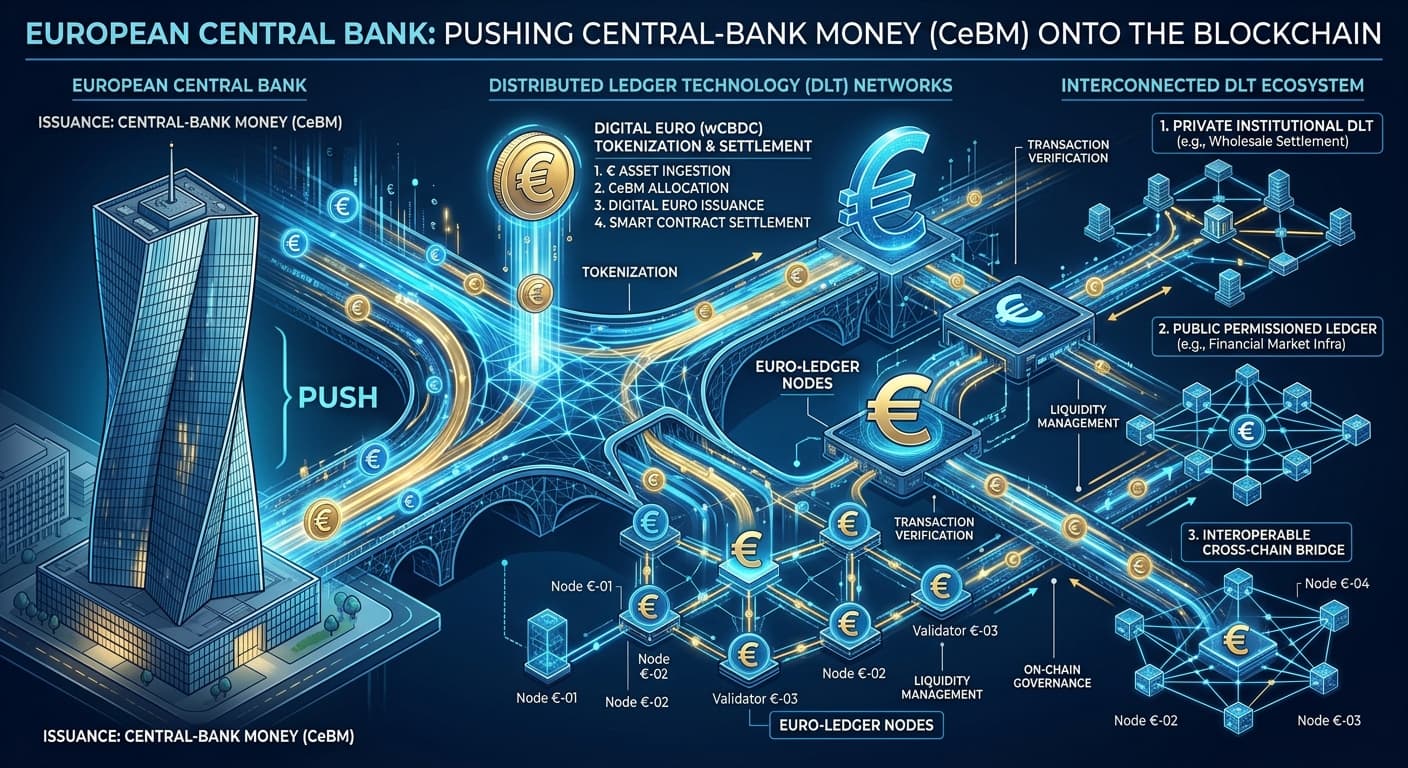
In one of the most explicit signals yet from a senior European monetary official, European Central Bank (ECB) Executive Board member Isabel Schnabel stated that central bank money must be brought directly onto blockchain infrastructure. Delivering her remarks at the Jackson Hole Economic Policy Symposium on August 28, 2026, Schnabel argued that integrating central bank reserves with distributed ledger technology (DLT) is essential to revamp monetary policy execution, streamline collateral management, and maintain the public sector’s role as the foundation of settlement.
As financial markets rapidly digitize private assets, bonds, and commercial bank deposits, Schnabel warned that keeping central bank money trapped in legacy infrastructure creates severe operational friction. To capture the full efficiency gains of Web3 technologies, monetary authorities must ensure that the ultimate risk-free settlement asset operates natively alongside tokenized assets within a modern tokenized financial system.
Overcoming the “Mismatch” Between Tokenized Assets and Settlement Rails
The core thesis of Schnabel’s address centers on a growing disconnect within digital asset markets. While capital market participants increasingly issue, trade, and manage tokenized bonds, debt instruments, and money market funds on distributed ledgers, cash settlement still frequently relies on traditional interbank payment rails like Europe’s TARGET services.
| Settlement Phase | Asset Infrastructure | Cash Infrastructure | Settlement Dynamics & Efficiency |
| Current Settlement Mismatch | Tokenized Security / Bond (Traded on DLT) | Interbank Cash Settlement (Legacy TARGET Platform) | Asynchronous: Operational messaging & synchronization lag |
| Proposed On-Chain Settlement | Tokenized Security (On-Chain) | Central Bank Money (On-Chain) | Atomic DvP: Simultaneous Delivery vs. Payment on a Single Ledger |
When a bank purchases a tokenized security today, ownership transfers on-chain, but the underlying cash leg must clear through conventional payment systems. This asynchronous arrangement requires complex messaging mechanisms to reconcile completion across two disparate networks.
 Robinhood’s Evolving Wealth Management Strategy Targets the Future of Retail Investing→
 Fed Rate Hike May Not Rattle Crypto Markets, Grayscale Says→
 Solana Tokenized Equity Supply Surges to Record $684M Amid Multi-Platform Expansion→
 XRP Ledger Foundation Advances Ecosystem Resilience with Strategic Infrastructure Upgrades→
By bringing central bank reserves directly on-chain, financial institutions can execute true Delivery versus Payment (DvP)—an atomic settlement process where ownership of the asset and transfer of payment complete simultaneously in a single transaction block. This removes counterparty settlement risk, reduces capital buffer requirements, and eliminates multi-day clearing delays.
Project Pontes and Project Appia: Building Europe’s DLT Backbone
To transition from conceptual research to operational market infrastructure, the Eurosystem is advancing a two-tier pilot strategy designed to establish a unified tokenized financial system across the euro area.
Schnabel highlighted two pivotal ECB initiatives:
- Project Pontes: Set for operational launch in September 2026, Pontes will directly connect participant DLT platforms with existing TARGET services. This connection allows commercial financial institutions to settle tokenized asset transactions using real, risk-free central bank money without waiting for a fully native wholesale central bank digital currency (CBDC).
- Project Appia: Introduced in 2025, Appia represents a comprehensive framework to establish long-term architectural standards for European DLT settlement. A finalized institutional blueprint for Appia is expected by 2028.
Key Specifications of ECB Tokenization Initiatives
| Initiative | Target Function | Launch / Key Milestone | Core Objective |
| Project Pontes | Interoperability Layer | September 2026 | Connect DLT networks to TARGET services for atomic wholesale settlement. |
| Project Appia | Long-Term Infrastructure | Blueprint by 2028 | Design Europe’s standardized architectural framework for a tokenized financial system. |
| Retail Digital Euro | Consumer Payments | Pilot Validation Stage | Provide a public digital cash alternative for everyday peer-to-peer and merchant payments. |
Wholesale On-Chain Money vs. The Retail Digital Euro
A crucial distinction in Schnabel’s message—and one often conflated in broader market commentary—is the operational difference between wholesale on-chain central bank money and retail CBDCs.
While the consumer-focused retail Digital Euro aims to provide individual households with a public payment instrument for everyday transactions, moving central bank money on-chain addresses the deep structural plumbing of the wholesale banking system. It equips commercial banks, liquidity providers, and asset managers with programmable liquidity tools.
Schnabel also addressed the role of private stablecoins and tokenized commercial bank deposits. While private stablecoins facilitate liquidity on public blockchains, she emphasized that they cannot replace central bank money as the ultimate settlement anchor. Stablecoins carry credit, run, and liquidity risks, and lack the inherent central bank capacity to expand emergency liquidity during periods of systemic market stress.
Programmable Monetary Policy and Smart Contracts
Moving central bank liabilities onto distributed ledgers unlocks capabilities that extend beyond settlement mechanics. By leveraging smart contract logic, central banks can automate and fine-tune how monetary policy is transmitted to the broader economy.
Key programmable features include:
- Automated Rate Adjustments: Interest rates on central bank reserve balances can be updated dynamically across connected market participants via smart contract state updates.
- Real-Time Collateral Rebalancing: Financial institutions can lock, pledge, or release tokenized sovereign bonds as collateral instantaneously based on pre-programmed health factors, drastically reducing margin call response times.
- Targeted Emergency Liquidity: During liquidity crunches, central banks can deploy automated liquidity facilities that disburse funds directly to qualified counterparties upon verified conditions.
Expert Opinions and Industry Perspectives
To evaluate the broader impact of Schnabel’s announcement, industry analysts from both traditional finance and Web3 research sectors have weighed in on the implications for global liquidity and monetary sovereignty.
Include expert opinions on this monumental shift:
Dr. Marcus Vance, Chief Macro Strategist at Global FinTech Insights:
“Isabel Schnabel’s Jackson Hole speech signals a decisive pivot. Central banks realize that if they do not supply an on-chain settlement anchor, private stablecoins and tokenized commercial bank deposits will fill the vacuum. By bringing central bank money on-chain, the ECB is ensuring that public money remains the bedrock of wholesale finance in a digital era.”
Elena Rostova, Lead Blockchain Infrastructure Researcher:
“The launch of Project Pontes in September 2026 is the bridge traditional markets have been waiting for. Moving from isolated DLT trials to connecting live TARGET systems means institutional asset tokenization can scale without settlement mismatch risks. It sets a template that other major central banks will be forced to replicate.”
The Global Context: Central Banks Race On-Chain
The ECB’s aggressive roadmap reflects a broader global shift among major monetary authorities seeking to modernize capital markets.
The Bank for International Settlements (BIS), through its ongoing Project Agorá, has demonstrated how tokenized commercial bank deposits and central bank reserves can coexist on a unified programmable platform, completing cross-border settlements in seconds. Similarly, the Federal Reserve Bank of Dallas recently issued research analyzing how tokenized deposits affect bank lending, while the Bank of England and the Reserve Bank of India have launched dedicated trials to settle tokenized securities against central bank digital money.
For Europe, establishing an early operational lead through Project Pontes and Project Appia is vital to preventing capital fragmentation and maintaining euro dominance in digital trade. As tokenized asset markets expand, the seamless integration of reserve money on-chain will define the operational structure of the next-generation tokenized financial system.
Disclaimer
This article is provided for informational and educational purposes only and does not constitute financial, investment, or legal advice. Capital markets, tokenized securities, and digital asset technologies involve significant risks. Readers should conduct independent research and consult qualified financial advisors before making investment decisions.