

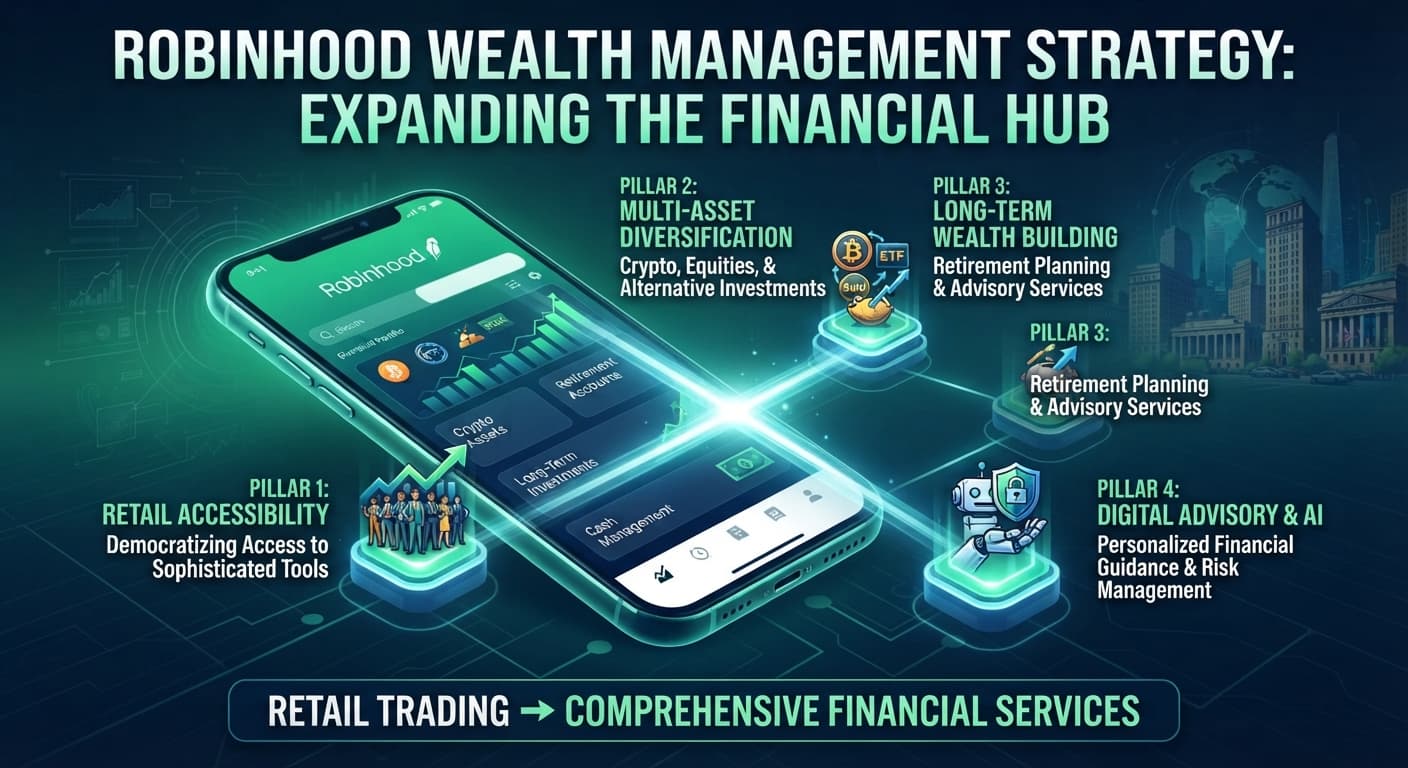
The financial technology sector is witnessing a paradigm shift in how brokerage platforms service everyday investors. Recent commentary from prominent market analysts and media figures, including Jim Cramer, has thrown a spotlight on Robinhood and its aggressive expansion into comprehensive wealth management. Long recognized as the trailblazer of commission-free retail trading, the platform is rapidly evolving into a full-scale financial hub designed to capture long-term client assets far beyond basic stock execution.
By introducing advanced tools, prediction markets, expanded cryptocurrency infrastructure, and holistic financial planning features, Robinhood is challenging legacy wealth management incumbents. This strategic pivot aims to retain aging retail cohorts as they accumulate wealth while continuing to onboard the next generation of digital-native participants.
| Strategic Focus | Core Objective | Market Implication |
| Wealth Management | Capture long-term savings and advisory assets | Deepens customer lifetime value beyond transactional fees |
| Crypto & Digital Assets | Expand tokenized and blockchain offerings | Positions the firm at the center of digital finance |
| Prediction Markets | Diversify product suites with event contracts | Capitalizes on high-engagement retail demand cycles |
The Transition from Brokerage to Comprehensive Financial Hub
For years, retail brokerages competed primarily on commission fees and mobile app usability. However, market saturation and shifting macroeconomic conditions have forced platforms to diversify. Robinhood’s strategic evolution focuses on transforming episodic traders into long-term wealth-building clients.
Include expert opinions: Market strategists note that transitioning a transactional user base into managed wealth accounts requires establishing deep trust, robust advisory tools, and seamless multi-asset access. By expanding into retirement accounts, cash sweep yields, and structured portfolio guidance, the firm is systematically plugging the leaks where retail capital historically migrated to traditional Wall Street giants.
 Fed Rate Hike May Not Rattle Crypto Markets, Grayscale Says→
 Solana Tokenized Equity Supply Surges to Record $684M Amid Multi-Platform Expansion→
 XRP Ledger Foundation Advances Ecosystem Resilience with Strategic Infrastructure Upgrades→
 OG.com Emerges as a Standalone $5B Entity in Landmark Robinhood Infrastructure Partnership→
“The expansion of digital brokerage platforms into full-scale wealth management represents the most disruptive force in modern retail finance.” — Fintech Market Analyst
Capitalizing on Crypto and Alternative Asset Integrations
A cornerstone of this growth trajectory involves deepening integration with digital assets and alternative financial instruments. By establishing robust clearing and infrastructure partnerships, Robinhood ensures that high-volume trading activities—ranging from equities to decentralized products—operate with institutional reliability.
Furthermore, recent product rollouts targeting prediction markets and multi-chain crypto access highlight the company’s commitment to staying ahead of consumer demand. These innovations provide users with diverse yield and speculative opportunities directly inside a unified application ecosystem.
| Growth Metric | Traditional Brokerage Model | Modern FinTech Approach |
| Primary Revenue | Payment for order flow & interest margins | Diversified software, subscriptions, & wealth fees |
| User Engagement | Transaction-driven intermittent logins | Daily financial management (banking, investing, crypto) |
| Product Depth | Standard equities and options | Multi-asset classes, crypto, and prediction contracts |
Navigating Regulatory Scrutiny and Market Volatility
As retail trading platforms scale into systemically important financial institutions, regulatory oversight intensifies. Compliance with frameworks set by regulatory bodies remains vital for sustaining consumer confidence. Analysts point out that maintaining transparent operations, robust cybersecurity, and stringent risk-management protocols will dictate which platforms successfully transition into permanent financial institutions.
Include expert opinions: Industry observers emphasize that managing risk during market sell-offs is the ultimate test for modern retail brokerages. Ensuring that users are well-educated and equipped with proper risk mitigation tools protects both the consumer and the long-term enterprise value of the platform.
Conclusion
Robinhood’s aggressive push into wealth management marks a defining chapter in the maturation of digital fintech. By bridging accessible retail trading with sophisticated financial services, crypto infrastructure, and long-term wealth-building tools, the platform is redefining what it means to be a modern financial institution. As execution continues, the broader financial sector will closely monitor how effectively tech-forward brokerages capture the future of global wealth.
Disclaimer
Disclaimer: The information provided in this article is for informational and educational purposes only and does not constitute financial, investment, or legal advice. Digital asset trading and equity investments carry inherent risks. Always conduct your own research and consult with a licensed financial advisor before making investment decisions.