

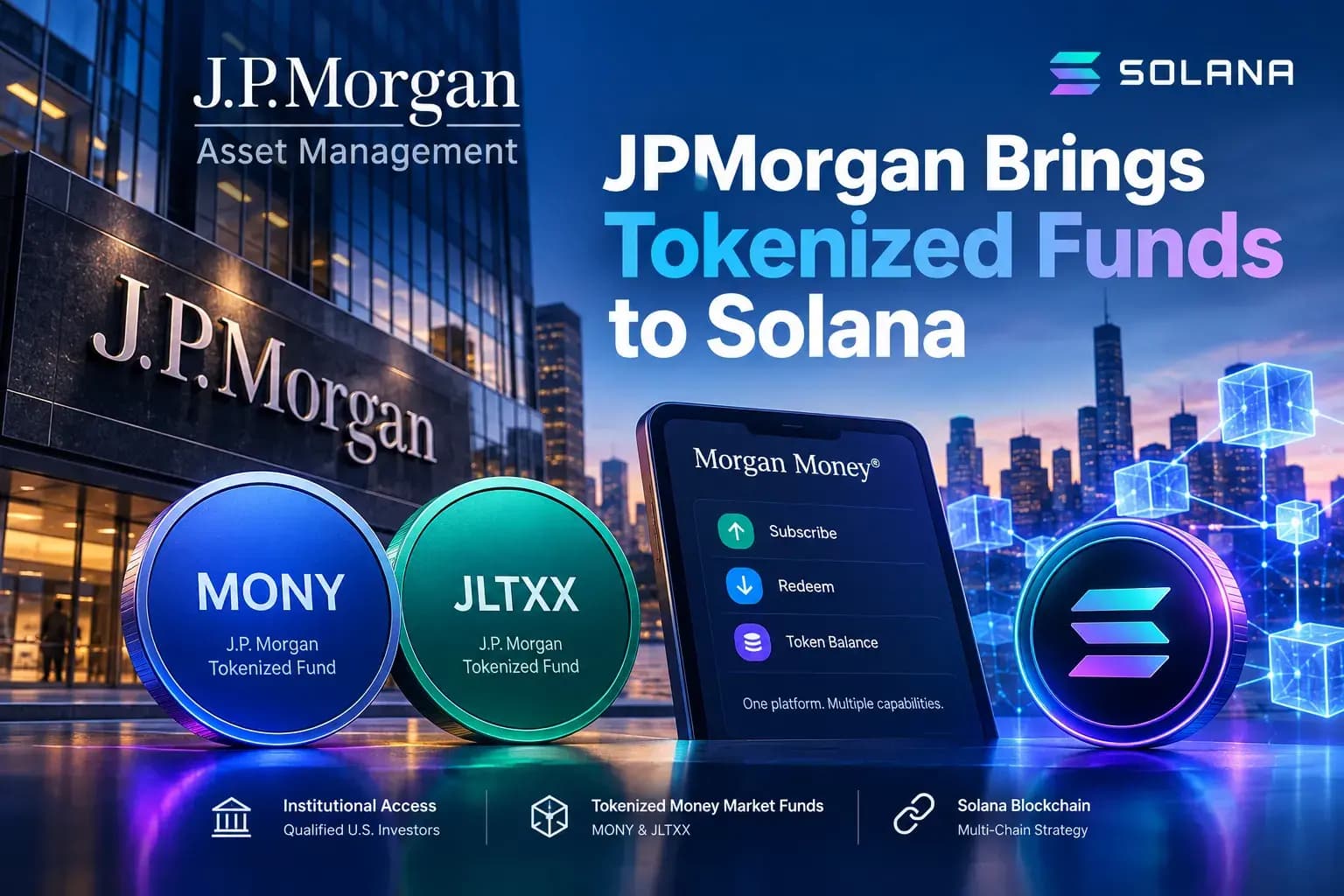
J.P. Morgan Asset Management has expanded its blockchain strategy by bringing two tokenized money market funds to Solana, giving qualified U.S. investors access to institutional cash-management products represented on a public blockchain.
The asset manager announced on October 22 that its My OnChain Net Yield Fund (MONY) and JPMorgan OnChain Liquidity–Token Money Market Fund (JLTXX) are now available on Solana through Morgan Money, its institutional liquidity-management platform.
BINANCE:SOLUSDT
Investors can use Morgan Money to subscribe to and redeem the funds, while receiving token balances at their blockchain addresses. The expansion gives J.P. Morgan’s tokenized liquidity products a presence across multiple public blockchain networks.
The move is particularly significant for Solana as traditional financial institutions increasingly experiment with public blockchains not merely for payments, but for regulated investment products, cash management and tokenized real-world assets.
 What Is Asset Tokenization and How Does It Work?→
 VersaBank Brings Tokenized Deposits to the U.S.→
 MoneyGram Joins XDC Network as Institutional Validator→
 Ripple, Meritz Bring Tokenization to Korea→
MONY and JLTXX Go Live on Solana
J.P. Morgan Asset Management confirmed that both funds are now available on the Solana blockchain, extending its tokenized cash-management infrastructure beyond Ethereum.
The development follows J.P. Morgan’s earlier expansion into public blockchain-based funds. MONY was introduced in December 2025, while JLTXX launched on Ethereum in May 2026.
JLTXX added a different structure to the firm’s digital-asset strategy. Unlike MONY, which is a private-placement product, JLTXX is a U.S.-registered government money market fund.
According to J.P. Morgan Asset Management, JLTXX invests exclusively in U.S. Treasury securities and overnight repurchase agreements fully collateralized by Treasury securities and/or cash.
That makes the underlying economics important. Tokenization does not transform the fund into a cryptocurrency. Instead, blockchain tokens digitally represent interests in a conventional investment fund whose portfolio consists of traditional financial assets.
For readers new to this structure, CryptoQuorum’s guide to real-world assets and tokenization explains how conventional assets can be represented and transferred using blockchain infrastructure.
Morgan Money Connects Traditional Funds to Blockchain
Morgan Money plays a central role in J.P. Morgan’s strategy.
The platform is an institutional trading, analytics and liquidity-management system through which eligible clients can subscribe to and redeem J.P. Morgan’s blockchain-based funds.
Rather than requiring institutional investors to manage the entire investment process directly onchain, Morgan Money provides a familiar interface while token balances are delivered to approved blockchain addresses.
That hybrid model may prove important for institutional adoption.
Large asset managers, corporations and financial institutions generally need compliance controls, portfolio reporting, risk analysis and established subscription and redemption processes. Public blockchain infrastructure can therefore operate as another settlement and ownership layer without eliminating the traditional fund-management systems surrounding the asset.
J.P. Morgan says the Solana integration allows clients to manage subscriptions, redemptions and token balances through one platform.
Why J.P. Morgan Chose a Multi-Chain Strategy
The announcement also reveals an important shift in how major financial institutions are approaching blockchain infrastructure.
Rather than committing to a single network, J.P. Morgan appears to be moving toward a multi-chain model.
Paul Przybylski, Global Head of Product, Digital & Tokenized Assets at J.P. Morgan Asset Management, summarized the strategy by saying that clients operate across more than one network and their liquidity should do the same.
Bringing MONY and JLTXX to Solana gives institutional investors and stablecoin issuers access to the funds across more of the blockchain networks on which they already operate.
That approach suggests that the future of institutional tokenization may not be dominated by one blockchain.
Instead, asset managers could distribute the same or similar financial products across several networks, allowing investors to select infrastructure according to liquidity, settlement requirements, custody arrangements and existing blockchain activity.
Why Solana Matters for Institutional Tokenization
Solana has increasingly become a venue for tokenized traditional financial assets.
CryptoQuorum recently reported that Securitize brought tokenized U.S. stocks to Solana, providing another example of regulated financial products moving onto public blockchain infrastructure.
The network’s broader RWA ecosystem has also expanded substantially. As CryptoQuorum reported in August, Solana’s RWA ecosystem surpassed $4 billion, highlighting growing activity involving tokenized financial assets.
J.P. Morgan’s arrival adds another major institutional name to that trend.
The significance is not simply that a global asset manager is using blockchain. It is that an established investment product is becoming available across multiple public networks through an institutional platform.
That is closer to financial-market infrastructure than an experimental token launch.
JLTXX Connects Tokenization With Stablecoin Reserves
JLTXX also has a potentially important role beyond conventional treasury management.
J.P. Morgan says the fund is designed to invest in a manner that supports stablecoin issuers operating under the GENIUS Act.
The fund seeks to maintain liquidity and principal stability while investing exclusively in U.S. Treasury securities and qualifying overnight repurchase agreements.
For stablecoin issuers, products structured around high-quality liquid assets could provide another mechanism for managing reserves while maintaining blockchain-based ownership records.
J.P. Morgan’s May launch announcement said the firm invested $100 million in JLTXX at launch, with additional participation from Anchorage Digital.
This connection between stablecoins, tokenized Treasuries and money market funds is becoming one of the more consequential areas of real-world asset tokenization.
Instead of attempting to replace traditional assets, blockchain infrastructure is increasingly being built around them.
Expert View: Modernizing Liquidity Without Changing the Asset
John Donohue, Head of Global Liquidity at J.P. Morgan Asset Management, described the strategy when JLTXX originally launched on Ethereum.
He said investors increasingly want to modernize liquidity management without changing the fundamentals of the assets they own.
That distinction is critical.
The investment case for blockchain-based funds does not necessarily depend on creating new asset classes. A tokenized Treasury fund still derives its economic characteristics from Treasury securities and related instruments.
The potential innovation lies in how ownership interests are recorded, transferred, integrated with other financial applications and potentially settled.
J.P. Morgan itself warns that blockchain technology introduces additional risks, including possible transaction delays, errors in recording token balances, cybersecurity vulnerabilities, regulatory changes, network changes and fluctuations in transaction fees.
Those risks mean tokenization should not automatically be interpreted as making a traditional fund safer, more liquid or more valuable.
Tokenized Funds Become an Institutional RWA Battleground
J.P. Morgan’s Solana expansion fits a much larger shift across asset management.
Traditional securities, Treasury products, investment funds and equities are increasingly being represented on public blockchain networks.
Nasdaq CEO Adena Friedman has argued that tokenization could reduce capital trapped in traditional market infrastructure, while Morgan Stanley’s digital-asset strategy leadership has projected that the broader tokenized asset market could eventually reach trillions of dollars.
CryptoQuorum covers these developments in its dedicated RWA section, where tokenized securities, funds and institutional blockchain infrastructure are becoming recurring themes.
Money market funds are particularly suited to this transition because they already occupy a central role in institutional liquidity management.
Blockchain representation potentially adds programmability and interoperability without requiring asset managers to reinvent the underlying portfolio.
What the Solana Expansion Means
The launch should not be interpreted as J.P. Morgan moving its entire asset-management business onchain.
Access remains restricted, regulatory requirements still apply, and the blockchain token represents an interest in a professionally managed financial product rather than a decentralized cryptocurrency.
But the direction of travel is increasingly clear.
J.P. Morgan Asset Management reported $4.8 trillion in assets under management as of September 30, 2026. When an institution of that scale distributes regulated investment products across public blockchains, tokenization moves further away from the experimental stage.
The more important question is what comes next.
If institutional investors begin holding tokenized fund shares across several networks, asset managers will increasingly need infrastructure connecting blockchains, custody providers, stablecoins, trading platforms and traditional portfolio-management systems.
In that environment, Ethereum and Solana may be less competitors for a single winner-takes-all market than components of a broader multi-chain financial architecture.
J.P. Morgan’s decision to make MONY and JLTXX available on Solana provides another indication that this architecture is already beginning to emerge.
For institutional finance, the next phase of tokenization may therefore be less about putting assets on a blockchain for its own sake — and more about making traditional financial products usable wherever digital liquidity already exists.
Disclaimer: This article is for informational purposes only and does not constitute investment, legal or financial advice. Digital assets, tokenized securities and blockchain-based investment products involve risks and may not be suitable for all investors.