English
  Español

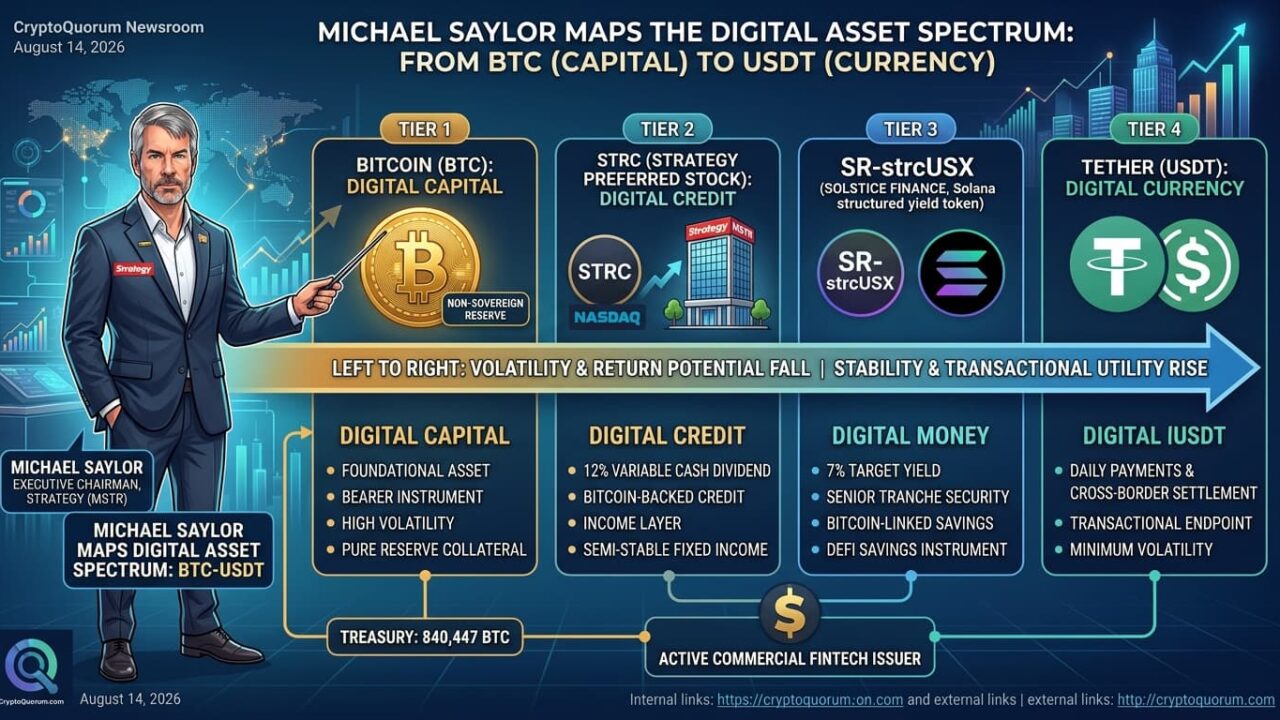
- Decoding the Four Tiers: From Pristine Capital to Daily Currency
- Tier 1 – Bitcoin: Digital Capital (The Reserve Asset)
- Tier 2 – STRC: Digital Credit (The Corporate Income Layer)
- Tier 3 – SR-strcUSX: Digital Money (On-Chain Structured Yield)
- Tier 4 – USDT: Digital Currency (The Settlement Rail)
- Corporate Evolution: Transforming Reserves Into Financial Infrastructure
- From Passive Storage to Active Yield Engineering
- Global Securitization and the CLARITY Act
- Industry Analysis: Strategic Innovation vs. Counterparty Risk
- Monetizing Volatility Into Fixed Income
- Defining Savings vs. Settlement in Web3
- The Skeptic’s View: Conflating Sovereign Assets With Leverage
- The Broader Impact on Digital Finance
In a statement that has sparked widespread debate across Wall Street and Web3, Strategy Executive Chairman Michael Saylor has introduced a unified monetary model for institutional crypto finance: the digital asset spectrum. Moving beyond the traditional “buy and hold” narrative, Saylor’s framework organizes four distinct asset classes along a single financial axis-balancing risk, yield, and transactional utility from Bitcoin on the left to Tether (USDT) on the right.
By placing spot Bitcoin, corporate credit, structured yield tokens, and fiat-backed stablecoins into a single continuum, Strategy aims to position its corporate treasury at the center of an emerging Bitcoin-native financial stack.
Decoding the Four Tiers: From Pristine Capital to Daily Currency
Saylor’s proposed digital asset spectrum categorizes instruments based on a fundamental economic tradeoff: as an asset moves from left to right, its price volatility and return potential decline, while its stability and transactional utility increase.
Read Also
Tier 1 – Bitcoin: Digital Capital (The Reserve Asset)
At the far-left anchor sits Bitcoin (BTC). Classified as “Digital Capital,” Bitcoin operates not as a medium of exchange, but as pristine, non-sovereign reserve collateral. It offers maximum upside and volatility without third-party counterparty risk. Strategy’s massive treasury of 840,447 BTC serves as the underlying collateral foundation supporting the remaining layers of the spectrum.
Tier 2 – STRC: Digital Credit (The Corporate Income Layer)
Occupying the second position is Strategy’s Nasdaq-listed perpetual preferred stock, STRC, designated as “Digital Credit.” Paying a variable 12% annualized cash dividend, STRC converts Bitcoin’s balance-sheet backing into a fixed-income instrument. It offers income-focused investors a semi-stable entry point that bridges equity markets with Bitcoin treasury productivity.
ETH / USD Real-Time Chart
Tier 3 – SR-strcUSX: Digital Money (On-Chain Structured Yield)
Bridging corporate finance and decentralized protocols, Solstice Finance’s SR-strcUSX represents “Digital Money.” Deployed on Solana, this senior-tranche token targets a 7% annual yield by vaulting STRC shares. By utilizing junior tranches to absorb value fluctuations, SR-strcUSX provides yield-bearing stability tailored for DeFi applications.
Tier 4 – USDT: Digital Currency (The Settlement Rail)
At the far-right endpoint lies Tether’s USDT, classified as “Digital Currency.” Functioning as a high-velocity medium of exchange, USDT delivers dollar parity and deep global liquidity, albeit accompanied by issuer, reserve, and regulatory counterparty risks.
Stay Ahead of the Curve
Join our weekly newsletter for exclusive insights.
Corporate Evolution: Transforming Reserves Into Financial Infrastructure
The presentation of the digital asset spectrum coincides with a strategic pivot in Strategy’s corporate playbook. Having liquidated 6,948 BTC ($432.5 million) earlier this summer to service dividend obligations and maintain liquidity, the company is actively transitioning from a passive holding vehicle into an active commercial fintech issuer.
From Passive Storage to Active Yield Engineering
Rather than allowing its treasury to remain an idle asset exposed purely to market spot prices, Strategy is structuring commercial credit products on top of its reserves. The digital asset spectrum provides the theoretical rationale for this transition, detailing how institutional capital can flow from spot BTC into preferred stock instruments like STRC, and subsequently into global DeFi protocols.
Global Securitization and the CLARITY Act
This multi-tiered model is already expanding globally through products like Brazil’s DIGY11 ETF on the B3 exchange, which offers local investors exposure to STRC. Furthermore, as the U.S. Senate prepares for a pivotal vote on the CLARITY Act, regulatory classification will determine how seamlessly institutional investors can allocate capital across these four distinct asset tiers.
Industry Analysis: Strategic Innovation vs. Counterparty Risk
Financial analysts, regulatory experts, and market commentators remain divided on whether Saylor’s framework represents a breakthrough in capital efficiency or an over-leveraged corporate model.
Monetizing Volatility Into Fixed Income
Institutional research desks note that the framework provides a structured taxonomy for converting volatile digital capital into income-bearing credit. By segmenting risk profiles, Strategy is providing a roadmap for traditional portfolio managers seeking yield without direct exposure to spot market drawdowns.
Defining Savings vs. Settlement in Web3
DeFi analysts highlight that distinguishing between “Digital Money” (SR-strcUSX) and “Digital Currency” (USDT) mirrors the traditional banking division between yield-bearing money market accounts and zero-yield checking accounts. This functional split gives Web3 treasuries a clear mechanism for capital allocation.
The Skeptic’s View: Conflating Sovereign Assets With Leverage
Conversely, critics emphasize that placing self-sovereign Bitcoin on the same spectrum as corporate debt creates a potential false equivalence. While Bitcoin carries zero issuer risk, STRC and its derivative DeFi tokens depend entirely on Strategy’s ongoing solvency, corporate governance, and dividend declarations.
The Broader Impact on Digital Finance
Saylor’s digital asset spectrum offers one of the most comprehensive blueprints to date for a Bitcoin-backed financial system. Whether interpreted as a long-term monetary theory or a targeted marketing strategy for Strategy’s suite of financial products, the model demonstrates that Bitcoin’s role in global finance is expanding far beyond passive treasury reserves into complex capital markets.
Disclaimer: This article is for informational purposes only and does not constitute financial, investment, or legal advice. Digital asset markets carry inherent risks. Always conduct independent research before making investment decisions.