

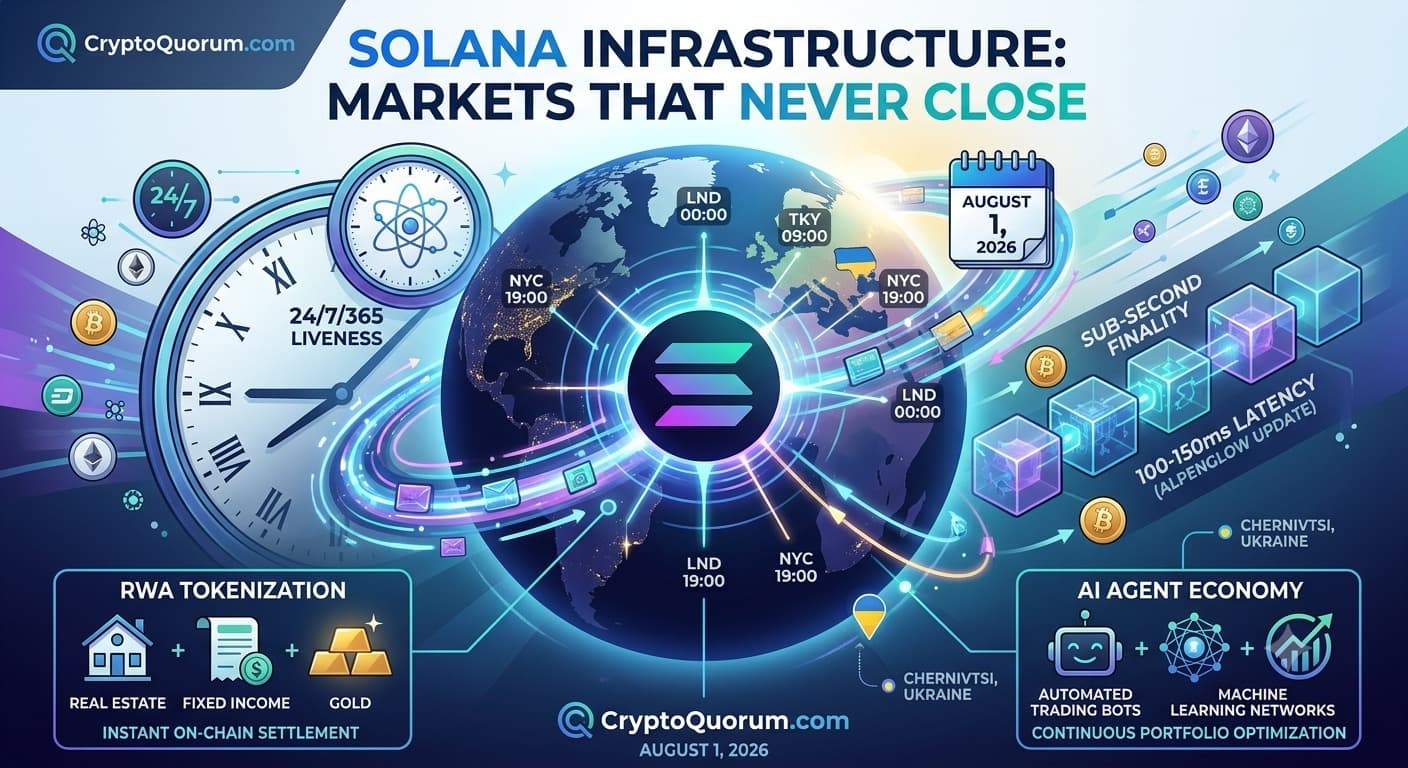
In a concise declaration summarizing the evolution of global decentralized finance, Solana recently issued a clear assessment of the modern financial landscape: “markets that never close, with execution that beats the ones that do.”
The statement captures a fundamental structural transition taking place across institutional finance in 2026. For decades, traditional capital markets have operated within rigid, legacy-bound schedules—closing on weekends, observing regional holidays, and creating artificial liquidity gaps. Meanwhile, Solana has expanded beyond its early reputation as a consumer network to establish itself as the premier execution engine for an internet-native capital market.
By combining continuous 24/7 operation with deterministic, sub-second transaction finality, Solana is demonstrating that decentralized blockchain architecture can outperform centralized financial infrastructure not just in uptime, but in execution quality, fairness, and performance.
The Limitations of Legacy Finance vs. Continuous Liquidity
Traditional financial venues such as the New York Stock Exchange (NYSE), Nasdaq, and the Chicago Mercantile Exchange (CME) were constructed around physical floor trading hours and legacy banking clearinghouses. When high-impact macroeconomic events, central bank policy shifts, or geopolitical developments occur outside standard operating hours, investors in traditional markets are left stranded. Gap risk—the dangerous price disparity between Friday’s market close and Monday’s market open—remains a structural flaw of traditional 9-to-5 finance.
 Brian Armstrong Rallies Crypto Voters as Pressure Mounts on Senate Leadership to Pass the CLARITY Act→
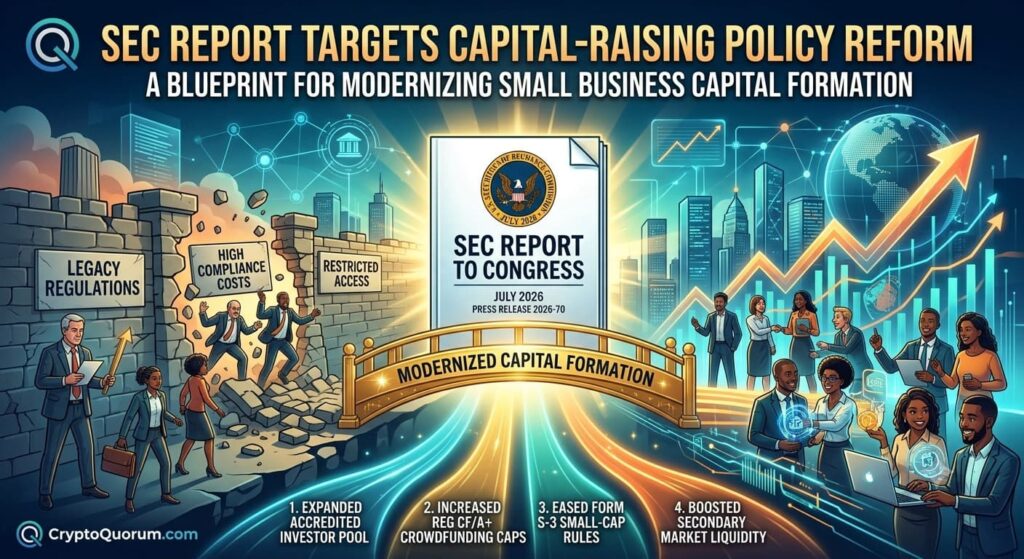 SEC Delivers Landmark Small Business Report to Congress: A Blueprint for Capital-Raising Policy Overhaul→
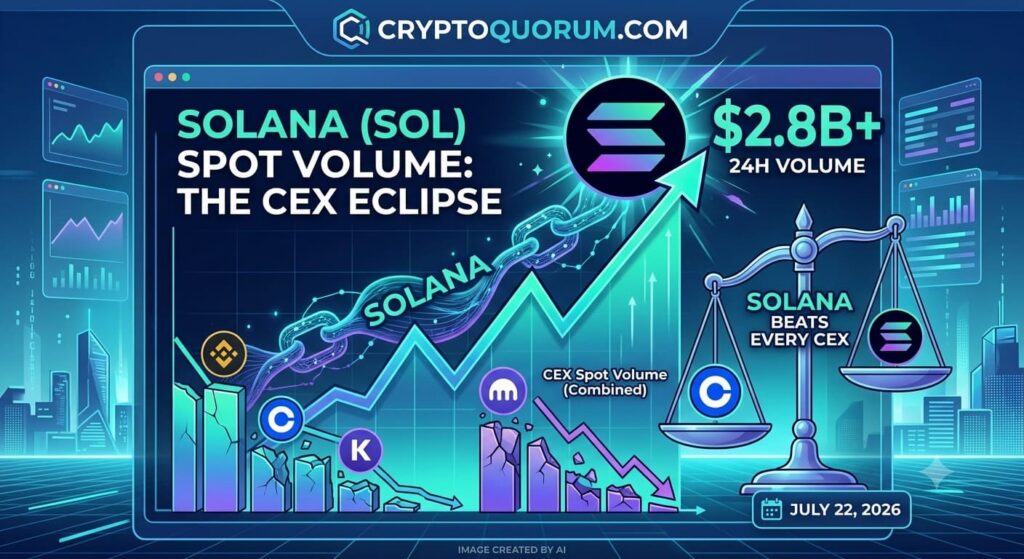 Solana Spot Volume Now Beats Every CEX But One – and the Number Keeps Growing→
 Coinbase’s Ryan VanGrack: Whether You Love or Hate Crypto, You Should Want It Regulated→
By contrast, public blockchain technology introduced markets that never close. However, early decentralized networks faced their own technical trade-offs. Early blockchain platforms often suffered from execution latency, unpredictable gas fees, and severe network congestion during periods of peak volatility, making them difficult to utilize for high-frequency institutional trading or complex structured derivatives.
Solana’s 2026 technical roadmap has systematically addressed these bottlenecks. Through core protocol upgrades—including the Alpenglow consensus mechanism, the integration of the Firedancer validator client, and Application-Controlled Execution (ACE)—Solana now delivers settlement windows in the low-hundreds-of-milliseconds range. This sub-second deterministic finality allows institutional market makers, quantitative algorithms, and everyday retail traders to access continuous liquidity without sacrificing execution speed.
Technical Superiority: Why Solana Beats Traditional Venues
To compete with and ultimately surpass traditional centralized venues, an on-chain venue must provide more than 24-hour availability; it must deliver superior execution integrity. Solana achieves this through several key architectural features:
- Sub-Hundred-Millisecond Latency: The Alpenglow consensus upgrade reduced transaction finality down to 100–150 milliseconds. This enables high-frequency market makers to update order books in real time, narrowing bid-ask spreads across decentralized exchanges (DEXs) like Jupiter, Orca, and Phoenix.
- Deterministic Execution & Application-Controlled Execution (ACE): In traditional markets, dark pools and payment-for-order-flow (PFOF) arrangements often subject retail orders to adverse selection. Solana’s ACE framework empowers decentralized applications to control their own sequencing and matching rules on-chain, mitigating predatory Maximum Extractable Value (MEV) and ensuring auditable, transparent transaction ordering.
- Predictable Micro-Cent Transaction Fees: High transaction costs on legacy blockchains act as a penalty during high-volatility events. Solana’s local priority fee model isolates fee spikes to specific state accounts, keeping general network transactions consistently low-cost even when trading volumes surge.
- Order-Flow Privacy: Institutional participation requires order-flow confidentiality to prevent front-running. Solana’s modern cryptographic primitives provide private transaction routing options, satisfying institutional best-execution policies while preserving public verifiability.
Expert Opinions: Industry Leaders on the Institutional Paradigm Shift
Financial analysts, technology builders, and institutional fund managers overwhelmingly agree that the transition to continuous capital markets is gaining momentum, with Solana leading the execution layer.
Anatoly Yakovenko, Co-Founder of Solana Labs, has consistently highlighted the network’s goal of becoming a friction-free order book for global assets:
“The ultimate vision for an Internet Capital Market is not just about moving fast—it’s about building a deterministic, global execution environment where matching, clearing, and settlement happen simultaneously. When you remove clearinghouse delays and open access 24/7/365, you eliminate systemic counterparty risk. Markets should never sleep, and execution should never lag.”
Blockdaemon institutional research analysts noted in their 2026 report on digital asset architecture:
“Solana has transitioned from being viewed purely as a high-throughput retail chain to serving as the high-performance execution layer for modern on-chain finance. While other platforms serve as broad settlement layers, Solana operates as a deterministic, exchange-grade venue. A chain that reliably settles in low-hundreds-of-milliseconds with auditable execution rules maps directly into institutional trading, treasury, and intraday liquidity operations.”
Commenting on the structural advantage of round-the-clock trading venues, digital asset multi-asset managers at Cypher Capital observed:
“Traditional fund managers still operate under a Monday-to-Friday mental model, parking risk over weekends. But global news and economic sentiment shift constantly. Assets that trade on global sentiment naturally belong on markets that never close. Solana’s low latency allows active managers to manage portfolio risk continuously, executing trades when news hits rather than waiting for Monday morning market opens.”
Real-World Asset (RWA) Tokenization and AI Agent Integration
The demand for continuous, high-speed execution extends far beyond speculative tokens. In 2026, real-world assets (RWAs)—including tokenized gold, U.S. Treasury bills, corporate debt, and foreign exchange (FX) corridors—are expanding on Solana to leverage its infrastructure.
For instance, tokenized commodities like Streamex’s gold token ($GLDY) trade around the clock on Solana-based DEXs. When geopolitical headlines break over a weekend, investors can instantly rebalance capital into tokenized gold or yield-bearing stablecoins. Traditional commodity desks, bound by exchange operating hours, cannot offer this level of immediate execution.
Furthermore, the rise of autonomous AI trading agents—such as protocols utilizing MoonPay’s PayBox connector and localized machine learning models—has created a new class of market participants that operate continuously. AI agents require high-frequency, low-cost API settlement rails to execute automated micro-arbitrage and portfolio rebalancing. Solana provides the specific execution environment these autonomous economic systems require to operate reliably without human intervention.
The Path Ahead: Building the Internet’s Financial Engine
The realization of markets that never close, supported by execution that rivals traditional alternatives, is moving from concept to operational reality. By addressing the dual requirements of continuous liveness and sub-second deterministic finality, Solana has established key infrastructure for a unified global financial market.
As financial institutions continue to tokenize equity, fixed-income, and commodity instruments, the friction of traditional exchange hours will increasingly be viewed as an archaic remnant of pre-digital finance. In the emerging era of global digital finance, capital naturally flows toward venues that offer maximum liquidity, absolute transparency, and uninterrupted execution. Solana’s evolving network architecture positions it at the center of this financial transformation.
Disclaimer: This article is for informational purposes only and does not constitute financial, investment, or legal advice. Digital asset trading involves risk. Always conduct thorough independent research and consult a certified financial advisor before engaging in trading or investment activities.