English
  Español

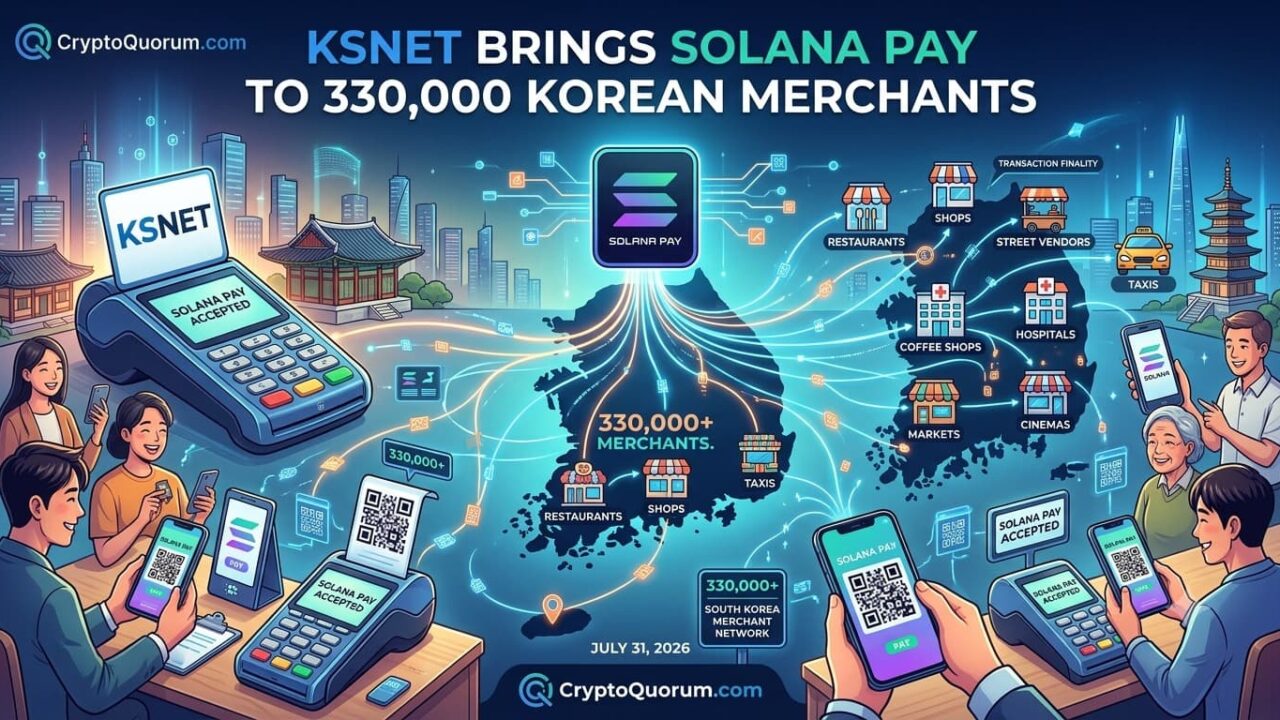
South Korea‘s payment infrastructure is being rewritten – and Solana is holding the pen. On July 30, 2026, one of Korea’s largest merchant payment processors signed a deal that could put blockchain payments in front of tens of millions of Korean consumers.
The Solana Foundation and KSNET, a South Korean fintech company with a 26-year track record as a Value-Added Network operator and payment gateway, formalised a memorandum of understanding at KSNET’s headquarters in Seoul’s Seocho-gu district. The agreement sets the stage for integrating Solana Pay into a merchant network serving more than 330,000 businesses and processing approximately 130 million transactions and nearly $4 billion in monthly payment volume.
The announcement, broken on Solana’s official X account, sent an immediate signal across the crypto industry: Solana is no longer competing for DeFi market share alone. It is competing for the mainstream payment rails of one of Asia’s most technologically advanced economies – and it is winning those partnerships at an accelerating pace.
Read Also
Who Is KSNET – and Why This Partnership Is Significant
A Quarter-Century of Korean Payment Infrastructure
KSNET is not a startup chasing a blockchain partnership for visibility. With a track record of over 25 years in the South Korean financial sector, the firm serves as a Value-Added Network and payment gateway in the local market, processing approximately 130 million transactions per month.
VAN operators occupy a critical role in Korea’s payment ecosystem that has no direct equivalent in most Western markets. They sit between merchants and card networks – acquiring, routing, and settling transactions across every point-of-sale terminal in their network. When a Korean consumer taps their card at a convenience store, a restaurant, or a retail outlet, a VAN operator is the invisible infrastructure making that transaction work in milliseconds. KSNET does that for 330,000 businesses.
ETH / USD Real-Time Chart
That scale makes the MOU with the Solana Foundation categorically different from most blockchain-payment partnerships. This is not a crypto company adding a payments feature. It is a payment company that already processes $4 billion monthly deciding that blockchain infrastructure belongs in its stack.
The Breadth of Korea’s Blockchain Payment Momentum
The KSNET deal does not arrive in isolation. Earlier this year, Shinhan Card partnered with Solana to explore blockchain-based payment infrastructure. In June, Toss Bank also signed an MOU with Solana to test stablecoin-powered cross-border remittances. Unlike those initiatives, KSNET’s partnership extends beyond stablecoin settlements by introducing AI-native payment infrastructure through x402, making it one of the first Korean payment companies to formally evaluate autonomous machine-to-machine payments.
Stay Ahead of the Curve
Join our weekly newsletter for exclusive insights.
In the space of four months, three major Korean financial institutions – Shinhan Card, Toss Bank, and KSNET – have signed formal agreements with the Solana Foundation. Korea is not exploring blockchain payments as a concept. It is building the infrastructure for them at scale.
The Two Proof-of-Concept Projects: What KSNET Is Actually Testing
Phase One: Solana Pay in the Existing Merchant Ecosystem
The first proof of concept integrates Solana Pay into KSNET’s existing offline and online merchant payment ecosystem. The goal is to demonstrate that blockchain-native payments can run seamlessly in the established payment setting of the country while remaining compatible with existing financial systems.
The critical design constraint is compatibility with the Korean won settlement system. The payment model is expected to remain aligned with South Korean financial regulations and continue using the country’s existing Korean won settlement system. Maintaining compatibility with local settlement infrastructure could help reduce liquidity concerns commonly associated with digital asset transfers and limit exposure to exchange-rate volatility.
This is the same design philosophy that has made every successful blockchain payment integration in Asia work: rather than asking merchants and consumers to adopt a new currency, the blockchain layer handles settlement efficiency while the familiar national currency remains the unit of account. The merchant receives won. The blockchain handles the routing. The customer barely notices the infrastructure has changed.
A notable feature of the integration is comprehensive regulatory compliance. KSNET mentioned that the platform will add stringent anti-money laundering rules to prevent illegal capital from entering the payment network. AML integration from day one – rather than as a retrofitted compliance layer – signals that KSNET is approaching this as a production-grade infrastructure project, not a proof-of-concept that will be shelved after a press release.
Phase Two: The x402 Protocol and AI-Native Commerce
The second proof of concept is the one that distinguishes the KSNET partnership from every previous Solana Pay integration. The second phase of the collaboration focuses on analysing the x402 protocol within KSNET’s automated payment systems. This tool utilises the HTTP 402 (“Payment Required”) status code – a standard communication protocol between web browsers and servers. The x402 specification allows artificial intelligence agents to autonomously execute micropayments when requesting access to application programming interfaces or restricted digital content. The transaction does not require complex login processes or credit card authentication.
The x402 protocol is Solana’s answer to the question of how autonomous AI agents pay for things. When an AI system needs to call an API, access a data feed, or consume a digital service, it needs a payment mechanism that works at machine speed – sub-second, with no human authentication step, and at cost levels that make micro-scale transactions economically viable. Credit card networks, which require authentication, settlement delays, and fees that make sub-dollar transactions uneconomical, cannot serve that market. x402, settled on Solana, can.
With the continued rise of AI-driven technologies, machine-to-machine payments are becoming one of the most promising applications for blockchain technology. The ability of Solana to settle transactions quickly and efficiently makes it an excellent tool for managing such micropayments, making it an attractive blockchain application for the future.
Expert Opinions: What Industry Leaders Are Saying
Park Hankook, KSNET CEO: Payment Expertise Meets Blockchain Security
KSNET’s CEO was direct about his company’s strategic intent in the partnership. CEO Park Hankook of KSNET noted that the firm would leverage its experience in payments to provide a trustworthy digital asset payment system, specifically citing KSNET’s settlement and payment expertise as the foundation for building the most protected payment framework for consumers using the new infrastructure.
That framing – trustworthy, protected, built on operational expertise – is deliberate. Blockchain payment partnerships fail when they promise speed and novelty but cannot deliver the reliability and compliance that regulated payment networks require. Park Hankook is positioning KSNET as the compliance and infrastructure anchor that makes Solana’s technology deployable in a regulated Korean market.
CoinTrust: Compatibility Is the Critical Design Choice
CoinTrust analysts noted that KSNET’s plan to maintain compatibility with local settlement infrastructure is the critical design choice that could determine whether the partnership moves from proof of concept to commercial deployment. Blockchain payment integrations that require merchants to operate in a different currency or settlement system from their existing banking relationships face adoption barriers that technical excellence cannot overcome.
The won-compatibility decision is, in this sense, the single most commercially significant element of the KSNET-Solana design. It makes the integration invisible to the merchant at the settlement level – the most effective way to drive adoption of new payment technology in an established market.
CryptoTimes: The x402 Dimension Sets This Apart
CryptoTimes’ analysis highlighted that the KSNET partnership’s x402 phase makes it the first Korean payment company to formally evaluate autonomous machine-to-machine payments at commercial scale, noting that traditional card networks operate under multi-level fee structures where fixed banking costs make micropayments for small amounts commercially unviable. The x402 protocol on Solana addresses that structural barrier directly.
The commercial viability argument for x402 is not abstract. If a South Korean e-commerce platform wants to charge 0.001 USD for an API call, or a content platform wants to enable pay-per-paragraph reading, or an AI agent needs to pay for real-time data access, no existing card network can deliver that economically. Solana’s fee structure – fractions of a cent per transaction – makes it the only current public blockchain where such use cases work at the numbers that businesses require.
ABAB News: Market Pressure on Traditional Payment Networks Is Real
ABAB News’ financial analysis described the partnership as an event-driven implementation of blockchain payments that strengthens market expectations for Solana’s adoption among physical merchants, while also putting pressure on traditional payment networks.
That competitive framing is the one that the incumbent payment infrastructure – Visa, Mastercard, and Korea’s own domestic card networks – will be watching most closely. A VAN operator with 330,000 merchant relationships and $4 billion in monthly volume testing blockchain settlement is a competitive signal that none of those networks can ignore.
Solana’s Korea Strategy: A Pattern of Institutional Depth
Three Deals, One Vision
The KSNET MOU is the third major Korean financial institution partnership the Solana Foundation has announced in 2026. Each deal covers a different segment of the financial infrastructure stack:
Toss Bank’s June MOU targets cross-border remittances – the international money transfer market where blockchain’s speed and cost advantages are most immediately demonstrable. Shinhan Card’s partnership addresses domestic card infrastructure – the consumer payment layer that touches every Korean with a bank account. And KSNET’s deal covers the merchant acquiring and settlement layer – the infrastructure that connects payment acceptance to financial settlement across 330,000 businesses.
Together, these three partnerships sketch the outline of a complete Korean financial infrastructure built on Solana rails: international settlement, domestic consumer payments, and merchant processing. No other public blockchain has secured partnerships at this depth across the Korean financial system in a comparable timeframe.
The Baillie Gifford Signal: Institutions Choosing Solana
The KSNET news arrived alongside another notable Solana milestone on July 30: Baillie Gifford’s BGDA_UK, a BNY client with £197 billion in assets under management, is utilising the group’s new digital transfer agent for the first “fully native” UK-regulated tokenised fund, issued on Solana. A £197 billion fund choosing Solana as its tokenisation infrastructure on the same day a Korean payment giant signs a Solana Pay MOU is not coincidence. It is convergent validation from two completely different ends of the institutional spectrum.
What Happens Next: From MOU to Production
The Proof-of-Concept Timeline
The KSNET-Solana Foundation partnership currently covers two proof-of-concept projects. No commercial launch date has been announced. The PoC for Solana Pay integration with KSNET’s merchant ecosystem will evaluate whether blockchain-native payments can meet the performance, reliability, and regulatory requirements of a production payment network in South Korea. The x402 evaluation will test whether AI-native micropayment architecture can function within KSNET’s automated payment systems at the latency and cost levels that machine-to-machine commerce requires.
If commercialised, the integration would significantly expand Solana’s presence in one of Asia’s most advanced digital payment markets. Although the MOU is related to the testing of the proof-of-concept model rather than actual live deployment, a positive outcome may open new possibilities for Solana’s expansion. The cooperation is also indicative of the increasing institutional trust in blockchain-based payment systems.
The important qualification in that framing – “if commercialised” – deserves attention. An MOU is a commitment to test, not a commitment to deploy. The PoC results will determine whether the partnership moves to production. But the selection of KSNET as the testing partner – a company processing $4 billion monthly with 26 years of payment infrastructure experience – means the test conditions will be as demanding and realistic as any in the Korean market.
A Race Against Time: The Regulatory Window
The KSNET partnership’s timing is directly connected to South Korea’s shifting regulatory landscape. South Korea plans to impose foreign exchange controls on crypto transfers starting December 2026, creating urgency for institutions to establish compliant blockchain payment frameworks ahead of that deadline. KSNET’s integration plan – with its AML requirements, won-compatibility design, and regulatory-first approach – reads as a framework designed to operate within, not around, that incoming regulatory structure.
For Solana, a network that has spent 2026 breaking records in transaction volume, dApp revenue, and tokenised asset markets, the KSNET deal represents a different kind of milestone: not a blockchain competing against other blockchains, but a blockchain becoming invisible within the payment infrastructure that hundreds of thousands of merchants and millions of consumers already use every day.
That invisibility – the moment when the technology disappears behind the experience – may be the most significant measure of Solana Pay’s success in South Korea.
Disclaimer: This article is for informational purposes only and does not constitute financial or investment advice. Always conduct your own research before making any investment decisions.