

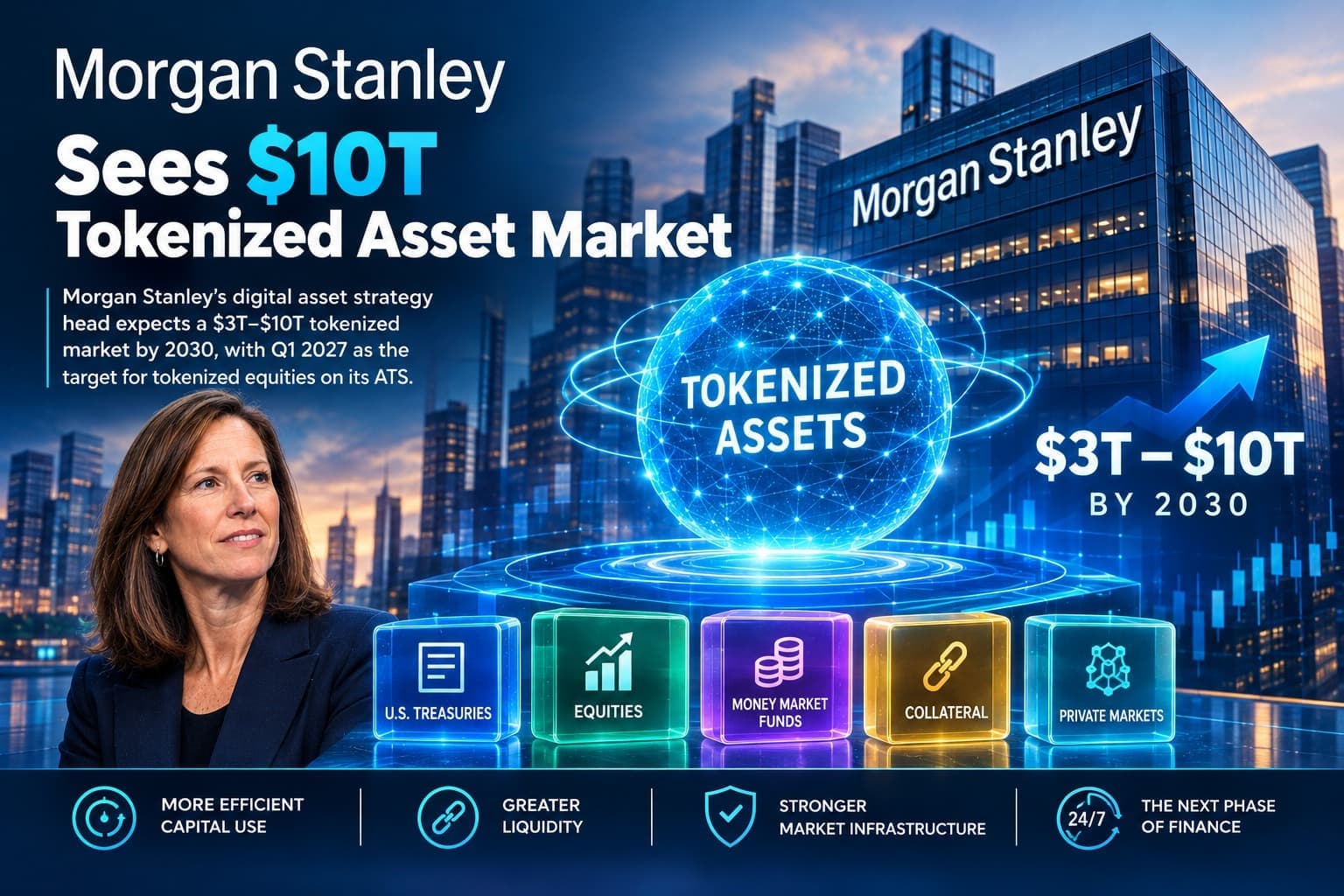
Morgan Stanley is preparing for a financial system in which stocks, private funds and other traditional investments increasingly move onchain, with the bank’s digital asset strategy chief saying the tokenized real-world asset market could reach between $3 trillion and $10 trillion by 2030.
Amy Oldenburg, Morgan Stanley’s Head of Digital Asset Strategy, told The Block during TOKEN2049 that she expects the market to fall within that range “without question.” She also described growing competitive pressure among financial institutions, saying there is “a lot of FOMO in the institutional space.”
The remarks, amplified by Ondo Finance on X, come as Morgan Stanley builds infrastructure to support tokenized equities on its alternative trading system, or ATS. Oldenburg now sees the first quarter of 2027 as a more realistic target, moving back an earlier expectation of the second half of 2026.
The combination of an aggressive long-term market estimate and a more cautious implementation schedule captures the state of institutional tokenization: expectations are enormous, but the infrastructure, products and regulatory framework are still developing.
 Nasdaq CEO: Tokenization Could Unlock Billions→
 SEC Proposes Expanding Cross-Trading for Funds→
 Securitize Brings Tokenized Stocks to Solana→
 XRP Asia Officially Launches in Seoul to Accelerate XRP Ledger Adoption Across the Asia-Pacific Region→
Morgan Stanley targets Q1 2027 for tokenized equities
Morgan Stanley’s planned ATS support is significant because it would integrate blockchain-based equities into infrastructure operated by one of Wall Street’s largest financial institutions.
An alternative trading system matches securities orders outside traditional national securities exchanges such as Nasdaq or the New York Stock Exchange. Morgan Stanley already works with direct equities, derivatives and swaps, and Oldenburg described tokenization as an extension of the firm’s existing model.
But the timeline has changed.
Oldenburg previously indicated that support could arrive during the second half of 2026. She now says Q1 2027 is more realistic because both the infrastructure and the available products need additional development.
“We need product in order to be able to support them within the ATS,” Oldenburg told The Block.
She also made an important distinction about institutional demand: limited activity does not necessarily mean institutions have rejected the concept. There are still relatively few suitable products available for institutions to trade through this type of regulated infrastructure.
That creates a chicken-and-egg problem. Financial institutions want evidence of client demand before investing heavily in infrastructure, while investors need compliant products and market infrastructure before meaningful demand can emerge.
Why the $3 trillion-$10 trillion forecast matters
The upper end of Oldenburg’s forecast would represent a dramatic expansion from today’s onchain RWA market.
It should therefore be treated as an outlook rather than a guaranteed outcome. Reaching trillions of dollars would require substantial migration of traditional financial instruments onto blockchain-based infrastructure.
Potential candidates extend well beyond public stocks.
Oldenburg identified private shares, structured notes, customized financial products and access to private funds as areas where blockchain infrastructure could offer near-term benefits. These markets often involve more manual administration, fragmented records and complex transfer processes than publicly traded equities.
That makes them potentially attractive targets for tokenization.
Blockchain-based records could reduce some reconciliation and administrative work while making ownership and transfers more programmable. Whether those efficiencies materialize at scale will depend on legal structures, interoperability, custody, liquidity and regulation.
CryptoQuorum’s guide to real-world asset tokenization explains the broader model connecting conventional financial instruments with blockchain networks.
Institutional “FOMO” is becoming visible
Perhaps the most revealing part of Oldenburg’s comments was not the multitrillion-dollar forecast but her description of institutional behavior.
“Energy drives energy across our industry,” she said, adding that the past 12 months had produced a wave of announcements and “a lot of FOMO in the institutional space.”
That assessment is increasingly supported by developments across traditional finance.
Nasdaq is developing an issuer-centric tokenized equity framework. Securitize has launched blockchain-based U.S. stock products. Other market operators and financial institutions are exploring digital collateral, blockchain settlement and tokenized funds.
CryptoQuorum recently examined Nasdaq CEO Adena Friedman’s view that tokenization could unlock billions in trapped capital. That argument focuses less on creating digital versions of stocks and more on improving the movement of collateral across financial markets.
Morgan Stanley’s strategy points in a similar direction. The long-term opportunity is not necessarily a separate blockchain stock market. It is financial infrastructure in which conventional and onchain instruments can coexist.
DTCC could provide a critical piece of infrastructure
Oldenburg specifically highlighted the Depository Trust & Clearing Corporation’s tokenization initiative as an important milestone.
DTCC said in May that The Depository Trust Company’s new tokenization service was scheduled for an October 2026 launch after limited production transactions during the summer.
In July, DTCC successfully processed production transactions using DTC-tokenized assets, including Treasury and equity transactions.
The initiative matters because DTC sits at the core of U.S. securities infrastructure.
DTCC says DTC custodies more than $114 trillion in assets. Its tokenization service is designed so tokenized DTC-custodied securities retain the same entitlements, investor protections and ownership rights as assets held in conventional form.
That is fundamentally different from simply issuing an unrelated crypto token designed to track a stock’s market price.
For an institution such as Morgan Stanley, infrastructure connecting established securities ownership with blockchain networks could remove one of the largest obstacles to institutional adoption.
Morgan Stanley is building more than a trading venue
The bank’s strategy also extends beyond its ATS.
According to Oldenburg, Morgan Stanley is developing proprietary wallet infrastructure that could allow customers to hold blockchain-based financial products without requiring them to manage the technical complexity normally associated with crypto wallets.
The firm has also established a Digital Asset Lab where it can test blockchain and crypto-native technologies before deploying them in production.
Meanwhile, the Office of the Comptroller of the Currency approved Morgan Stanley’s application to establish Morgan Stanley Digital Trust in June 2026, adding another component to the firm’s digital-asset infrastructure strategy.
Together, these initiatives suggest that Morgan Stanley is preparing for a hybrid financial environment rather than betting on an abrupt replacement of conventional markets.
Clients could eventually hold traditional securities alongside blockchain-based versions while the underlying institution handles custody, compliance and technical infrastructure.
Regulation remains central to tokenized securities
Moving stocks or other securities onto a blockchain does not remove them from securities regulation.
The SEC made this explicit in its January 2026 Statement on Tokenized Securities.
SEC staff defined a tokenized security as a security represented as a crypto asset where ownership records are maintained wholly or partly through one or more crypto networks. The statement also distinguishes issuer-sponsored structures from third-party tokenization models.
Most importantly, the technology used to record ownership does not by itself change the legal nature of the instrument.
SEC Commissioner Hester Peirce previously summarized the principle clearly: blockchain can change how securities are distributed and traded, but it does not magically change what the underlying asset is.
That distinction will become increasingly important as banks, exchanges and crypto-native companies launch competing products.
Investors need to know whether a blockchain token represents direct ownership of a security, a security entitlement, a derivative or another contractual claim.
From tokenized equities to collateral
The next phase may also extend beyond trading.
Oldenburg pointed to collateral as an important question once larger volumes of assets exist onchain.
A tokenized Treasury, stock or fund interest could potentially be transferred, pledged or settled more efficiently than an asset moving through disconnected systems and intermediaries.
DTCC’s July production tests included collateral pledges, cross-chain transfers and delivery-versus-payment transactions involving tokenized U.S. Treasury and equity assets.
That brings Morgan Stanley’s strategy into the same institutional conversation now taking place at Nasdaq and other major financial firms: blockchain’s largest potential benefit may be capital efficiency rather than simply offering investors another way to trade stocks.
Oldenburg characterized the broader direction as the “securitization of everything.”
A $10 trillion market is not guaranteed
The scale of the forecast requires perspective.
Reaching even $3 trillion by 2030 would require enormous growth in issuance, institutional participation and infrastructure. Reaching $10 trillion would require an even more profound migration of financial activity onchain.
Several barriers remain.
Regulated custody must scale. Blockchain networks and traditional settlement systems need interoperability. Institutions need reliable digital cash or other settlement assets. Tokenized markets require sufficient liquidity. Cybersecurity and wallet infrastructure must meet institutional standards.
There is also no guarantee that putting an asset onchain automatically improves its economics.
An illiquid private security remains economically illiquid simply because its ownership record is tokenized. Technology may reduce administrative friction, but it cannot manufacture demand or eliminate investment risk.
That is why Morgan Stanley’s revised 2027 timetable may be as important as its trillion-dollar forecast. The bank appears bullish on the destination while remaining pragmatic about the infrastructure required to reach it.
Wall Street is moving toward a hybrid onchain market
Morgan Stanley is not predicting that conventional finance disappears.
Instead, its strategy points toward a hybrid system in which capital can be raised, allocated and managed through both traditional and blockchain-based infrastructure.
The development of an ATS for tokenized equities, institutional wallets, digital-asset custody capabilities and an internal technology lab suggests the bank wants to be prepared before client demand reaches scale.
At the same time, DTCC is building infrastructure capable of connecting DTC-custodied securities with blockchain networks, while regulators are defining how existing securities laws apply to blockchain representations.
The pieces are beginning to connect.
Whether the market reaches $3 trillion, $10 trillion or something substantially smaller by 2030 remains uncertain. But Oldenburg’s comments show how dramatically the institutional debate has changed.
Wall Street is increasingly asking not whether financial assets can move onchain, but which assets should move first—and how quickly institutions can build the infrastructure to support them.
Disclaimer: This article is for informational purposes only and does not constitute investment, financial or legal advice. Forecasts for tokenized markets are inherently uncertain, and tokenized securities can involve regulatory, liquidity, custody, counterparty and technology risks.