

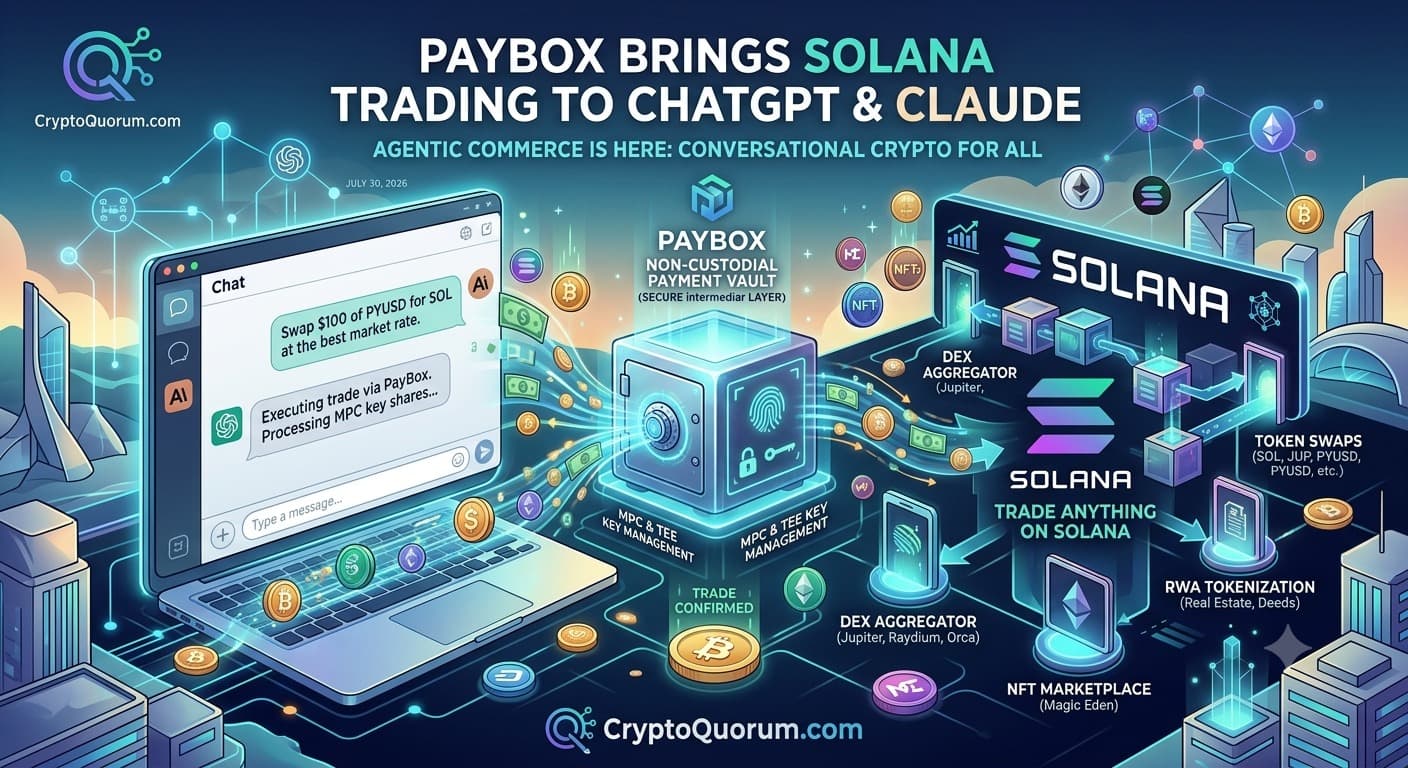
The boundary between artificial intelligence and decentralized finance has reached a major milestone. In a joint announcement that marks a shift toward agentic Web3 commerce, global payments firm MoonPay released PayBox—a non-custodial payment vault and custom connector that embeds financial execution directly within OpenAI’s ChatGPT and Anthropic’s Claude.
With this integration, millions of conversational AI users can now trade anything on Solana simply by typing natural-language prompts into their chat interface.
CRYPTOCAP:TOTAL Real-Time Chart
Rather than navigating complex decentralized exchange (DEX) interfaces, managing public keys across browser extensions, or manually computing slippage, users can instruct their AI assistant to execute token swaps, route liquidity, and manage digital asset portfolios. Powered by Solana’s high-throughput architecture and open payment standards like Coinbase’s x402 protocol, PayBox transforms generalized large language models (LLMs) into active participants in the Web3 economy.
The Architectural Breakthrough: What Is PayBox?
For years, AI models like Claude and ChatGPT have excelled at text generation, market analysis, and code synthesis. However, when tasked with executing economic actions, AI assistants encountered a persistent barrier: security and custody. Traditional LLMs cannot independently store private keys, hold bank credentials, or directly authorize blockchain transactions without introducing catastrophic risk.
 TRON Ecosystem Expands in Q2 2026 Across AI, Payments and Tokenization→
 BIS Tests XRP Ledger to Verify Official Statistics Onchain→
 Chainlink: AI systems are becoming financial participants, .→
 XDC Network Hits Record 27.7M Transactions in August→
PayBox resolves this impasse by operating as an isolated, non-custodial payment vault that interfaces with AI models via specialized Model Context Protocol (MCP) connectors. Instead of granting the AI direct access to wallet private keys or payment credentials, PayBox acts as a secure intermediary layer.
Key architectural features of PayBox include:
- Non-Custodial Multi-Party Computation (MPC): Powered by security infrastructure from Sodot, PayBox utilizes MPC and Trusted Execution Environments (TEEs). Wallet keys are sharded, ensuring that neither MoonPay, OpenAI, Anthropic, nor the AI model itself can unilaterally access or spend user funds.
- Universal Asset Support: Built to handle both Web3 and traditional finance rails, PayBox manages Solana-native assets, EVM token standards, cross-chain bridges, and debit card credentials via Visa’s agentic commerce protocol.
- Open Standard Integration: The vault natively supports x402, an open HTTP payment standard originally authored by Coinbase and contributed to the Linux Foundation, enabling AI agents to pay for API microservices, digital goods, and on-chain liquidity seamlessly.
By combining MPC key management with natural-language processing, PayBox equips everyday consumers with the ability to trade anything on Solana without needing technical knowledge of RPC nodes, gas fees, or smart contract interactions.
How Conversational Trading Works: Prompt, Approve, Pay
Executing an on-chain transaction through PayBox requires no code, wallet browser extensions, or manual copy-pasting of contract addresses. The user experience operates across a three-step pipeline: Prompt, Approve, and Pay.
[ User Natural Language Prompt ]
               │
               ▼
[ AI Agent Research & Transaction Preparation ]
               │
               ▼
[ PayBox Vault & MPC Security Shield ]
               │
               ▼
[ User Passkey Approval (FIDO2 / Biometric) ]
               │
               ▼
[ Solana On-Chain Settlement ]
1. The Natural-Language Prompt
Inside a standard ChatGPT or Claude conversational thread, the user initiates a request. Examples include:
- “Swap $100 of PYUSD for SOL at the best market rate.”
- “Buy $50 worth of Jupiter (JUP) tokens and stake them.”
- “Onramp $200 from my linked card directly to my Solana wallet.”
2. Transaction Preparation
The AI assistant interprets the intent, queries real-time market data across Solana DEX aggregators, calculates optimal routing, and builds the payload for the proposed transaction.
3. Verification and Approval
The transaction is passed to the PayBox vault interface. To prevent rogue AI behavior or prompt-injection attacks, PayBox enforces strict permission modes configured by the user:
- Always Ask Mode (Default): Every transaction generates a hardware-bound passkey request (such as Face ID or Touch ID). The passkey signature is scoped strictly to that single transaction hash and expires immediately after use, preventing replay attacks.
- Autonomous Mode: Advanced users can delegate limited spending authority to the AI agent. In this mode, the AI can automatically execute actions provided they fall within predefined boundaries, such as a daily spending cap, maximum slippage tolerance, or a whitelisted set of Solana token mints.
Once verified by the user’s passkey, PayBox signs and broadcasts the transaction to the network, making it possible to trade anything on Solana in seconds with full cryptographic assurance.
Why Solana Serves as the Premier Settlement Layer for AI Agents
While PayBox supports multiple EVM networks, Solana’s network design makes it uniquely suited for conversational AI commerce. Machine-to-machine invoicing and AI-driven portfolio rebalancing demand specific performance parameters that legacy networks struggle to provide.
1. Sub-Second Latency and Finality
AI trading strategies rely on rapid execution. Solana’s 400-millisecond block times ensure that when an AI model identifies an arbitrage or token swap opportunity, the trade is settled on-chain before market conditions degrade.
2. Predictable, Micro-Cent Transaction Fees
A conversational interface encourages frequent, smaller transactions—such as daily dollar-cost averaging or buying small amounts of utility tokens. Solana’s low transaction fees (typically fractions of a cent) ensure that micro-transactions remain economically viable, whereas high gas fees on Ethereum would render conversational trading unfeasible.
3. Deep On-Chain Liquidity
Through Solana’s unified liquidity layer, AI agents connected to PayBox can instantly route trades across liquidity hubs like Jupiter, Raydium, and Orca, ensuring minimal price impact when users instruct their agents to trade anything on Solana.
Expert Insights: The Shift to Agentic Commerce
Industry leaders view the launch of PayBox inside Claude and ChatGPT as a foundational shift in how humans interact with financial assets.
Ivan Soto-Wright, CEO and Founder of MoonPay, emphasized the historical evolution of payments:
“The card hid the cash. The phone hid the card. This is the era where money disappears into conversation. Billions of AI agents are coming online, and every single one of them will need to hold, move, and spend money safely. Someone had to build the trust layer for that world. PayBox is the product MoonPay was built to make.”
Addressing the technical safeguards required when granting financial capabilities to LLMs, Neeraj Prasad, Chief Engineer at MoonPay Labs (and former founder of AI trading platform Dawn Labs), noted:
“Generalised LLMs are exceptional at reasoning, but they should never touch user keys directly. We built PayBox so that agentic payments occur inside secure, isolated environments while communicating across open rails like Solana and x402. The AI prepares the trade, but cryptographic authority remains entirely in the hands of the user.”
Crypto security analysts have also commended the protocol’s use of passkey-scoped authorization. By separating the intelligence layer (ChatGPT/Claude) from the cryptographic signing layer (PayBox MPC), the architecture mitigates key leakage risks associated with malicious prompts or software bugs inside third-party AI models.
The Broader Impact on Web3 Adoption and AI Integration
The integration of PayBox into mainstream AI platforms addresses one of Web3’s longest-standing hurdles: user experience. For over a decade, onboarding non-technical retail users required navigating complex seed phrases, gas management, and network switching.
By abstracting these friction points into natural conversational prompts, PayBox allows users to trade anything on Solana without ever needing to understand underlying blockchain mechanics. Furthermore, as developers integrate the PayBox SDK into custom autonomous agents, the platform opens the door for complex automated workflows—such as AI agents buying computing power, funding predictive models, or paying for API access autonomously.
As OpenAI, Anthropic, and MoonPay expand support to additional model frameworks like Google Gemini and xAI’s Grok, conversational execution is set to become a standard interface for personal finance and Web3 management.
CRYPTOCAP:TOTAL3 Real-Time Chart
Disclaimer: This article is for informational purposes only and does not constitute financial, investment, or legal advice. Trading digital assets on Solana involves risk. Always ensure your PayBox permission settings and spending caps are configured according to your individual risk tolerance before enabling autonomous transactions.