

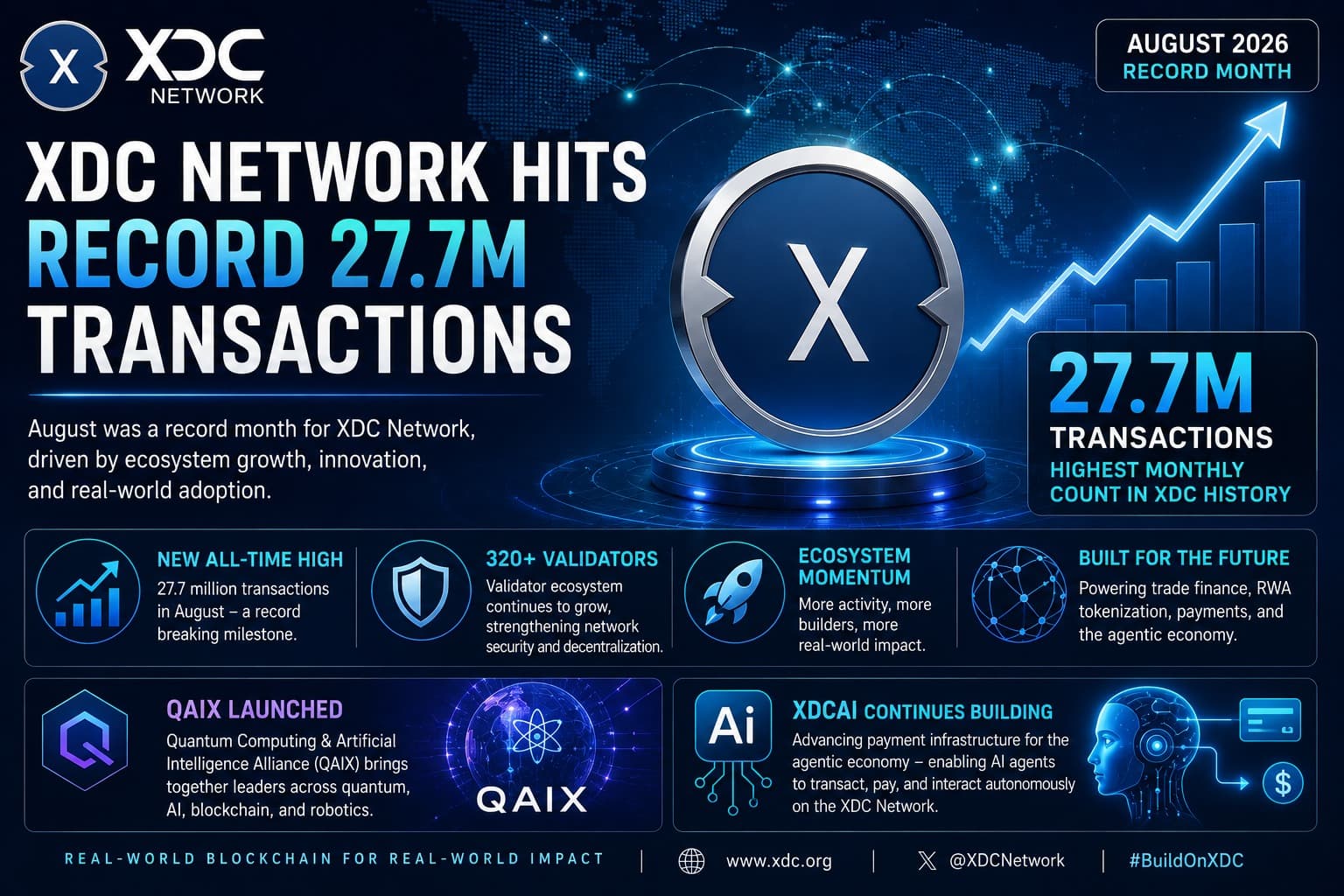
August marked a record month for the XDC Network, with the blockchain processing 27.7 million transactions, according to an ecosystem update published by XDC Network on Sept. 3.
The monthly figure represents the highest transaction count in the network’s history. XDC says the milestone came alongside continued growth in its validator ecosystem, the launch of the Quantum Computing and Artificial Intelligence Alliance (QAIX), and further development of infrastructure designed for the emerging agentic economy.
The developments point to a strategy that increasingly connects blockchain infrastructure with trade finance, real-world assets, payments and autonomous software.
A New Monthly Transaction Record
The headline figure is straightforward: 27.7 million transactions were recorded during August, according to XDC Network.
 Polygon Discloses Critical Security Patches Following Successful Austin and Kyoto Hard Forks→
 Wall Street Moves to Solana From a Phone→
 Chainlink expands its role in tokenized equities→
 Mastercard joins XRP Ledger Hackathon ahead of Ripple Swell→
The network previously described the figure as representing approximately 50% growth over the preceding six months, making the milestone more significant than a single-month spike. XDC Foundation had already highlighted the new all-time high in its weekly ecosystem reporting.
The increase comes as the blockchain continues targeting financial applications rather than focusing exclusively on retail cryptocurrency activity.
XDC’s stated areas of focus include real-world asset tokenization, trade finance, payments, enterprise applications and AI-driven transactions.
That combination is important because transaction growth alone does not explain what is driving activity. A blockchain can record large numbers of low-value transactions without generating comparable economic value. Conversely, a smaller number of high-value institutional transactions can be economically significant.
For that reason, the 27.7 million figure is best treated as an indicator of network utilization rather than a standalone measure of commercial success.
Validator Ecosystem Passes 320
Infrastructure development was another major part of the August story.
The validator ecosystem surpassed 320 validators, with institutional and infrastructure companies increasingly participating in the network’s validation layer. XDC Foundation previously reported approximately 26.6% validator growth over the quarter and described the expansion as strengthening network security and decentralization.
Among the organizations joining or expanding their involvement were Hex Trust, Clear Street and LinkPool, while Cointelegraph Decentralization Guardians also added nodes.
Clear Street’s participation is particularly notable because the company operates financial-market infrastructure for institutional clients. Its own platform currently says it serves more than 700 institutional clients and supports approximately $16 billion in customer balances.
According to reporting on the XDC development, Clear Street CEO Robert Rutherford framed the company’s involvement around the evolution of capital-market infrastructure, saying the firm wanted to help build and operate the next layer of those markets.
Why Institutional Validators Matter
Validators perform a fundamental role in blockchain networks by participating in transaction processing and consensus.
For an enterprise-focused blockchain, however, the identity of validators can also matter.
Participation by established financial infrastructure providers can demonstrate that professional market participants are willing to operate infrastructure connected to the network. It does not automatically prove that institutional transaction volumes will follow, but it can strengthen the ecosystem’s infrastructure base.
XDC already counts organizations such as Deutsche Telekom, SBI Holdings, Animoca Brands, HashKey Cloud and Republic among its broader validator ecosystem.
The trend therefore extends beyond simply increasing the number of nodes. It reflects an effort to build a validator community with participation from technology companies, financial firms and institutional infrastructure providers.
QAIX Brings Quantum Computing and AI Into the Ecosystem
August also saw the launch of QAIX, described by XDC as the Quantum Computing and Artificial Intelligence Alliance.
The initiative brings together participants from quantum computing, artificial intelligence, digital assets, financial infrastructure and industrial robotics. QAIX says its headquarters are in Manhattan, with additional activity across major U.S. technology and financial centers.
The alliance gives XDC another connection to technologies that could influence financial infrastructure over the coming years.
Quantum computing is particularly relevant to digital-asset infrastructure because sufficiently powerful quantum systems could eventually challenge some cryptographic assumptions used by blockchain networks. AI, meanwhile, is already creating a different requirement: software needs infrastructure capable of making and settling transactions autonomously.
QAIX therefore fits into a broader technological narrative rather than representing another conventional blockchain application.
XDC AI Targets the Agentic Economy
The other major development is XDC AI.
The project is designed around the idea that AI agents will eventually do more than generate text, analyze information or recommend actions. They will increasingly be expected to execute transactions, purchase services and interact with financial systems.
XDC AI combines the open x402 payment standard with USDC settlement on XDC. Its current infrastructure allows agents to make payments for APIs and other services on a per-request basis.
The system is designed so an AI agent can make a payment without holding native XDC for gas. Instead, the payment is made in USDC while a relayer handles the network fee.
That architecture is aimed at machine-to-machine commerce.
For example, an AI agent could theoretically access a paid data service, request an API call and settle the exact amount required without a conventional subscription or manual checkout process.
Expert Opinion: AI Needs a Payment Layer
XDC co-founder Ritesh Kakkad has argued that AI agents need more than intelligence to become economic participants.
In an interview covered by Decrypt, Kakkad highlighted the convergence of AI agents, stablecoins and enterprise blockchain as an important area for future financial infrastructure.
XDC co-founder Atul Khekade has similarly emphasized that autonomous systems need real-time settlement, compliance, KYC/AML controls and spending limits before they can safely handle financial transactions.
This is an important distinction.
The challenge is not simply teaching an AI model how to send money. The infrastructure must also determine how much the agent can spend, where it can spend it, how the transaction is authorized and what happens if the agent makes a mistake.
Independent research into agentic finance has highlighted the same problem. Researchers from Microsoft, Google DeepMind and Columbia University have explored financial safeguards for situations in which autonomous agents execute transactions incorrectly.
The development of these controls could become as important as the payment rails themselves.
From Blockchain Transactions to Real-World Payments
XDC’s August developments also included the integration of XDC with OrbitX corporate cards, extending the ecosystem toward business payments. The network also saw the launch of XDC/USDT perpetual futures on KuCoin Futures.
These developments cover very different use cases.
Corporate cards address everyday spending and treasury operations. Perpetual futures address cryptocurrency market trading. XDC AI focuses on autonomous software payments.
The common denominator is infrastructure.
Rather than depending on one application category, the ecosystem is attempting to create multiple pathways through which XDC-based infrastructure can interact with businesses, financial markets and software.
That approach is similar to the institutional direction visible elsewhere in the blockchain sector. CryptoQuorum previously covered Zand’s integration with XDC Network, where the focus was on connecting regulated banking services with blockchain-based payments and digital-asset infrastructure.
Trade Finance Remains a Core Use Case
XDC’s original institutional positioning around trade finance remains important to understanding the August numbers.
Trade finance involves documentation, receivables, invoices, letters of credit and other financial processes that can involve multiple parties and jurisdictions.
Blockchain can potentially provide a shared transaction record and programmable settlement layer, while tokenization can turn traditionally fragmented financial claims into digitally transferable assets.
The network’s August activity included continued development around these applications. XDC Foundation also highlighted an initiative involving SBI XDC Network APAC, TOPPAN and Ginco that was selected for an Osaka Prefecture program supporting new financial services using blockchain technology.
The project is designed to test a trade-finance workflow involving verifiable corporate identity and on-chain export factoring.
That development is relevant because it demonstrates the type of institutional workflow XDC is targeting: not simply moving cryptocurrency, but digitizing processes associated with international commerce.
CryptoQuorum’s recent coverage of tokenization and ownership records provides additional context for why blockchain-based records and settlement are becoming increasingly important to financial-market infrastructure.
Capacity Is Not the Same as Actual Usage
XDC describes its network as capable of processing thousands of transactions per second. However, theoretical throughput should not be confused with the 27.7 million transactions actually recorded during August.
The monthly figure works out to an average of roughly 10.3 transactions per second across the entire month.
That is substantially below the network’s stated maximum capacity.
This distinction is useful for readers evaluating blockchain performance. A high theoretical TPS figure indicates potential capacity, while actual transactions show utilization. Both metrics matter, but they answer different questions.
The fact that XDC can process substantially more activity than its current average suggests there may be capacity for additional growth. It does not, however, guarantee that future demand will materialize.
What the August Record Means for XDC
The strongest interpretation of the August data is that XDC is moving beyond a purely infrastructure-focused narrative toward a broader ecosystem model.
Three developments stand out:
First, network usage increased. The 27.7 million monthly transactions established a new historical record.
Second, infrastructure participation expanded. More than 320 validators, including institutional participants, now contribute to the network.
Third, the ecosystem is diversifying. QAIX, XDC AI, corporate cards, trade-finance projects and derivatives all represent different applications of the underlying infrastructure.
That diversification could become important if XDC wants to compete for institutional adoption.
The challenge will be converting ecosystem announcements and infrastructure development into sustained real-world usage.
What to Watch in September and Beyond
Several metrics will help determine whether August represents the beginning of a longer-term trend.
- Monthly transaction activity: Can XDC maintain or exceed the 27.7 million level?
- Validator growth: Will institutional participation continue expanding?
- Agentic payments: Will XDC AI generate meaningful real-world transaction volume?
- Trade finance: Will pilot programs develop into production deployments?
- Tokenization: Will more real-world assets move onto the network?
- Revenue and economic value: Will higher transaction activity translate into measurable value captured by applications and network participants?
These indicators will provide a more complete picture than transaction count alone.
The Bottom Line
August was a milestone month for XDC.
The network recorded 27.7 million transactions, its highest monthly total to date, while its validator ecosystem surpassed 320 participants. At the same time, QAIX launched and XDC AI continued developing payment infrastructure for autonomous software agents.
The broader direction is clear: XDC is positioning itself at the intersection of trade finance, real-world assets, payments, institutional blockchain infrastructure and the emerging agentic economy.
The 27.7 million transaction record is encouraging, but it should not be interpreted as proof that every part of that strategy has achieved commercial scale.
The more important test will be whether transaction growth continues while institutional projects, tokenization initiatives and AI-driven payments move from experimentation into sustained production use.
For now, August provides evidence that activity across the XDC ecosystem is expanding—and that the network is building toward a financial infrastructure model that extends well beyond conventional cryptocurrency transfers.
Disclaimer: This article is for informational and educational purposes only and does not constitute financial, investment, legal or tax advice. Cryptocurrency and digital assets are highly volatile and may result in partial or total loss of capital. Network activity, validator growth, partnerships and ecosystem developments do not guarantee future adoption or XDC price appreciation. Readers should conduct their own research and consult a qualified financial professional before making investment decisions.