

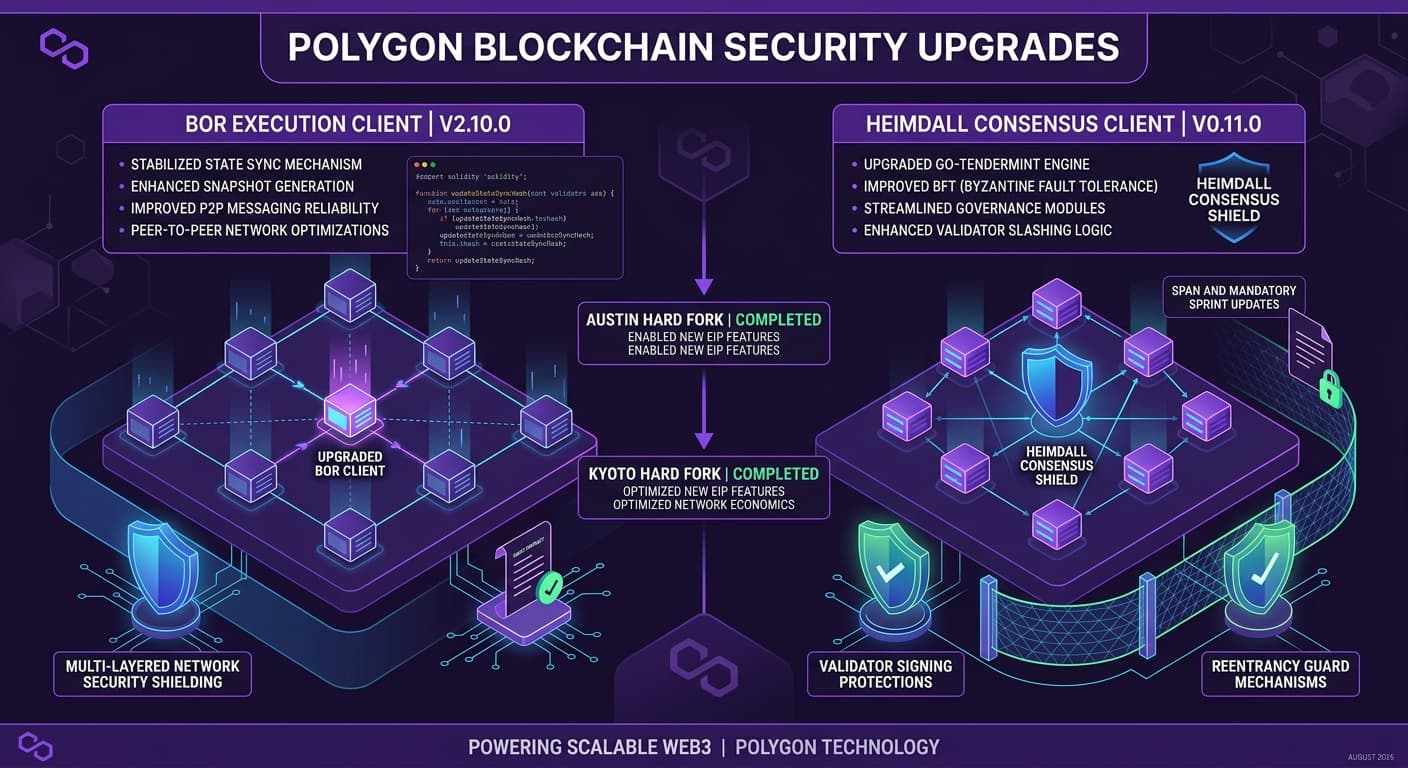
Polygon Labs has published a comprehensive post-mortem detailing critical fixes delivered through two recent network upgrades: the Austin hard fork for the Bor execution layer and the Kyoto hard fork for the Heimdall consensus layer. The security review, released on the official Polygon governance forum, confirms that while no active exploits were detected on mainnet, unpatched nodes have diverged from the canonical chain and must be upgraded immediately.
These coordinated Polygon security upgrades address potential denial-of-service (DoS) vulnerabilities, un-metered resource consumption vectors, and serialization exploits capable of disrupting block production and consensus finality across the Polygon Proof-of-Stake (PoS) ecosystem.
Technical Overview: The Bor v2.10.0 Release and Austin Hard Fork
The execution client for Polygon PoS, Bor, was upgraded to version 2.10.0 to execute the Austin hard fork at mainnet block height 91,949,700. The patch targeted two primary vectors that posed resource exhaustion risks to execution nodes.
1. Gas Caps on L1-to-L2 State Synchronization
Prior to the Austin hard fork, state-sync events originating from Ethereum Layer 1 deposit contracts executed smart contract code and precompiles on Bor without being counted against a fixed block-level gas ceiling. A sudden influx of complex state-sync transactions or a single resource-heavy execution could cause severe processing latency, leading to transient block stalls across the validator set.
 Chainlink Bridges Traditional Capital Markets and Decentralized Finance Through Secure Oracle Infrastructure→
 How CFOs Are Transforming Corporate Treasury With Digital Assets, XRP, and RLUSD→
 XRP Ledger Foundation Advances Ecosystem Resilience with Strategic Infrastructure Upgrades→
 Zebec and MoneyGram Expand Stablecoin Payroll Through Stellar→
Bor v2.10.0 introduces strict per-block gas bounds for state-sync events. By enforcing these limits, the network guarantees that state bridge processing cannot consume excessive execution cycles or delay standard transaction processing.
2. Removal of Unbounded TxDependency Extra-Data Fields
Bor previously utilized a custom TxDependency extra-data field as an optimization hint for parallel transaction processing. However, the wire format lacked an explicit payload size restriction. A malicious block producer could theoretically inject an arbitrarily large binary blob into a candidate block. While the block itself might satisfy validation rules, peer nodes attempting to parse the oversized payload would suffer memory spikes or process crashes.
Under the Austin upgrade rules, the TxDependency field has been completely stripped from the network wire format, eliminating the payload amplification vector entirely.
Technical Overview: The Heimdall v0.11.0 Release and Kyoto Hard Fork
While Bor governs smart contract execution, Heimdall handles consensus, checkpointing, and validator management. The Kyoto hard fork, activated at Heimdall block height 51,533,000 on August 18, 2026, upgraded the consensus client to version 0.11.0 to eliminate critical vulnerabilities within its underlying Cosmos SDK dependencies.
Polygon PoS Architecture [ Bor Execution Client v2.10.0 ] <–> [ Heimdall Consensus v0.11.0 ]
- Austin Hard Fork – Kyoto Hard Fork
- L1-L2 State-Sync Gas Ceiling – Protobuf Nesting Checks
- TxDependency Vector Stripped – Validator Signature Fixes
Protobuf Serialization Exploits and Validator Workload
The most severe vulnerability addressed in Heimdall involved nested google.protobuf.Any messages. Attackers could craft low-cost transactions containing deeply nested protocol buffer structures. When processing these messages, validator nodes were forced into expensive recursive decoding loops.
In a Proof-of-Stake framework, imposing disproportionate decoding workloads on consensus nodes risks causing validator timeouts, missed block proposals, and degraded finality. Heimdall v0.11.0 implements mandatory byte-level nesting depth checks at both mempool ingestion and block creation.
Additional Consensus and Checkpoint Hardening
The Kyoto upgrade implemented several protocol-level stability fixes:
- Idempotent Downtime Messages: Repeated validator downtime notifications no longer trigger duplicate state transitions.
- Injective Event Replay Keys: Log indexes for top-up, clerk, and staking events were modified to prevent layer-1 events from shadowing one another.
- Milestone Vote Binding: Milestone-range votes are now explicitly bound to signed parent hashes, preventing consensus confusion during block span transitions.
Summary of Polygon Security Upgrades
The table below outlines the key technical specifications and requirements associated with the recent releases:
| Feature / Upgrade | Bor v2.10.0 (Austin HF) | Heimdall v0.11.0 (Kyoto HF) |
| Layer Target | Execution Layer (Bor) | Consensus Layer (Heimdall) |
| Activation Height | Mainnet Block 91,949,700 | Mainnet Block 51,533,000 |
| Primary Vulnerability | Un-metered State-Sync & Oversized TxDependency | Protobuf Any Nesting & Signature Edge Cases |
| Impact Severity | High (Block Stalls, Peer Crashes) | Critical (Validator CPU Overload, Consensus Drift) |
| State Migration Needed? | No (Binary Upgrade Only) | No (Binary Upgrade Only) |
| Required Action | Mandatory Update for All Bor Nodes | Mandatory Update for All Validators & Full Nodes |
Operational Consequences for Node Operators
Polygon Labs emphasized that these release cycles were conducted under a responsible disclosure model. Patches were battle-tested on the Amoy testnet before mainnet deployment, with public technical details withheld until binary updates were made available to node operators.
However, because both the Austin and Kyoto hard forks altered core execution and validation rules, any node still running legacy software has automatically fallen out of consensus.
Important Operational Notice for Validators:
Nodes operating on binaries older than Bor v2.10.0 or Heimdall v0.11.0 are currently following a non-canonical fork. To re-sync with the live mainnet, operators must install the latest releases, roll back local state to a pre-fork block height, and re-synchronize using official RPC bootnodes.
Expert Opinions and Industry Perspective
Blockchain security analysts highlight that silent patches followed by delayed post-mortems represent standard best practice for critical Layer 1 and Layer 2 infrastructure.
Independent security researcher Nathan Worsley noted on X that the severity of the Heimdall consensus vectors necessitated a rapid, closed-door patching cycle to protect network assets. Furthermore, ecosystem historical data links these findings to past bug bounty programs, including high-severity rewards exceeding $2 million for value-at-risk discoveries in bridge logic.
“In high-throughput Proof-of-Stake networks like Polygon, execution gas limits and consensus parsing logic are primary attack surfaces,” noted a senior Web3 security auditor. “Un-metered state-sync events and recursive protobuf decoding are classic resource exhaustion vectors. Polygon’s proactive deployment of these Polygon security upgrades prevented potential network halts without risking user funds.”
Network Health and Strategic Impact
These maintenance upgrades come as Polygon continues to bolster its infrastructure efficiency following earlier performance releases, such as July’s Ithaca hard fork. With major enterprise integrations and institutional stablecoins—such as PayPal’s PYUSD—relying on Polygon PoS for high-volume settlement, ensuring node software resilience remains paramount.
Disclaimer
This article is for informational purposes only and does not constitute financial, investment, or technical advice. Cryptocurrency investments and node operations carry inherent risks. Always perform your own due diligence and consult official project documentation before executing network updates or code changes.