

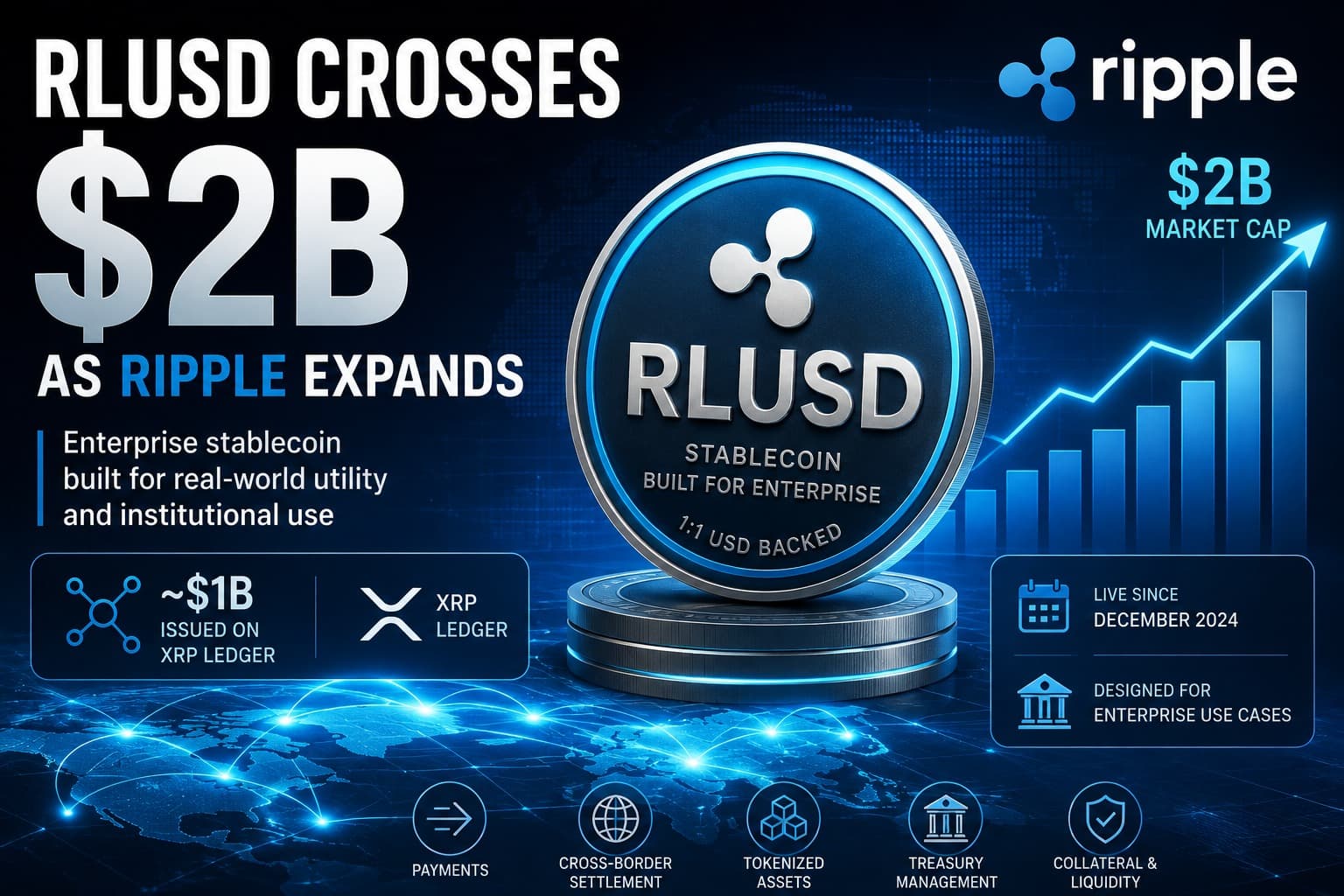
Ripple’s dollar-backed stablecoin RLUSD has reached a new milestone, with Ripple stating that its market capitalization crossed $2 billion last week and that close to $1 billion of the token has been issued on the XRP Ledger (XRPL).
The milestone highlights how quickly Ripple has been developing RLUSD since its launch in December 2024. Rather than positioning the stablecoin primarily as a retail trading token, Ripple has consistently presented it as infrastructure for payments, settlement, tokenization, treasury operations and other institutional use cases.
CRYPTOCAP:TOTAL3 Real-Time Chart
The development also raises a broader question for the XRP ecosystem: can growing stablecoin activity turn the XRP Ledger into a more important settlement network for traditional financial institutions?
RLUSD reaches a new market milestone
Ripple announced the $2 billion milestone in a post on X, describing RLUSD as a stablecoin that has been live since December 2024 and built around real-world utility and enterprise applications.
 Why Crypto Rallied After Clarity Act Failed→
 Coinbase and Citi Expand Stablecoin Payments for Businesses→
 XRP Holders Close to Unlocking On-Chain RLUSD Borrowing as Validator Vote Nears Threshold→
 How CFOs Are Transforming Corporate Treasury With Digital Assets, XRP, and RLUSD→
The company’s positioning is important. Stablecoins have become one of the most significant bridges between traditional finance and blockchain networks, allowing users to represent fiat currencies on-chain while benefiting from blockchain-based settlement.
Ripple says RLUSD is designed to maintain a value of one U.S. dollar and is backed by segregated reserves consisting of cash and cash equivalents. The company also publishes monthly reserve reports and independent attestations.
There is, however, an important data point to keep in mind.
Ripple’s public transparency dashboard showed $1.5896 billion in circulating RLUSD and $1.7026 billion in reserve funds as of August 6, 2026.
That means the $2 billion figure cited by Ripple appears to represent a more recent market-cap or issuance milestone than the latest reserve snapshot currently displayed on its transparency page. Readers should therefore distinguish between the company’s latest announcement and independently verifiable circulating-supply data available at a specific reporting date.
That distinction is particularly important for stablecoin reporting, where issuance, circulating supply, market capitalization and reserve balances can change quickly.
Why the XRP Ledger matters
RLUSD is natively issued on both the XRP Ledger and Ethereum, giving the stablecoin access to two different blockchain ecosystems.
Ripple’s emphasis on the XRPL is nevertheless significant.
The XRP Ledger was designed for fast, low-cost transactions, making it suitable for applications where settlement speed and transaction efficiency are important.
Ripple says RLUSD transactions can settle in seconds on the XRP Ledger and Ethereum. The company is also positioning the stablecoin as a settlement asset for trading, derivatives and other financial applications.
This creates a potentially important relationship between the stablecoin and the underlying blockchain.
The more financial institutions use tokenized dollars for payments, settlement or collateral, the greater the potential utility of the network supporting those transactions.
CryptoQuorum’s recent coverage of Ripple’s UBRI research into AI, tokenization and the XRP Ledger examined a similar trend: Ripple is increasingly presenting the XRPL not simply as a cryptocurrency network, but as infrastructure for digital financial markets.
Enterprise use is the central strategy
Ripple’s enterprise positioning differentiates RLUSD from many stablecoins competing primarily for exchange liquidity and retail users.
The company says RLUSD is designed for businesses, payment providers, exchanges and financial institutions. Its stated use cases include cross-border settlement, remittances, treasury flows, tokenized assets and fiat on/off-ramps.
That strategy is becoming more visible across Ripple’s broader business.
In August, Ripple announced investments in ZILO and Licuido as part of an expansion of its digital capital-markets infrastructure. The company said the combined infrastructure is designed to support issuance, custody, collateral mobility and atomic settlement on the XRPL, with RLUSD serving as the regulated cash leg for delivery-versus-payment transactions.
This is an important development because it gives RLUSD a potential role beyond conventional stablecoin trading.
For example, imagine a tokenized fund being transferred between two institutional counterparties. Instead of completing the asset transfer and cash settlement through separate systems, blockchain infrastructure can theoretically coordinate the two legs of the transaction.
In that model, a dollar-backed token such as RLUSD can function as the cash component of an on-chain financial transaction.
Expert opinions: adoption matters more than the headline
The $2 billion milestone is significant, but market capitalization alone does not prove that a stablecoin has achieved deep economic utility.
A stablecoin can grow because users hold it on exchanges, because institutions mint tokens for treasury purposes, or because liquidity providers use it across decentralized and centralized markets.
The more important metric over time is likely to be transactional activity and institutional usage.
Ripple itself has increasingly emphasized this distinction.
In June, the company announced that RLUSD had reached approximately $1.7 billion in market capitalization and described the token as gaining traction in payments, tokenization and collateral management.
Meanwhile, the broader XRPL ecosystem has been experiencing increasing activity. CoinDesk reported in March that daily XRPL payments had reached approximately 2.7 million, while the number of automated market-maker pools had risen sharply and tokenized asset value was expanding.
These figures do not prove that RLUSD alone is responsible for network growth. But they illustrate the environment in which Ripple is attempting to build a larger institutional settlement ecosystem.
RLUSD and XRP are not the same thing
One of the most important distinctions for investors is that RLUSD and XRP serve different purposes.
XRP is the native cryptocurrency of the XRP Ledger. Its market value is determined by supply and demand, and Ripple describes it as a bridge asset for fast, low-cost transactions.
RLUSD, by contrast, is designed to maintain a stable value of one U.S. dollar and is backed by reserves.
This means increased use of the XRP Ledger does not automatically translate into an equivalent increase in demand for XRP.
That issue has become increasingly relevant as Ripple expands its institutional payments strategy.
For example, CoinDesk recently reported that South Korea’s Jeonbuk Bank adopted Ripple Payments for cross-border business transfers, while the specific asset used for settlement was not publicly identified. The report noted that Ripple has increasingly promoted RLUSD as a settlement asset for institutional activity.
The distinction is crucial.
More XRPL activity ≠ automatically higher XRP demand.
The economic relationship between network usage, XRP liquidity and RLUSD settlement will need to be evaluated based on actual transaction flows rather than assumptions.
A potential role in tokenized financial markets
Ripple’s latest capital-markets initiatives provide perhaps the clearest indication of where it wants RLUSD to go.
The company says its infrastructure combines issuance, custody, collateral utility, multi-currency investment and atomic settlement. RLUSD can serve as the cash leg in transactions involving tokenized financial assets.
That puts the stablecoin into a much larger trend: the tokenization of traditional financial assets.
Banks, asset managers and financial technology companies are increasingly experimenting with tokenized funds, securities and collateral.
If these markets develop at scale, demand could emerge for programmable dollar-denominated settlement assets that operate continuously rather than according to traditional banking hours.
That is precisely the market Ripple is targeting.
CryptoQuorum readers can also see this broader trend in our coverage of institutional XRP adoption and custody.
The risks behind the growth
Rapid stablecoin growth should not be interpreted as risk-free adoption.
RLUSD remains dependent on its reserve structure, issuer arrangements, regulatory framework, liquidity and redemption mechanisms.
Ripple says RLUSD is issued through Standard Custody & Trust Company, a limited-purpose trust company chartered and supervised by the New York Department of Financial Services. Ripple also says reserves are maintained in segregated accounts and subject to independent monthly attestations.
Those safeguards are important, but they do not eliminate all risks.
Regulatory requirements can change. Stablecoin liquidity can vary between markets. Institutional adoption can develop more slowly than projected. Competition from established issuers such as Tether and Circle also remains intense.
There is another strategic risk for Ripple: successful growth of its stablecoin does not necessarily mean that XRP captures the same economic value.
If institutions use RLUSD as their primary settlement asset, the XRP Ledger could gain substantial activity while the relationship between that activity and XRP demand remains indirect.
What comes next for RLUSD?
The $2 billion milestone is best viewed as a growth indicator rather than an endpoint.
The next stage will be determined by whether RLUSD can convert market capitalization into sustained real-world usage.
Key metrics to watch include:
- RLUSD circulating supply and reserve growth
- Settlement volume on the XRP Ledger
- Institutional payment adoption
- Tokenized-asset settlement activity
- Exchange liquidity
- Cross-chain issuance
- Treasury and collateral use
- Regulatory developments affecting stablecoins
If Ripple succeeds in embedding RLUSD into institutional payment and capital-market workflows, the stablecoin could become an important component of the company’s broader financial infrastructure strategy.
For the XRP Ledger, that could mean more transaction activity, deeper liquidity and a growing role in tokenized finance.
But the investment implications should be assessed separately. RLUSD’s growth is not, by itself, a direct price catalyst for XRP.
The more significant story may be the infrastructure being built around both assets.
RLUSD is increasingly being positioned not merely as another dollar stablecoin, but as a potential settlement layer connecting traditional finance with blockchain-based markets.
Whether that vision becomes a major part of global finance will depend on one factor above all: sustained institutional usage.
CRYPTOCAP:TOTAL3 Real-Time Chart
Recommended sources
Disclaimer: This article is provided for informational and educational purposes only and does not constitute investment, financial, legal or tax advice. Cryptocurrency and digital-asset markets are highly volatile. RLUSD and XRP involve different risks, and past performance or adoption does not guarantee future results. Readers should conduct independent research and consult a qualified financial professional before making investment decisions.