English
  Español

- Core Policy Recommendations: Modernizing Exempt Offerings and Investor Access
- 1. Expanding the Accredited Investor Definition
- 2. Raising Caps on Regulation Crowdfunding and Regulation A+
- 3. Streamlining Form S-3 and Repealing the “Baby Shelf” Constraint
- Expert Opinions: SEC Leadership and Industry Advocates
- The Intersection with Web3, Tokenization, and Digital Capital Markets
- Looking Ahead to Legislative Action
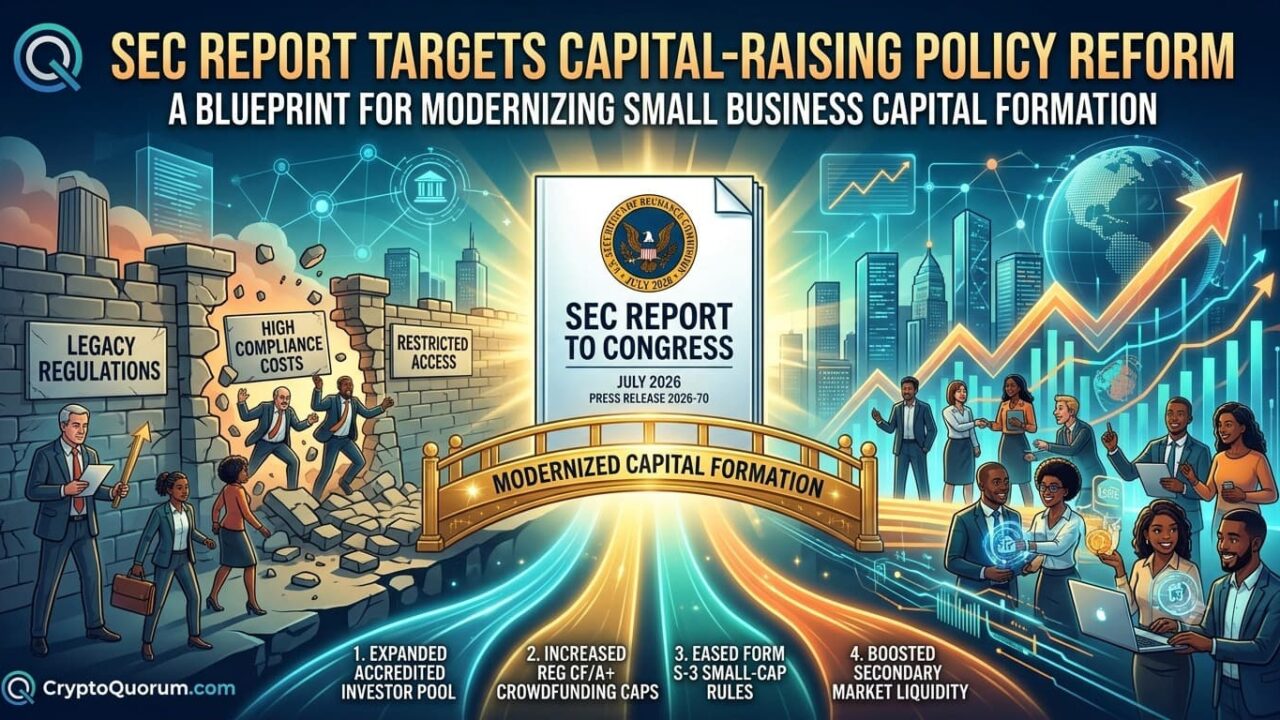
On July 27, 2026, the U.S. Securities and Exchange Commission (SEC) formally delivered its 2026 Small Business Forum Report to Congress, presenting a comprehensive roadmap for legislative and regulatory reform. Released under Press Release 2026-70, the report consolidates actionable policy recommendations developed during the agency’s 45th Annual Government-Business Forum on Small Business Capital Formation, which took place at SEC headquarters on March 9, 2026.
Organized by the SEC’s Office of the Advocate for Small Business Capital Formation, the annual forum serves as an official channel for entrepreneurs, startup founders, angel investors, and venture allocators to directly shape federal securities rules. This year’s submission arrives at a pivotal juncture for American financial markets, as regulators face mounting pressure to modernize capital formation, foster early-stage innovation, and ensure global economic competitiveness alongside evolving digital asset frameworks.
BTC / USD Real-Time Chart
The report details participant recommendations aimed at reforming nationwide capital-raising policy, paired with formal responses from the Commission. Spearheaded by SEC Chairman Paul Atkins alongside Commissioners Hester Peirce and Mark Uyeda, the submission signals a decisive agency shift toward easing compliance burdens for early-stage startups, growth companies, and smaller public issuers.
Core Policy Recommendations: Modernizing Exempt Offerings and Investor Access
The 2026 report presents targeted recommendations across four distinct phases of the business lifecycle: early-stage capital raising, growth-stage companies and smaller funds, small-cap public companies, and secondary market liquidity. At the center of these proposals is an effort to expand private capital access while reducing prohibitive compliance overhead.
Read Also
1. Expanding the Accredited Investor Definition
For decades, federal securities laws have restricted private market participation primarily through income and net-worth thresholds ($200,000 individual annual income or $1 million net worth). Forum participants strongly urged Congress and the SEC to update this definition by incorporating professional sophistication, financial certifications, and demonstrated investment experience. Expanding the accredited investor pool democratizes early-stage deal flow, allowing knowledgeable retail investors and Web3-native allocators to back early-stage founders legally.
2. Raising Caps on Regulation Crowdfunding and Regulation A+
To account for persistent economic inflation and elevated capital costs, the report recommends increasing maximum capital limits for exempt offerings. Participants advocated for expanding the Regulation Crowdfunding (Reg CF) cap from $5 million to $10 million, while raising Regulation A+ Tier 2 limits beyond the current $75 million threshold. These updates aim to allow emerging technology and blockchain ventures to raise non-dilutive capital without incurring the heavy legal expenses of a traditional initial public offering (IPO).
ETH / USD Real-Time Chart
3. Streamlining Form S-3 and Repealing the “Baby Shelf” Constraint
For smaller public companies, secondary capital formation remains fraught with structural friction. The report highlights recommendations to ease Form S-3 short-form registration eligibility and eliminate the restrictive “baby shelf” rule—which currently limits primary offerings over a 12-month period to no more than one-third of an issuer’s public float if that float is under $75 million. Removing these roadblocks grants smaller public firms necessary agility when raising growth capital in volatile market environments.
Expert Opinions: SEC Leadership and Industry Advocates
The delivery of the report brought notable commentary from SEC leadership and industry leaders, emphasizing the urgency of updating federal capital-raising policy.
Stay Ahead of the Curve
Join our weekly newsletter for exclusive insights.
SEC Chairman Paul Atkins highlighted the Commission’s statutory mandate to facilitate capital formation alongside investor protection:
“The annual Small Business Forum is a unique opportunity for innovators, investors, advisors, and policymakers to come together and help identify challenges in capital raising. Sharing ideas and delivering actionable recommendations to Congress ensures our capital markets remain the most dynamic and accessible in the world.”
Commissioner Hester Peirce (“Crypto Mom”), a long-standing advocate for regulatory safe harbors and market innovation, emphasized the need to align private capital rules with modern technological capabilities:
“If we want small businesses and emerging tech ventures to thrive domestically, we must replace rigid, legacy barriers with flexible, transparent frameworks. Capital formation shouldn’t be reserved exclusively for elite institutions or mega-funds. Modernizing our exempt offering framework and recognizing new technological tools for capital allocation is essential for maintaining long-term economic leadership.”
Commissioner Mark Uyeda echoed these sentiments, noting that regulatory compliance costs disproportionately weigh down smaller market participants:
“A one-size-fits-all regulatory approach penalizes small-cap public companies and early-stage entrepreneurs. Lowering unnecessary friction in capital-raising policy allows smaller enterprises to attract growth capital, build sustainable operations, and generate long-term value for everyday investors.”
Private venture capital attorneys and capital market panelists also commended the report’s direction. Sarah Hibbard, a corporate partner at Snell & Wilmer and forum panelist, noted during the proceedings that expanding accredited investor access and streamlining exempt filings directly bridges the gap between traditional venture finance and modern digital capital formation.
The Intersection with Web3, Tokenization, and Digital Capital Markets
While the SEC report focuses broadly on small business capital formation, its implications for the cryptocurrency and Web3 ecosystem are significant. As capital markets increasingly digitize, the line between traditional private placements and on-chain tokenization continues to blur.
The recommendations delivered to Congress complement ongoing legislative efforts, such as the proposed U.S. CLARITY Act and international reforms like Japan‘s Financial Instruments and Exchange Act (FIEA) amendments. By encouraging flexible exempt offering structures and broader investor eligibility, the report builds a foundational bridge toward:
- Compliant Tokenized Crowdfunding: Enabling startups to issue security tokens under updated Reg CF and Reg A+ frameworks, combining public transparency with automated, smart-contract-enforced compliance.
- On-Chain Private Equity & RWA: Streamlining private fund structures so accredited and sophisticated investors can trade tokenized real-world assets (RWA) and startup equity on regulated secondary venues.
- Decentralized Venture Capital: Reducing legal uncertainty for decentralized autonomous organizations (DAOs) and Web3 syndicates seeking to participate in early-stage seed rounds within clear federal guardrails.
As lawmakers evaluate the submission, updating federal capital-raising policy could serve as a pivotal mechanism to align traditional venture finance with decentralized capital markets.
Looking Ahead to Legislative Action
The delivery of the 2026 Small Business Forum Report places the primary responsibility on Capitol Hill. While the SEC maintains administrative authority over certain disclosure rules and filing procedures, major alterations to offering caps, statutory exemptions, and the accredited investor definition require explicit congressional legislation.
With bipartisan momentum building around market competitiveness and retail access, founders, venture capitalists, and digital asset innovators are watching closely to see which recommendations translate into binding law during the remainder of the 2026 legislative session. For emerging enterprises and Web3 builders alike, the SEC’s submission represents a meaningful step toward a more inclusive, efficient, and technologically integrated capital formation framework.
Disclaimer: This article is for informational purposes only and does not constitute financial, investment, or legal advice. Securities regulations and capital-raising policies vary by jurisdiction and are subject to legislative updates. Always conduct thorough research and consult certified legal counsel before launching an offering or making investment decisions.