

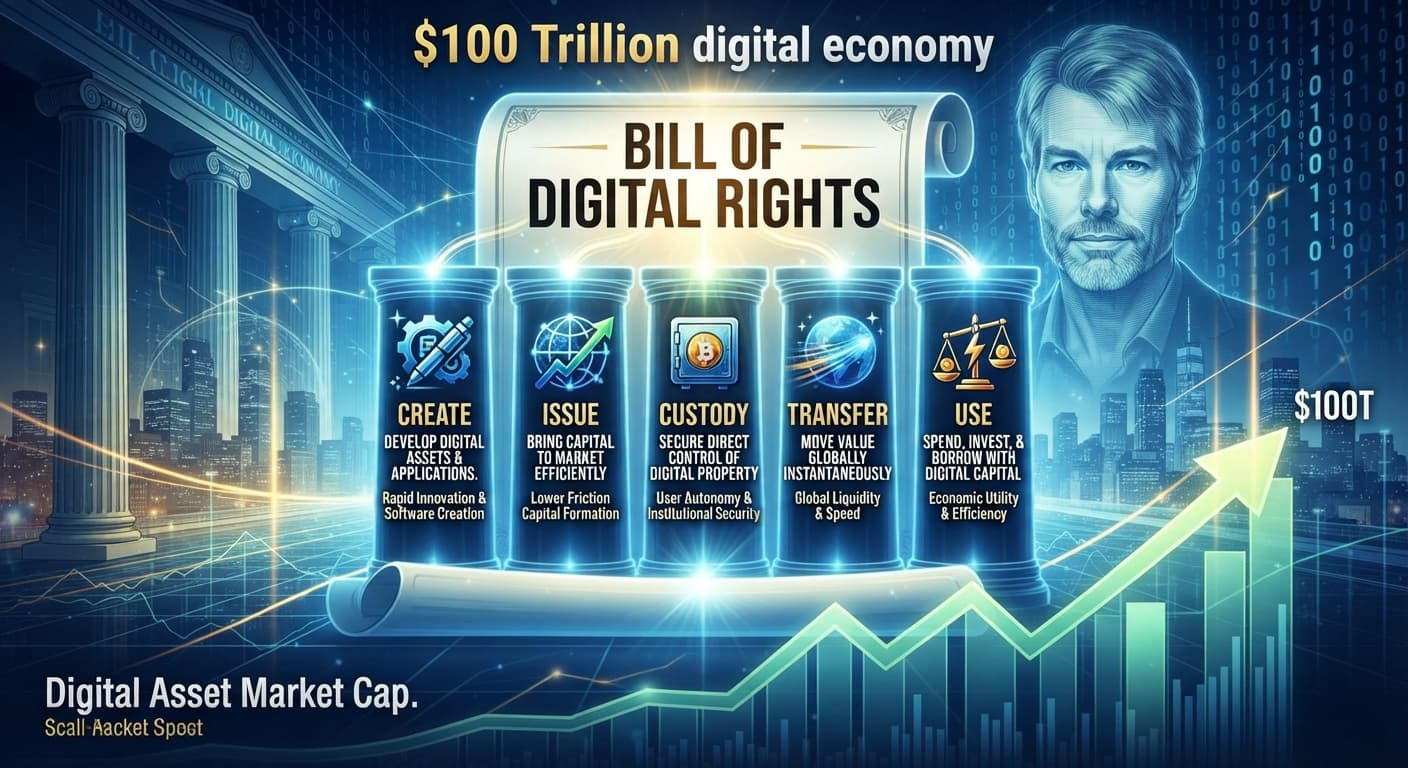
The convergence of artificial intelligence, high-performance computing, and decentralized networks is reshaping the architecture of global finance. As digital intelligence accelerates economic productivity, legacy regulatory systems risk stifling innovation unless policy frameworks evolve in tandem. In a comprehensive strategy essay titled “Prescriptions for Prosperity in the Digital Economy,” industry pioneer Michael Saylor outlines a bold economic vision designed to scale the digital asset market toward a staggering $100 trillion valuation.
Rather than relying on restrictive compliance mandates that hinder technological growth, Saylor advocates for a foundational bill of digital rights. This framework guarantees that individuals and corporations possess the legal freedom to build, finance, and transact using digital capital. As financial institutions and regulators grapple with how to integrate blockchain technology safely, these proposed policy shifts offer a clear roadmap for long-term economic prosperity.
BINANCE:BTCUSDT
| Digital Right | Core Definition | Economic Impact |
| Create | Develop new digital assets, financial instruments, and applications | Drives rapid software and fintech innovation |
| Issue | Bring assets to market to finance businesses and productive activity | Lowers capital formation costs for new enterprises |
| Custody | Hold assets directly or choose optimal third-party custodians | Enhances user autonomy and institutional security |
| Transfer | Move assets frictionlessly across wallets and service providers | Maximizes global liquidity and transaction velocity |
| Use | Spend, invest, earn income, and borrow against assets | Unlocks utility and enterprise capital efficiency |
Establishing the Five Fundamental Rights of Digital Assets
At the heart of the proposed framework is the principle that an asset’s economic potential is directly tied to what its owner is legally permitted to do with it. When regulators restrict an asset’s utility through punitive compliance or ambiguous legal definitions, they artificially depress its market value and utility.
To unlock true economic expansion, policy must recognize the distinct functions of digital tokens, digital currency, digital capital, and digital securities while securing a universal baseline of ownership. Clear disclosures, enforceable property rights, and strict accountability for fraud are essential to maintain functioning markets. However, rules must be crafted to encourage honest participation without prematurely choking off business models that are still evolving.
 BlackRock: AI Will Drive a New Machine-Native Economy→
 Solana Tokenized Stocks Smash Records with 850K Unique Holders and Institutional Adoption→
 VanEck: Bitcoin Could Hit $100,000 by Next Year as Fiscal Pressure and Liquidity Shape the Market→
 Fed Rate Hike May Not Rattle Crypto Markets, Grayscale Says→
Include expert opinions: Financial policy analysts note that establishing predictable digital property rights is the single most important step governments can take to encourage institutional capital allocation into blockchain infrastructure.
Financing 10 Million New Companies Through Capital Formation
As artificial intelligence automates traditional labor and transforms legacy industries, economic prosperity will increasingly rely on our ability to launch new enterprises at an unprecedented pace. An entrepreneur who builds a software product using AI tools should experience minimal friction when financing the company that brings it to market.
Traditional capital formation remains burdened by excessive costs, complex paperwork, and prohibitive legal expenses. By utilizing digital tokens and standardized issuance protocols, the friction of raising capital can be dramatically reduced. Policymakers should establish straightforward, proportionate disclosure requirements that allow everyday entrepreneurs to reach prospective investors without needing an army of corporate attorneys.
“Our ambition should be to enable 10 million new companies to raise capital. That is how the productivity of digital intelligence can become new employment, new products, and broadly shared prosperity.” — Michael Saylor
| Traditional Capital Formation | Digital Asset Capital Formation |
| High legal, accounting, and underwriting fees | Streamlined, tokenized issuance protocols |
| Months or years of regulatory delay | Rapid go-to-market execution for startups |
| Limited access restricted to accredited investors | Global, open-access investor participation |
Integrating Bitcoin and Digital Capital into Banking and Insurance
A cornerstone of Saylor’s economic thesis involves classifying Bitcoin as premier digital capital and systematically integrating it into traditional banking and insurance balance sheets. Under current international banking rules—such as specific Basel Accord guidelines applying high risk weights to certain crypto exposures—institutions face severe capital hurdles when holding digital assets.
Regulators should reassess these capital requirements based on the actual operational risks and specific business activities associated with digital assets rather than applying blanket penalties. Permitting regulated banks to custody Bitcoin, offer loans backed by digital collateral, and allowing insurance providers to incorporate digital capital into their product design will bridge the gap between traditional finance and decentralized networks.
Include expert opinions: Market observers emphasize that modernizing banking capital requirements for digital assets will unleash trillions of dollars in dormant institutional liquidity.
Removing Friction: The Need for a De Minimis Tax Exemption
One of the most persistent hurdles to practical digital currency adoption is the complex web of tax compliance surrounding everyday transactions. Under current tax laws in many jurisdictions, spending digital assets on minor purchases triggers capital gains or loss calculations for every individual transaction.
To foster widespread use, policymakers should implement a meaningful de minimis exemption for ordinary digital-asset payments. By establishing an inflation-adjusted threshold that removes transaction-by-transaction tax tracking for small purchases, governments can encourage consumers to utilize digital currency for everyday commerce without administrative paralysis.
Include expert opinions: Tax policy experts agree that removing transactional friction for small-value transfers is vital if digital currencies are to compete effectively with traditional fiat payment rails.
Conclusion
Michael Saylor’s “Prescriptions for Prosperity in the Digital Economy” provides a comprehensive blueprint for the next era of global finance. By championing a bill of digital rights, reducing the friction of capital formation, modernizing banking and insurance rules for Bitcoin, and establishing practical tax exemptions, policymakers can help scale the digital asset industry toward a $100 trillion future. As technology continues to outpace legacy regulation, adopting forward-thinking frameworks will determine which economies lead the digital renaissance.
Disclaimer
Disclaimer: The information provided in this article is for informational and educational purposes only and does not constitute financial, legal, or investment advice. Digital asset markets and cryptocurrency investments carry substantial risk. Always conduct thorough independent research and consult with a licensed professional before making financial decisions.