

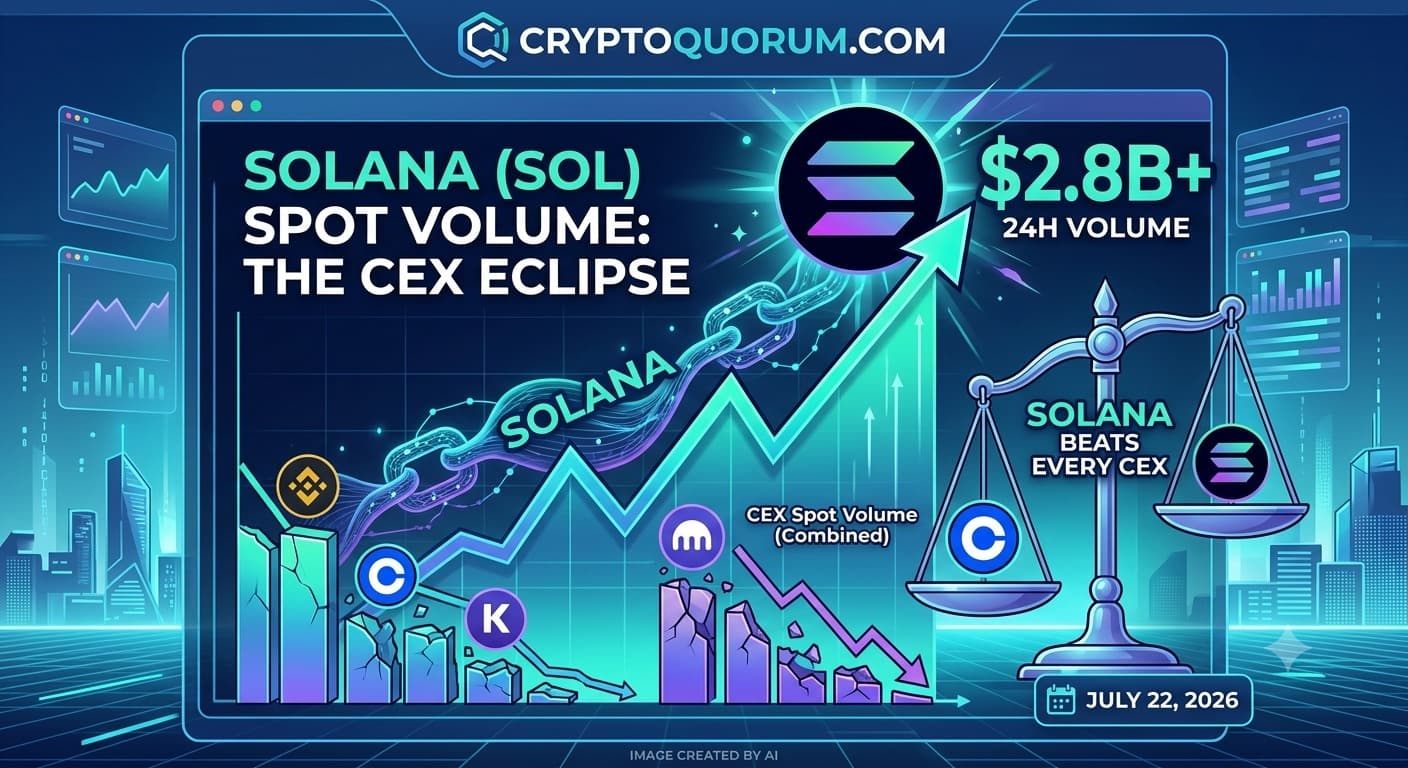
Two years ago, calling Solana a serious competitor to the world’s largest centralised crypto exchanges would have been dismissed as ecosystem boosterism. Today, it is a statistical fact – and the implications reach far beyond a single week of strong trading numbers.
On July 22, 2026, the official Solana X account posted a chart that stopped the crypto community mid-scroll: Solana’s on-chain spot trading volume now outpaces every centralised exchange in the world except one. Solana has climbed to the No. 2 spot in global spot crypto trading volume, processing roughly $12.25 billion weekly and sitting behind only Binance in the rankings.
CRYPTOCAP:TOTAL Real-Time Chart
Let the weight of that sentence settle. A decentralised blockchain network – with no customer service desk, no order book, no KYC onboarding flow, and no central company running it – is now processing more spot trading volume every week than Coinbase, Kraken, OKX, and Bybit. The only centralised venue still ahead globally is Binance, the world’s largest exchange by a commanding margin. Everything else, Solana has surpassed.
The Numbers Behind the Milestone
From $7 Billion to $12 Billion in Weeks
The trajectory of Solana spot volume acceleration over the past two months has been striking in both its pace and its consistency. During the week of June 12–18, Solana DEXs processed $7.19 billion in spot trading volume. That figure placed the network ahead of Coinbase, which handled roughly $6.39 billion, and Kraken, which came in around $4.37 billion. The only centralised venues that stayed ahead were Binance at $34.39 billion and Bybit at $9.47 billion.
 SEC examination priorities put tokenization on 2027→
 Crypto.com Brings Prediction Markets to Institutions→
 IMF Sees Global Growth at 3.1% in 2026 as AI Boom Offsets Energy Shock→
 Morgan Stanley Sees $10T Tokenized Asset Market→
By early July, the numbers had escalated further. On a weekly basis, Solana captured the second position globally in spot trading volumes at approximately $12.25 billion in early July, trailing only Binance. Solana DEXs logged $1.52 billion in spot volume on July 10, exceeding Bybit’s $1.36 billion. That marked the eighth consecutive day that Solana’s decentralised venues surpassed the centralised exchange.
Eight consecutive days of out-trading Bybit. Bybit, for context, is one of the five largest crypto exchanges on the planet. The streak is not a statistical anomaly. It is a signal.
The June Moment That Defined a New Benchmark
The most remarkable single data point in the June acceleration was one that landed entirely outside the crypto ecosystem’s normal frame of reference. On one Thursday in mid-June, Solana’s single-day DEX volume reportedly surpassed that of the New York Stock Exchange. A blockchain network out-trading the world’s largest equity exchange in a single day is the kind of statistic that demands an explanation beyond “memecoins are popular.” It reflects a structural shift in where liquidity lives and how quickly it can be accessed.
The broader 2026 picture is equally compelling. Solana’s cumulative spot trading volume across DEX platforms hit $1.6 trillion in 2025, capturing approximately 11.92% of the global market share. Daily on-chain activity has peaked at over 100 million transactions in mid-2026.
What Is Driving Solana’s Spot Volume Surge
Three Engines Running Simultaneously
Three forces are converging to push Solana’s numbers higher: memecoins, DeFi protocols, and tokenised real-world assets. Tokenised equities and real-world assets represent a fundamentally different kind of volume than memecoin speculation, reflecting institutional interest in the network’s reliability and settlement guarantees.
That three-engine structure is what makes the current Solana spot volume story qualitatively different from the memecoin-driven peaks of 2024. Memecoins remain a significant source of activity, but they are now running alongside tokenised SpaceX shares, BlackRock liquidity funds, xStocks instruments tracking the S&P 500, and Ondo’s tokenised yield products. The base of demand has diversified in ways that make a sudden reversal far less likely than a pure memecoin cycle.
Jupiter, Raydium, Orca: The Infrastructure Behind the Volume
The platforms driving this activity are familiar names in the Solana ecosystem. Jupiter, the dominant aggregator that routes trades across multiple liquidity sources, sits at the centre. Raydium, Orca, and Meteora handle large chunks of the direct trading volume.
Raydium has processed more than $1 trillion in cumulative trading volume since its 2021 launch. The protocol confirmed the milestone on May 29, 2026 – a landmark for any DeFi application, let alone one running on a single chain. Raydium’s concentrated liquidity pools now host the majority of xStocks trading pairs, making it the primary venue for the tokenised equity volume that has become one of Solana’s most distinctive institutional use cases.
Why the Architecture Makes the Volume Possible
Solana’s architecture was designed from the ground up for throughput. Low fees mean traders can execute strategies that would be cost-prohibitive on chains with higher gas costs. A retail trader swapping $50 worth of tokens doesn’t want to pay $8 in fees. On Solana, that same trade costs a fraction of a cent. Raydium’s concentrated liquidity pools and Orca’s whirlpool mechanism have both evolved into sophisticated market-making tools that rival what you’d find on any centralised order book.
The fee arithmetic matters enormously for volume concentration. High-frequency trading strategies, automated market makers, retail speculation, and institutional settlement all become economically viable at Solana’s cost level in ways that are simply not possible on Ethereum mainnet or most other layer-one competitors.
Expert Opinions: What the Data Means for Markets
Nick Ducoff, Solana Foundation: Seven Global Systemic Banks Are Already Here
The institutional context for Solana’s volume surge is provided by the Solana Foundation’s own institutional data. As noted in previous weeks, Nick Ducoff, the Solana Foundation’s head of institutional growth, confirmed that seven of the world’s 29 globally systemic banks have now built on Solana, including Morgan Stanley, JPMorgan, Citi, BNY, Société Générale, and Standard Chartered. These are not passive observers. They are active participants in the infrastructure that is generating the Solana spot volume now registering in global rankings.
0xINFRA, Raydium: Volume Share Is a Prerequisite, Not the Goal
The clearest internal voice on what the volume milestone actually means came from within Raydium’s own team. 0xINFRA, a member of Raydium’s leadership roster, framed Q2’s achievement as a foundation rather than an endpoint: “The focus for Q2 shifts from resilience to conversion: broadening LaunchLab distribution beyond concentrated partner channels, sustaining CLMM-led liquidity depth, and translating tokenized-asset share gains into repeatable monetisation.” The protocol views volume share as a prerequisite, not the goal; fee generation and sustainable liquidity depth are the next tests.
That framing is important for context. The Raydium team is not celebrating the $7 billion week as a destination. It is treating it as confirmation that the infrastructure is working – and as the starting point for capturing durable, monetisable liquidity rather than transient speculative peaks.
AMBCrypto: Volume Is the Market’s Most Important Q3 Signal
Analysts at AMBCrypto argued that if the volume trend persists, trading activity could emerge as a key driver of Solana’s momentum in Q3. “SOL is seeing strong trading activity across both DEXs and CEXs, showing deeper liquidity. Rising volume and stablecoin inflows suggest growing DeFi strength heading into Q3.”
The connection between volume and price is not automatic or immediate – as Solana’s own chart demonstrates, with SOL trading near $78 despite record network metrics. But volume is the upstream variable that drives fee revenue, protocol incentives, and ultimately the economic gravity that attracts builders, capital, and users over time.
Coinbase and Kraken: A Direct Revenue Pressure Signal
The competitive implications for centralised exchanges are concrete and direct. Coinbase and Kraken generate revenue primarily through trading fees. When volume migrates to decentralised venues, those revenue streams face direct pressure.
Coinbase generated roughly $6.39 billion in weekly spot volume during the week Solana registered $7.19 billion. That is not yet a catastrophic gap – Coinbase still provides fiat access, regulatory clarity, custody, and compliance infrastructure that on-chain venues cannot match for many institutional and retail use cases. But the directional trend is unmistakable: volume that could have gone to Coinbase is going to Solana instead, and the gap is widening rather than closing.
The Risks Beneath the Records
Concentration, Reliability, and Regulatory Scrutiny
The Solana spot volume story would be incomplete without its counterbalancing risks, and analysts have been consistent in naming them.
There is concentration risk: Jupiter handles a disproportionate share of routing, which means a single protocol failure could cascade across the ecosystem. Solana’s network has a history of outages, though reliability has improved significantly. Regulatory scrutiny of DEX platforms is intensifying globally.
A network processing $4.15 billion in daily DEX volume doesn’t get to have bad days without the market noticing immediately. The concentration of DEX volume on Solana creates both opportunity and risk. Protocols like Raydium and Orca stand to benefit enormously from continued growth. But concentration also means that any technical issues, network congestion, or consensus failures on Solana would have outsized impact on the entire DEX market.
These are not hypothetical risks. Solana has experienced well-documented network degradation events in previous years. The 2026 version of the network is materially more reliable than the 2022 version – but “more reliable” and “immune to failure” are very different statements for a system processing more daily volume than most of the world’s stock exchanges.
The SOL Price Disconnect: Records Without a Rally
The most striking anomaly in the current Solana story remains the disconnect between network fundamentals and token price. Despite ranking second globally in Solana spot volume and setting records across revenue, transactions, and tokenised assets, SOL has closed nine consecutive months in the red, currently priced at $73.5 – a significant distance from its prior cycle peak near $293.
That disconnect has two possible interpretations. The pessimistic reading: the market is correctly discounting network activity driven by speculative, low-quality volume that will not sustain. The optimistic reading: the market has not yet priced in the structural shift underway, and the gap between fundamentals and price represents the most significant asymmetric opportunity in the Solana ecosystem.
The weekly chart has printed a bullish engulfing candle, a pattern where a positive week’s body fully covers the prior negative week, typically read as a momentum reversal signal – though it has not yet been confirmed with follow-through volume.
Only One Exchange Left to Surpass
The Solana Foundation’s post on July 22 – “Spot volume on Solana now beats every CEX but one” – is a provocation dressed as a data point. The “one” is Binance, which at $34 billion weekly still commands a volume multiple that Solana’s DEX ecosystem has not approached. Closing that gap, if it ever happens, would require a combination of continued tokenised asset growth, institutional adoption at scale, and the kind of retail trading volumes that only a genuine altcoin supercycle generates.
But the fact that the conversation is now framed this way – as a race between a decentralised blockchain and the world’s largest crypto exchange – would have seemed entirely implausible 24 months ago. The infrastructure that makes it possible has been built. The institutional relationships are in place. The regulatory frameworks, in Japan and increasingly elsewhere, are taking shape.
Solana spot volume is no longer measured against other blockchains. It is measured against Binance. That reframing alone may be the most important story in crypto markets in July 2026.
CRYPTOCAP:TOTAL Real-Time Chart
Disclaimer: This article is for informational purposes only and does not constitute financial or investment advice. Cryptocurrency markets are highly volatile. Always conduct your own research before making any investment decisions.