

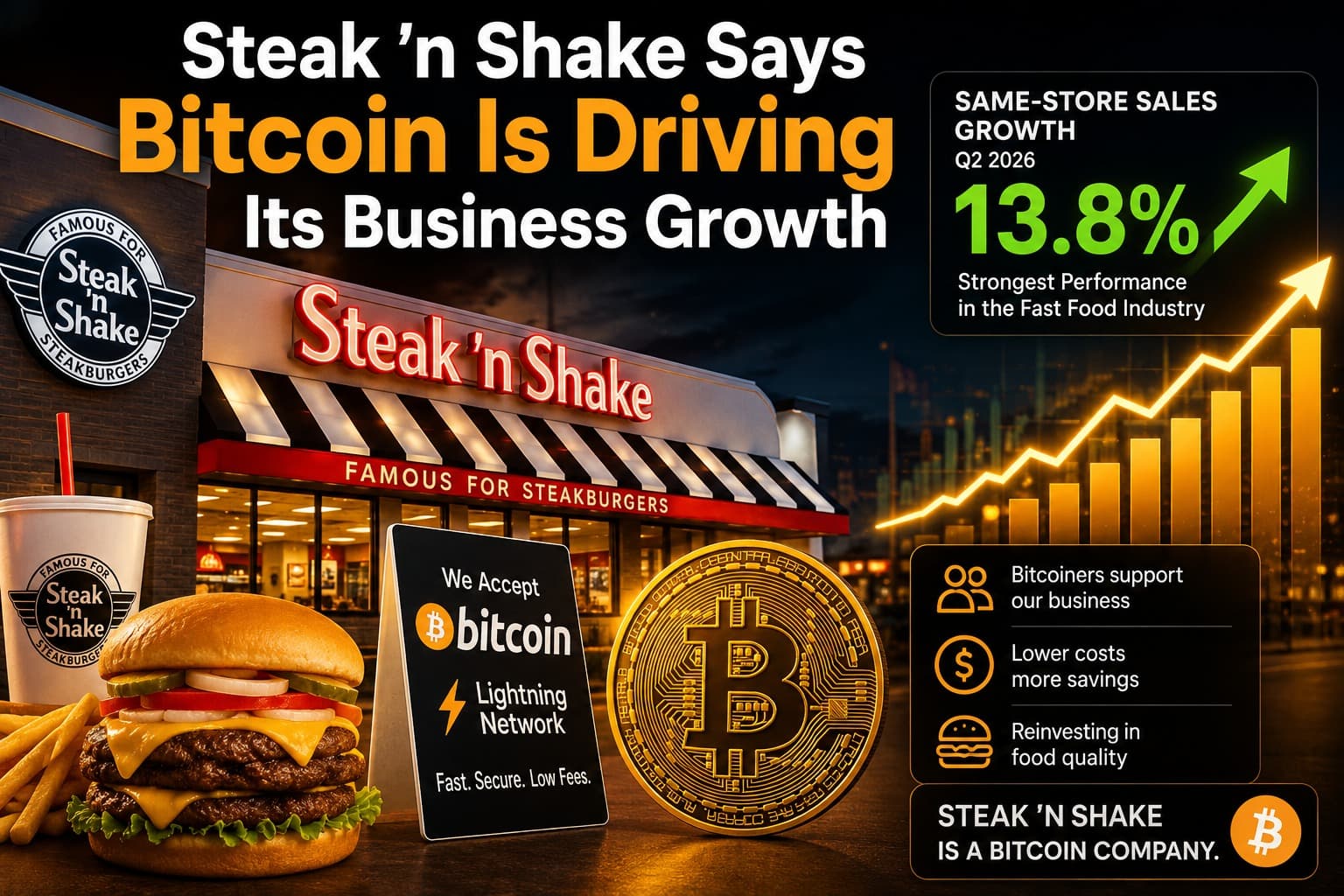
Steak ’n Shake is calling itself a “Bitcoin company” after reporting strong same-store sales growth and crediting Bitcoin users with helping its business. The fast-food chain says the combination of customer loyalty, lower payment costs and its broader Bitcoin strategy is creating a new model for restaurant growth.
Steak ’n Shake Calls Itself a Bitcoin Company
Steak ’n Shake has taken its Bitcoin strategy a step further, describing itself as a “Bitcoin company” and crediting Bitcoin holders with helping strengthen its restaurant business.
BINANCE:BTCUSDT
In a post published on X on August 30, the company said that since it began accepting Bitcoin, it has produced what it described as the best same-store sales performance in the fast-food industry.
The company also highlighted the loyalty of Bitcoin users and said the additional business and savings generated by its strategy have allowed it to reinvest in food quality.
 Robinhood’s Evolving Wealth Management Strategy Targets the Future of Retail Investing→
 Fed Rate Hike May Not Rattle Crypto Markets, Grayscale Says→
 Solana Tokenized Equity Supply Surges to Record $684M Amid Multi-Platform Expansion→
 XRP Ledger Foundation Advances Ecosystem Resilience with Strategic Infrastructure Upgrades→
That distinction is important. Steak ’n Shake is no longer presenting cryptocurrency merely as a payment experiment. Its latest comments suggest that Bitcoin has become part of a broader business strategy involving customer acquisition, payment economics, corporate reserves and employee incentives.
However, investors should distinguish between the company’s attribution and independently verified causation. Steak ’n Shake has reported strong comparable sales, but the available financial disclosures do not establish that Bitcoin alone caused those results.
Steak ’n Shake’s Sales Have Been Strong
The company’s latest financial results provide a useful benchmark.
Biglari Holdings, the parent company of Steak ’n Shake, reported that domestic same-store sales across company-operated and franchise-partner-operated restaurants increased 13.8% in the second quarter of 2026. Company-operated restaurants recorded an 11.9% increase, while franchise-partner same-store sales rose 14.5%.
That performance comes alongside a broader restructuring of the restaurant business.
Biglari’s filing also shows that Steak ’n Shake materially increased the quality of its food ingredients. Food costs at company-operated restaurants rose to 33.3% of net sales in Q2 2026, compared with 30.2% a year earlier, with the company explicitly attributing the increase primarily to improvements in ingredient quality.
This supports one part of the company’s latest Bitcoin narrative: management says stronger business and savings have provided room to reinvest.
It does not, however, mean that every dollar of increased sales should be attributed to Bitcoin.
The restaurant chain has simultaneously pursued changes in food quality, branding, operations and customer engagement. These factors can all influence comparable-store sales.
How Bitcoin Payments Work at Steak ’n Shake
Steak ’n Shake launched Bitcoin payments in the United States in May 2025, using the Bitcoin Lightning Network to process transactions.
The initial rollout covered 393 U.S. locations, according to Speed, the payment infrastructure provider involved in the implementation.
Lightning is particularly relevant for restaurants because conventional Bitcoin transactions on the base layer are not designed around rapid, low-value point-of-sale purchases.
The Lightning Network operates as a Layer 2 payment system, allowing transactions to be settled quickly without putting every individual payment directly onto Bitcoin’s base blockchain.
CryptoQuorum has previously examined the broader role of Layer 2 networks in blockchain scalability, including the Lightning Network’s potential for faster and lower-cost Bitcoin transactions.
Steak ’n Shake’s own terms confirm that customers can use Bitcoin for certain in-store and drive-through purchases through a compatible third-party wallet. The restaurant also states that Bitcoin transactions are final and that any exchange-rate or wallet-related fees are governed by the customer’s wallet provider.
That makes the restaurant’s implementation more than a marketing announcement: Bitcoin is integrated into an actual retail checkout process.
Lower Payment Costs Could Matter
One of the most interesting elements of the strategy is payment economics.
Steak ’n Shake executives have previously said that Bitcoin payments can significantly reduce payment-processing expenses compared with traditional card transactions. Michael Boes, a Steak ’n Shake executive, said at the Bitcoin 2026 conference that the company had reduced processing costs and linked the savings to its broader business transformation.
Speed, the payment infrastructure provider, has separately claimed that Steak ’n Shake cut payment-processing costs by about 50% through its Lightning implementation. Because that figure comes from a commercial service provider involved in the rollout, it should be treated as a company-reported case-study figure rather than an independently audited industry benchmark.
Even relatively small savings can become meaningful across a large restaurant network.
For a business operating on tight margins, payment processing is an operating expense. If an alternative payment rail can reduce those expenses while also attracting incremental customers, it can potentially create a double benefit.
That appears to be the strategic argument behind Steak ’n Shake’s Bitcoin push.
Expert Opinions: Adoption Is About More Than Speculation
The Steak ’n Shake example also illustrates a broader debate about Bitcoin’s role in the economy.
Michael Boes has argued that Bitcoin became an important component of the company’s turnaround, pointing to new customers, lower payment costs and investment in the restaurant’s menu. Bitcoin Magazine reported that he attributed significant business benefits to the company’s Bitcoin strategy at the Bitcoin 2026 conference.
The more important question, however, is whether this model can be replicated.
Bitcoin adoption at a restaurant is fundamentally different from holding Bitcoin as a speculative asset. A payment transaction creates a direct connection between digital-asset ownership and everyday economic activity.
That is potentially significant because merchants do not need customers to believe Bitcoin will replace the dollar in order to use it. They only need a payment system that is fast, reliable and economically competitive.
Steak ’n Shake’s strategy therefore provides an interesting real-world test of whether Bitcoin can function as a transactional asset at scale.
From Checkout Option to Corporate Strategy
Steak ’n Shake has also connected customer Bitcoin payments to its corporate Bitcoin strategy.
Earlier reports indicated that Bitcoin received from restaurant customers was being directed toward a Strategic Bitcoin Reserve rather than immediately converted into fiat currency. The company has also discussed using its Bitcoin strategy to support employee incentives.
This creates a circular model:
customers → Bitcoin payments → company treasury → business and employee incentives
That model is considerably more ambitious than simply allowing customers to scan a QR code at the register.
It effectively makes Bitcoin part of the company’s financial infrastructure.
For comparison, CryptoQuorum’s recent coverage of Michael Saylor’s digital-capital framework explores a similar shift in how businesses increasingly view Bitcoin—not only as an asset to hold, but as a component of broader corporate financial strategies.
Steak ’n Shake’s approach is different from Strategy’s institutional treasury model, but both point toward the same broader trend: Bitcoin is increasingly being incorporated into corporate decision-making.
What the Steak ’n Shake Case Does—and Does Not—Prove
The restaurant chain’s latest statement is significant, but it should not be interpreted as definitive evidence that Bitcoin automatically increases sales for every merchant.
There are several variables involved.
First, Bitcoin users may represent a particularly engaged customer segment. Their loyalty could generate repeat business that would not occur with a conventional payment promotion.
Second, lower processing costs can improve restaurant economics, but the magnitude depends on the percentage of customers actually paying with Bitcoin and the cost structure of the payment infrastructure.
Third, Steak ’n Shake has made several other strategic changes at the same time. Its Q2 financial filing specifically points to higher-quality food ingredients, while broader reporting has highlighted changes in branding and restaurant operations.
Finally, the company’s 13.8% comparable-sales growth is a financial result, not a measurement of Bitcoin’s individual contribution.
The strongest conclusion is therefore more nuanced: Steak ’n Shake has demonstrated that Bitcoin can coexist with, and potentially support, a broader restaurant turnaround strategy.
Why This Matters for Bitcoin Adoption
The significance of Steak ’n Shake may ultimately have less to do with burgers than with payments.
Bitcoin has spent much of its history being discussed as an investment asset, digital gold or corporate treasury reserve. Retail payments represent a different use case.
If more businesses discover that Bitcoin can bring loyal customers, reduce payment costs or create new financial incentives, adoption could develop through ordinary commerce rather than financial markets alone.
Steak ’n Shake’s experience is therefore worth watching.
The company’s latest statement is clearly bullish on Bitcoin. The financial results provide evidence that the restaurant business is performing strongly. What remains uncertain is precisely how much of that performance can be attributed to Bitcoin versus the company’s other strategic initiatives.
That distinction will become increasingly important as more companies experiment with cryptocurrency payments.
For now, Steak ’n Shake has moved Bitcoin from the checkout counter into the center of its corporate identity—and that makes the burger chain an unusually visible case study in real-world Bitcoin adoption.
Disclaimer: This article is for informational and educational purposes only and does not constitute financial, investment, tax, legal or payment advice. Statements attributed to Steak ’n Shake or third-party providers reflect their respective claims and should not be interpreted as independently verified proof that Bitcoin caused the company’s sales growth. Cryptocurrency markets are highly volatile, and readers should conduct their own research before making financial decisions.